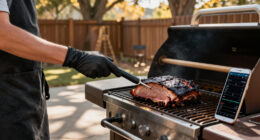

Wireless meat thermometers let you track cooking without staying beside the grill, but the best choice depends on how you cook and how much setup you want. I’d start with the MEATER Plus for a straightforward single-probe setup, while the ThermoMaven WiFi model with four probes stands out for monitoring several cuts and the ThermoMaven G1 for its smart display base. The main tradeoffs are probe capacity, connection range and reliability, and whether you want an app-only system or a base you can check at a glance. More probes can help with large cooks, but they also bring more setup and storage. Read on for my full breakdown of all 15 options and how to choose among them.

Get the latest gadgets delivered free with Prime
- Fast, free delivery on millions of items
- Prime Video, Amazon Music and more included
- Member-only deals all year
Complete the kit

Key Takeaways
- The lineup splits between simple single-probe cooking and multi-probe monitoring: the MEATER Plus favors a lean setup, while several ThermoMaven, INKBIRD, and CHEF iQ models offer three or four probes for multi-cut cooks.
- A smart display base can reduce reliance on a phone: the ThermoMaven G1, P2, and four-probe WiFi models pair app features with a base display, unlike options whose main controls sit in an app.
- Connectivity claims are not interchangeable: the MEATER Plus lists Bluetooth range, while products such as ThermoMaven’s 3000FT model and WiFi systems use different connection approaches; match the stated setup to your cooking space.
- Probe count is only useful when it matches the cook: four-probe models suit several cuts or a crowded smoker, while a two-probe thermometer can be simpler for routine meals.
- Special features target different priorities: the CHEF iQ Sense two-probe model emphasizes ultra-thin probes, while the INKBIRD WiFi 5G model lists Apple Watch alerts and IP67 waterproofing.
| MEATER Plus Smart Meat Thermometer, Walnut, Bluetooth, 165ft, Grill & Oven |  | Best for App-Guided Cooking | Connectivity: Bluetooth | Advertised range: Up to 165 feet | Temperature sensors: Dual sensors for internal and ambient temperatures | VIEW LATEST PRICE | See Our Full Breakdown |
| ThermoMaven G1 Wireless Meat Thermometer with Smart Display Base |  | Best for Long-Range, Phone-Free Monitoring | Display: Digital smart display base | Sensors: 6 (5 internal and 1 external) | Accuracy: ±0.5°F, NIST-certified | VIEW LATEST PRICE | See Our Full Breakdown |
| ThermoMaven WiFi Wireless Meat Thermometer, 4 Probes, Smart Base, 6 Sensors |  | Best for Multi-Item Cooking | Probe count: 4 | Sensors per probe: 6 (5 internal and 1 external) | Accuracy: ±0.5°F, NIST-certified | VIEW LATEST PRICE | See Our Full Breakdown |
| INKBIRD WiFi Wireless Meat Thermometer with 4 Probes and 360° Readable LCD Standalone Base |  | Best for Flexible Connection Modes | Model: 14B-2 | Probe count: 4 | Connectivity: Wi-Fi, Bluetooth 5.4, and offline mode | VIEW LATEST PRICE | See Our Full Breakdown |
| Wireless Meat Thermometer, 2 Probes, Smart Base, 6 Sensors |  | Best for Straightforward Two-Item Cooking | Brand and model: JoyBear FM200 | Probe count: 2 | Sensors: 6 | VIEW LATEST PRICE | See Our Full Breakdown |
| MEATER Pro XL Wireless Meat Thermometer with 4 Probes and OLED Charger |  | Best for Multi-Protein Cooking | Probe count: 4 | Connectivity: Wi-Fi and Bluetooth | Temperature range: 32°F to 1000°F | VIEW LATEST PRICE | See Our Full Breakdown |
| ThermoMaven P2 WiFi Wireless Meat Thermometer with 2 Probes and Smart Display Base |  | Best for Accuracy-Focused Cooks | Probes: 2 | Sensors: 6 total: 5 internal and 1 external | Accuracy: ±0.5°F; NIST certified | VIEW LATEST PRICE | See Our Full Breakdown |
| ThermoMaven Smart WiFi Wireless Meat Thermometer with 2 Probes |  | Best for App-Guided Cooking | Model: WT02 Lite | Probe count: 2 | Sensors per probe: 6 | VIEW LATEST PRICE | See Our Full Breakdown |
| CHEF iQ Sense Smart Wireless Meat Thermometer with 4 Probes |  | Best for Guided Multi-Item Cooking | Model: iQ Sense CQ60-4C-Z1-E | Probe count: 4 | Sensors: 5 per system: 4 internal sensors and 1 ambient sensor | VIEW LATEST PRICE | See Our Full Breakdown |
| ThermoMaven 3000FT Wireless Meat Thermometer with 2 Probes | 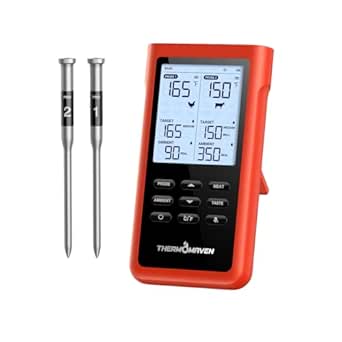 | Best for Long-Range, App-Free Monitoring | Wireless range: Up to 3,000 ft | Connectivity: Sub-1G | Probe count: 2 ultra-thin probes | VIEW LATEST PRICE | See Our Full Breakdown |
| GoveeLife Smart Wireless Meat Thermometer with Dual Probes and App Alerts |  | Best for a Readable On-Grill Display | Probe configuration: Dual internal/external probes | Connectivity: Bluetooth and 2.4 GHz Wi-Fi | Bluetooth range: 500 ft | VIEW LATEST PRICE | See Our Full Breakdown |
| CHEF iQ Sense Gen3 Smart Wireless Meat Thermometer with 3 Probes |  | Best for Cooking Several Foods at Once | Probe count: 3 | Sensors per probe: 5: 4 internal and 1 ambient | Connectivity: Wi-Fi and Bluetooth | VIEW LATEST PRICE | See Our Full Breakdown |
| CHEF iQ Sense Smart Wireless Meat Thermometer with 2 Ultra-Thin Probes |  | Best Two-Probe App-Guided Pick | Probe count: 2 | Sensors per probe: 5: 4 internal and 1 ambient | Connectivity: Wi-Fi and Bluetooth | VIEW LATEST PRICE | See Our Full Breakdown |
| INKBIRD Wireless Meat Thermometer with WiFi 5G & Bluetooth 5.4, 4 Probes, 5 Sensors, NIST Accuracy, Apple Watch Alerts, IP67 Waterproof | 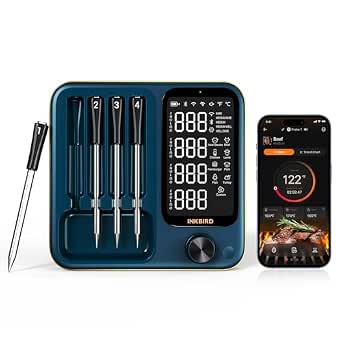 | Best for Precision and Four-Probe Coverage | Probe count: 4 | Sensors per probe: 5: 4 internal and 1 ambient | Accuracy: ±0.5°F, NIST-certified | VIEW LATEST PRICE | See Our Full Breakdown |
| CHEF iQ Sense Gen3 Smart Wireless Meat Thermometer |  | Best Single-Probe Starter | Probe count: 1 | Sensor configuration: 5 total: 4 internal and 1 ambient | Connectivity: Wi-Fi and Bluetooth | VIEW LATEST PRICE | See Our Full Breakdown |
| wireless meat thermometer | Connectivity | Probe count | Battery life | Accuracy |
|---|---|---|---|---|
| MEATER Plus Smart Meat Thermom | Bluetooth | — | — | — |
| ThermoMaven G1 Wireless Meat T | Sub-1G, Bluetooth, and Wi-Fi | — | — | ±0.5°F, NIST-certified |
| ThermoMaven WiFi Wireless Meat | 2.4 GHz Wi-Fi and Bluetooth | 4 | 24+ hours | ±0.5°F, NIST-certified |
| INKBIRD WiFi Wireless Meat The | Wi-Fi, Bluetooth 5.4, and offline mode | 4 | Up to 25 hours | ±1°F |
| Wireless Meat Thermometer | Bluetooth | 2 | 30 hours | ±0.5°F |
| MEATER Pro XL Wireless Meat Th | Wi-Fi and Bluetooth | 4 | Up to 24 hours of continuous cooking | — |
| ThermoMaven P2 WiFi Wireless M | 2.4 GHz Wi-Fi and Bluetooth | — | — | ±0.5°F; NIST certified |
| ThermoMaven Smart WiFi Wireles | Wi-Fi, Bluetooth, and RF | 2 | — | — |
| CHEF iQ Sense Smart Wireless M | Wi-Fi and Bluetooth | 4 | Up to 50 hours | — |
| ThermoMaven 3000FT Wireless Me | Sub-1G | 2 ultra-thin probes | — | ±0.5°F; NIST-certified sensors |
| GoveeLife Smart Wireless Meat | Bluetooth and 2.4 GHz Wi-Fi | — | Up to 48 hours | ±1.8°F |
| CHEF iQ Sense Gen3 Smart Wirel | Wi-Fi and Bluetooth | 3 | Up to 50 hours | — |
| CHEF iQ Sense Smart Wireless M | Wi-Fi and Bluetooth | 2 | — | — |
| INKBIRD Wireless Meat Thermome | Wi-Fi 5G and Bluetooth 5.4 | 4 | Up to 25 hours | ±0.5°F, NIST-certified |
| CHEF iQ Sense Gen3 Smart Wirel | Wi-Fi and Bluetooth | 1 | Up to 50 hours per charge | — |
More Details on Our Top Picks
MEATER Plus Smart Meat Thermometer, Walnut, Bluetooth, 165ft, Grill & Oven
The MEATER Plus is the most app-led choice here: its Guided Cook System supplies step-by-step instructions, alerts, and estimated finish times, which can help newer cooks manage a roast without repeatedly opening the oven. Its fully wireless probe avoids a cable through the oven door, while the charger’s Bluetooth repeater is designed to extend the connection around the home. Compared with the ThermoMaven G1, it gives up the G1’s on-device display and long-range Sub-1G link in favor of a more guided phone experience. The probe tracks meat and ambient temperatures, but its 212°F internal ceiling and Bluetooth-based monitoring make it less suited to cooks seeking broad temperature headroom or a standalone base. Choose it for guided indoor and outdoor cooks; skip it if you want to check readings without a phone.
Pros:- Guided Cook System offers instructions, alerts, and estimated finish times in the app.
- Wireless probe has dual sensors for meat and ambient temperatures.
- Charger includes a Bluetooth repeater to extend the connection.
- Probe is dishwasher-safe and rechargeable.
Cons:- Phone app is central to monitoring; there is no smart display base.
- Internal temperature limit is 212°F.
- Bluetooth monitoring is less suited to long-range tracking than the ThermoMaven G1’s Sub-1G connection.
Best for: Home cooks who want app-based step-by-step guidance and alerts for roasts, grilling, and everyday meals.
Not ideal for: Cooks who need a standalone display, longer-range connectivity than Bluetooth, or an internal-temperature limit above 212°F.
- Connectivity:Bluetooth
- Advertised range:Up to 165 feet
- Temperature sensors:Dual sensors for internal and ambient temperatures
- Internal temperature limit:212°F
- Ambient temperature limit:527°F
- Power:Rechargeable probe; charger uses 1 AAA battery
- Probe care:Dishwasher-safe
- Item length:6.18 inches
Our verdict“Pick the MEATER Plus for app-led cooking help, but choose the ThermoMaven G1 if you want on-device readings and longer-range monitoring.”
ThermoMaven G1 Wireless Meat Thermometer with Smart Display Base
The ThermoMaven G1 suits cooks who want to check temperatures at the grill rather than rely on an app. Its smart display base shows readings and allows temperature settings directly on the device, while Sub-1G connectivity is listed for up to 3,000 feet unobstructed. That gives it a clearer range-and-display advantage over the MEATER Plus, which relies on its app and Bluetooth repeater. The G1 also combines six sensors with NIST-certified ±0.5°F accuracy, and the probe is dishwasher-safe. Its tradeoff is capacity: one probe cannot monitor several cuts independently, unlike the four-probe ThermoMaven P4. The base also needs careful handling, since it is not described as waterproof, and the probe’s 221°F internal limit may not suit every high-heat technique.
Pros:- Smart display base allows readings and temperature settings without an app.
- Sub-1G connection is listed for up to 3,000 feet unobstructed.
- Six sensors provide NIST-certified ±0.5°F accuracy.
- IPX8 waterproof, dishwasher-safe probe simplifies cleanup.
Cons:- One probe offers less capacity than the four-probe ThermoMaven P4.
- Base should be wiped clean and is not described as waterproof.
- Probe internal temperature limit is 221°F.
Best for: Grill and smoker owners who want a readable base, long-range monitoring, and one highly accurate probe.
Not ideal for: Hosts cooking several separate cuts at once or cooks who need a waterproof display base or an internal limit above 221°F.
- Display:Digital smart display base
- Sensors:6 (5 internal and 1 external)
- Accuracy:±0.5°F, NIST-certified
- Connectivity:Sub-1G, Bluetooth, and Wi-Fi
- Wireless range:Up to 3,000 feet unobstructed; 700 feet obstructed
- Probe temperature limits:221°F internal; 752°F ambient
- Probe care:IPX8 waterproof and dishwasher-safe
- Probe immersion depth:1 meter
Our verdict“Choose the G1 for long-range, phone-free monitoring with one probe; select the ThermoMaven P4 if you need to track several dishes at once.”
ThermoMaven WiFi Wireless Meat Thermometer, 4 Probes, Smart Base, 6 Sensors
For cooks handling several meats or dishes in one session, the ThermoMaven P4 has the strongest capacity in this group: four probes can track separate cooks, and its display base provides readings without requiring a phone. Wi-Fi adds remote app monitoring, while the probes also connect to the base over Bluetooth long range. Compared with the INKBIRD 14B-2, the P4 pairs a similar four-probe setup with a stated ±0.5°F NIST-certified accuracy rather than ±1°F. Its internal limit is 221°F, though, so the higher 752°F ambient rating should not be mistaken for a 752°F meat-reading limit. The four-probe setup also means more pieces to place, charge, and keep organized than with the two-probe JoyBear FM200. This is a better match for busy cooks than for occasional single-roast dinners.
Pros:- Four probes can monitor separate dishes at the same time.
- Display base provides local readings and settings without an app.
- Wi-Fi supports remote app monitoring, with Bluetooth linking probes to the base.
- Six sensors offer NIST-certified ±0.5°F accuracy.
Cons:- Four probes require more setup and charging than the two-probe JoyBear FM200.
- Internal temperature limit is 221°F, despite the higher ambient limit.
- The listed temperature resolution differs between product details and specifications.
Best for: Hosts, barbecue cooks, and restaurant kitchens monitoring up to four separate meats or dishes in one session.
Not ideal for: Occasional cooks who usually prepare one item and prefer a simpler, lower-capacity setup.
- Probe count:4
- Sensors per probe:6 (5 internal and 1 external)
- Accuracy:±0.5°F, NIST-certified
- Connectivity:2.4 GHz Wi-Fi and Bluetooth
- Temperature limits:221°F internal; 752°F ambient
- Response time:0.5 seconds
- Probe immersion depth:6.6 inches
- Battery life:24+ hours
- Probe care:IPX8 waterproof and dishwasher-safe
Our verdict“Choose the P4 when four simultaneous readings and a local display matter more than a compact, simple setup.”
INKBIRD WiFi Wireless Meat Thermometer with 4 Probes and 360° Readable LCD Standalone Base
The INKBIRD 14B-2 stands out for giving cooks a choice of Wi-Fi, Bluetooth, or offline monitoring, which is useful when a network is unavailable or a phone connection is inconvenient. Its four probes match the capacity of the ThermoMaven P4, and the backlit LCD base can be read from different angles and mounted magnetically. The P4 has the stronger stated accuracy, at ±0.5°F versus INKBIRD’s ±1°F, while the INKBIRD counters with a listed 25-hour battery life and a 25-minute charge time. App presets and graphs add guidance, but the more advanced tools depend on the app. Its 212°F food-temperature ceiling also makes it a weaker fit for techniques that push probe readings above that level; the 572°F ambient rating applies to the cooking environment, not the food reading.
Pros:- Four probes allow simultaneous monitoring of multiple meats.
- Wi-Fi, Bluetooth 5.4, and offline modes offer flexible monitoring.
- Backlit LCD base has magnetic mounting and a 360° readable design.
- Listed battery life is up to 25 hours, with a 25-minute charge time.
Cons:- ±1°F stated accuracy is less precise than the ThermoMaven P4’s ±0.5°F.
- Food temperature range tops out at 212°F.
- Advanced presets and data synchronization rely on the app.
Best for: Cooks who want four probes, a readable standalone base, and the option to monitor with or without a network.
Not ideal for: Precision-focused cooks who prefer ±0.5°F accuracy or anyone needing a food-temperature limit above 212°F.
- Model:14B-2
- Probe count:4
- Connectivity:Wi-Fi, Bluetooth 5.4, and offline mode
- Accuracy:±1°F
- Food temperature range:14–212°F
- Ambient temperature range:32–572°F
- Battery life:Up to 25 hours
- Charging time:25 minutes
- Probe protection:IP67 waterproof
Our verdict“Pick the INKBIRD 14B-2 for four-probe versatility and offline monitoring, but favor the ThermoMaven P4 if stated accuracy is the priority.”
Wireless Meat Thermometer, 2 Probes, Smart Base, 6 Sensors
The JoyBear FM200 offers a practical middle ground for cooks who want more than one reading but do not need the four-probe capacity of the ThermoMaven P4 or INKBIRD 14B-2. Its two wireless probes and smart display base make it possible to track two items and check temperatures without keeping a phone in hand. The listed ±0.5°F accuracy, 0.5-second response time, and 30-hour battery life make it well suited to longer cooks. Its Bluetooth connection is simpler than Wi-Fi-equipped alternatives, but that also means fewer options for remote monitoring beyond its Bluetooth setup. The IP67 dishwasher-safe probes ease cleanup, although they need to be dried thoroughly before charging and the base itself is not waterproof. For a small household or a two-cut cook, the reduced probe count can mean less setup without giving up a local display.
Pros:- Two probes can track separate foods simultaneously.
- Smart display base allows temperature checks without a phone.
- Six sensors provide stated ±0.5°F accuracy and 0.5-second response time.
- Listed 30-hour battery life and dishwasher-safe IP67 probes suit extended cooks and cleanup.
Cons:- Two probes offer less capacity than the four-probe ThermoMaven P4 and INKBIRD 14B-2.
- Bluetooth connectivity does not provide the listed Wi-Fi monitoring of those alternatives.
- Probes need thorough drying before charging, and the base is not waterproof.
Best for: Small households and grill cooks who routinely monitor two items and want a smart base rather than app-only operation.
Not ideal for: Hosts cooking three or more separate dishes, or buyers who need Wi-Fi-based remote monitoring.
- Brand and model:JoyBear FM200
- Probe count:2
- Sensors:6
- Accuracy:±0.5°F
- Response time:0.5 seconds
- Connectivity:Bluetooth
- Battery life:30 hours
- Charging time:25 minutes
- Probe protection:IP67 waterproof; dishwasher-safe
Our verdict“Choose the JoyBear FM200 for two-item cooks who value a local display and long listed battery life over four-probe capacity or Wi-Fi.”
MEATER Pro XL Wireless Meat Thermometer with 4 Probes and OLED Charger
The MEATER Pro XL is the strongest fit here for cooks who regularly manage several proteins at once: its four probes can track separate cuts or different sections of a large roast. Unlike the CHEF iQ Sense Smart Wireless Meat Thermometer with 4 Probes, it adds an OLED readout on the charger, so you can check temperatures without opening the app. Dual Wi-Fi and Bluetooth also give it more flexible remote monitoring than a Bluetooth-only setup. The tradeoff is a more involved, app-centered system: detailed features require a smartphone, and the charger must stay powered for off-grid use. Its fast USB-C charging helps limit downtime, but buyers seeking a simple two-probe setup may find the extra capacity unnecessary.
Pros:- Four probes track multiple foods or doneness targets simultaneously.
- OLED charger display shows readings without requiring a phone in hand.
- Wi-Fi and Bluetooth support remote monitoring across different cooking setups.
- USB-C charging takes 30 minutes and supports up to 24 hours of cooking.
Cons:- Detailed features and analytics require the smartphone app.
- Four-probe setup adds complexity compared with simpler two-probe options.
- The charger needs to be charged for off-grid monitoring.
Best for: Hosts and smoking enthusiasts who cook several proteins or need separate readings across large cuts.
Not ideal for: Cooks who want a straightforward, phone-free setup or rarely monitor more than one piece of meat.
- Probe count:4
- Connectivity:Wi-Fi and Bluetooth
- Temperature range:32°F to 1000°F
- Response time:500 milliseconds
- Battery life:Up to 24 hours of continuous cooking
- Charging:USB-C; 30-minute charging time
- Display:OLED display on charger
- Probe material and care:Stainless steel; dishwasher-safe and oven-safe
Our verdict“Choose the MEATER Pro XL if you routinely cook several proteins and want both remote access and a readout on the charger.”
ThermoMaven P2 WiFi Wireless Meat Thermometer with 2 Probes and Smart Display Base
The ThermoMaven P2 suits cooks who value a clearly specified accuracy level and want useful controls on the base, not just in an app. Its two probes carry NIST-certified ±0.5°F accuracy, while the smart display lets you view readings and set target temperatures locally. Compared with the ThermoMaven 3000FT Wireless Meat Thermometer, the P2 adds Wi-Fi monitoring and a smart base, but it gives up that model’s stated 3,000-foot Sub-1G range. The probes are IPX8 waterproof for easier cleanup, and quick charging can provide up to two hours of use after two minutes. One specification is inconsistent: resolution is listed as both 0.01°F and 0.5°F, so I would not choose it based on fine display increments. Wi-Fi also requires a 2.4 GHz network.
Pros:- NIST-certified accuracy is specified at ±0.5°F.
- Smart base displays readings and supports target settings without the app.
- Wi-Fi extends monitoring beyond Bluetooth range.
- IPX8 waterproof probes are dishwasher-safe.
Cons:- Wi-Fi monitoring requires a 2.4 GHz network.
- Resolution is inconsistently listed as 0.01°F and 0.5°F.
- Two probes offer less capacity than the four-probe MEATER Pro XL.
Best for: Accuracy-minded home cooks who want two-probe monitoring, local base controls, and remote access over 2.4 GHz Wi-Fi.
Not ideal for: Buyers who need a clearly documented display resolution or cannot connect to a 2.4 GHz Wi-Fi network.
- Probes:2
- Sensors:6 total: 5 internal and 1 external
- Accuracy:±0.5°F; NIST certified
- Internal temperature range:32°F to 221°F
- Ambient temperature range:Up to 752°F
- Connectivity:2.4 GHz Wi-Fi and Bluetooth
- Base battery life:24+ hours
- Probe charging:2 minutes for up to 2 hours of use
- Display:Digital display on smart base
Our verdict“Pick the P2 if certified accuracy and base-level controls matter more to you than maximum probe count or extra-long stated range.”
ThermoMaven Smart WiFi Wireless Meat Thermometer with 2 Probes
This ThermoMaven is the app-forward choice for cooks who want more than a temperature number: its app offers graphs, alerts, and AI-guided recipes, while the standalone base can show readings without keeping a phone nearby. Each of its two probes has six sensors, giving cooks detailed tracking of the meat’s core temperature. Compared with the ThermoMaven P2, this model lists Wi-Fi, Bluetooth, and RF connectivity and a wireless range of up to 1,000 feet; the P2 instead specifies NIST certification and a 2-minute probe-charge figure. The broad connectivity and guided features make this appealing for mixed indoor and outdoor cooking, but remote Wi-Fi monitoring requires connecting the base to a phone’s Wi-Fi. It also uses three nonstandard batteries, a less convenient power arrangement than a rechargeable system.
Pros:- App provides temperature graphs, alerts, and AI-guided recipes.
- Standalone digital base supports at-a-glance monitoring without a phone nearby.
- Six sensors in each probe support detailed temperature tracking.
- Wi-Fi, Bluetooth, and RF connectivity with a stated range up to 1,000 feet.
Cons:- Wi-Fi remote monitoring requires connecting the base to a phone’s Wi-Fi.
- Uses three nonstandard batteries.
- Two probes provide less capacity than the four-probe MEATER Pro XL.
Best for: Home cooks who want recipe guidance and temperature history alongside two-probe monitoring for grilling, roasting, or smoking.
Not ideal for: Buyers who prefer standard, readily replaceable batteries or want Wi-Fi remote monitoring without setup through a phone.
- Model:WT02 Lite
- Probe count:2
- Sensors per probe:6
- Wireless range:Up to 1,000 ft
- Connectivity:Wi-Fi, Bluetooth, and RF
- Temperature accuracy:±0.5°F
- Upper temperature range:752°F
- Display:Digital display on smart base
- Power:Rechargeable; three nonstandard batteries included
Our verdict“Choose this model if app-based guidance and cooking graphs are useful to you, and its battery setup fits your routine.”
CHEF iQ Sense Smart Wireless Meat Thermometer with 4 Probes
The CHEF iQ Sense is designed for cooks who want four-probe capacity paired with a guided app rather than a display-first system. It can monitor several cuts or doneness targets at once, while the app supplies real-time updates, estimates, reminders, timers, and recipes. That makes it a more coaching-oriented alternative to the MEATER Pro XL, which adds an OLED charger display for checking readings without opening a phone. The CHEF iQ’s stated battery life of up to 50 hours is a useful fit for long cooks, and its waterproof, dishwasher-safe probes simplify cleanup. The main compromise is dependence on the app for smart features; there is no charger display listed here. Its 1000°F upper temperature figure describes the system’s stated operating capability, not a promise that every cooking environment is suitable.
Pros:- Four probes can track multiple proteins or different doneness targets.
- App includes temperature updates, estimates, reminders, timers, and guided recipes.
- Up to 50 hours of stated battery life suits extended cooks.
- Waterproof, dishwasher-safe stainless-steel probes simplify cleanup.
Cons:- Smart features require the CHEF iQ app.
- No standalone hub display is listed, unlike the MEATER Pro XL’s OLED charger.
- A four-probe system may be more than needed for cooks who usually monitor one dish.
Best for: Cooks preparing several dishes who want recipe guidance, cooking estimates, and reminders in one app.
Not ideal for: Shoppers who want a standalone screen for readings or prefer to cook without relying on a smartphone app.
- Model:iQ Sense CQ60-4C-Z1-E
- Probe count:4
- Sensors:5 per system: 4 internal sensors and 1 ambient sensor
- Upper temperature range:1000°F
- Battery life:Up to 50 hours
- Connectivity:Wi-Fi and Bluetooth
- Immersion depth:4.75 inches
- Probe material and care:Stainless steel; waterproof and dishwasher-safe
- Warranty:3 years
Our verdict“Choose the CHEF iQ Sense if you want four-probe capacity and app-led cooking support more than a built-in readout.”
ThermoMaven 3000FT Wireless Meat Thermometer with 2 Probes
The ThermoMaven 3000FT puts straightforward, long-range monitoring ahead of app features. Its Sub-1G connection and standalone LCD base are aimed at cooks who want to move away from the grill or smoker without creating an account or managing phone settings. Two probes, each with six NIST-certified sensors, let you keep tabs on separate foods; the probes are also waterproof and dishwasher-safe. Compared with the ThermoMaven P2, this model has a much longer stated wireless range and a simpler app-free approach, while the P2 adds Wi-Fi and a smart base. That simplicity comes with limits: the thermometer needs an AAA battery, and its 752°F upper temperature range may not suit cooking setups that run hotter. Its plastic base is functional, but less premium in feel than stainless-steel probe construction.
Pros:- Sub-1G connectivity has a stated range of up to 3,000 feet.
- Standalone LCD base works without an app or account.
- Two probes with six NIST-certified sensors each support monitoring separate foods.
- Waterproof, dishwasher-safe probes are suited to routine cleanup.
Cons:- Requires an AAA battery rather than a rechargeable power setup.
- The 752°F upper limit may not fit higher-temperature cooking applications.
- Lacks the Wi-Fi remote access available on the ThermoMaven P2.
Best for: Grill and smoker cooks who want a long stated wireless range, two probes, and readings on a dedicated base without an app.
Not ideal for: Cooks who need Wi-Fi-based remote access, rechargeable power, or a temperature ceiling above 752°F.
- Wireless range:Up to 3,000 ft
- Connectivity:Sub-1G
- Probe count:2 ultra-thin probes
- Sensors:6 per probe
- Accuracy:±0.5°F; NIST-certified sensors
- Temperature range:14°F to 752°F
- Response time and resolution:0.5 seconds; 0.5°F
- Display:Digital LCD base with magnetic mount
- Power:One included AAA battery
Our verdict“Pick this ThermoMaven if app-free use and long-range monitoring matter more to you than Wi-Fi access or rechargeable power.”
GoveeLife Smart Wireless Meat Thermometer with Dual Probes and App Alerts
The GoveeLife H5192 is a good fit if you want app-based monitoring without relying on your phone as the only temperature display. Its 10-function LCD base can sit or attach magnetically near the cooker, while two probes let you track separate foods or compare internal and ambient temperatures. Bluetooth range is listed at 500 feet, and Wi-Fi adds remote access, so it offers more flexibility than a Bluetooth-only setup like the MEATER Plus. The tradeoff is that alerts and guided cooking depend on the app and a working connection; the base is useful, but it does not remove that dependency. Its 5-inch immersion depth is also shorter than the 4.75-inch CHEF iQ probes only by a small margin, so unusually thick cuts and some probe placements may need attention.
Pros:- Dual probes can track two foods or internal and ambient temperatures at once.
- LCD display base provides a local readout, and its magnetic backing allows hands-free placement.
- Bluetooth and 2.4 GHz Wi-Fi support both nearby monitoring and remote app alerts.
- Rechargeable probe is rated IP68 waterproof and runs for up to 48 hours.
Cons:- Guided cooking and app alerts depend on Bluetooth or Wi-Fi connectivity.
- The stated 5-inch immersion depth may constrain placement in some thick cuts or cooking setups.
Best for: Grill and smoker owners who want two temperature readings plus a physical display they can glance at without opening the app.
Not ideal for: Cooks who want a completely app-independent system or need a probe with more than 5 inches of stated immersion depth.
- Probe configuration:Dual internal/external probes
- Connectivity:Bluetooth and 2.4 GHz Wi-Fi
- Bluetooth range:500 ft
- Accuracy:±1.8°F
- Display:10-function LCD
- Temperature range:14°F to 572°F
- Battery life:Up to 48 hours
- Water resistance:IP68
Our verdict“Choose the GoveeLife if you want dual-probe app monitoring with a glanceable base display, but skip it if you need app-free guidance or deeper probe placement.”
CHEF iQ Sense Gen3 Smart Wireless Meat Thermometer with 3 Probes
When one probe is not enough, the three-probe CHEF iQ Sense Gen3 can follow three foods or doneness targets in parallel, a practical step up from the two-probe GoveeLife H5192 and the two-probe CHEF iQ option. Each probe uses five sensors, including an ambient sensor, to give the app more context than a single internal reading. Wi-Fi supports remote updates, while the probes’ 50-hour runtime and dishwasher-safe construction suit long cooks followed by simpler cleanup. Its 1000°F rating is notably higher than the listed 572°F limit of the GoveeLife and INKBIRD four-probe model, though that does not make the system a standalone thermometer: the display is app-based, and cooking guidance and notifications run through CHEF iQ’s app. You also need to recharge the probes between cooks.
Pros:- Three probes allow simultaneous monitoring of multiple foods or doneness levels.
- Five sensors per probe include an ambient reading alongside internal temperatures.
- Wi-Fi enables remote app updates, cooking guidance, and notifications.
- Waterproof, dishwasher-safe probes are rated to 1000°F and run for up to 50 hours per charge.
Cons:- The app is the display and is required for remote monitoring and guided cooking.
- Rechargeable probes need charging between cooks.
- A three-probe setup may be more equipment than cooks who usually monitor one cut need.
Best for: Hosts and batch cooks who regularly monitor three different cuts, foods, or doneness targets and want app-based guidance.
Not ideal for: Buyers who prefer a physical display on the cooker, do not want to use an app, or rarely need more than one temperature reading.
- Probe count:3
- Sensors per probe:5: 4 internal and 1 ambient
- Connectivity:Wi-Fi and Bluetooth
- Maximum temperature:1000°F
- Probe immersion depth:4.75 inches
- Battery life:Up to 50 hours
- Probe care:Waterproof and dishwasher-safe
- Warranty:3 years
Our verdict“Pick this CHEF iQ package when three simultaneous readings and high-temperature capability matter more than having a physical display base.”
CHEF iQ Sense Smart Wireless Meat Thermometer with 2 Ultra-Thin Probes
The two-probe CHEF iQ Sense suits cooks who want separate readings for two cuts or doneness targets without stepping up to the three-probe Gen3 package. Both probes have four internal sensors and an ambient sensor, and the app adds temperature updates, estimates, reminders, and guided recipes. That makes it more feature-rich for app-led cooking than the GoveeLife H5192, whose standout advantage is its physical LCD base rather than this model’s app-centered approach. Wi-Fi supports remote monitoring, and both probes charge in the hub at once, which simplifies the routine after a cook. The tradeoffs are a 4.75-inch immersion depth that can limit placement and reliance on the CHEF iQ app for the remote features. If three foods need monitoring, the three-probe CHEF iQ is the clearer fit.
Pros:- Two probes support separate foods or doneness targets.
- Five sensors per probe combine internal readings with ambient temperature.
- Wi-Fi and Bluetooth support app monitoring, estimates, reminders, and guided recipes.
- Both waterproof, dishwasher-safe probes charge together in the hub and run for up to 50 hours.
Cons:- Remote monitoring and guided cooking depend on the CHEF iQ app.
- The 4.75-inch immersion depth may restrict placement in some cuts or cooking setups.
Best for: Home cooks who routinely prepare two cuts or doneness levels and want app guidance, remote updates, and easy probe cleanup.
Not ideal for: Cooks who need three or more simultaneous readings, a physical display, or greater probe immersion depth.
- Probe count:2
- Sensors per probe:5: 4 internal and 1 ambient
- Connectivity:Wi-Fi and Bluetooth
- Maximum heat resistance:1000°F
- Probe immersion depth:4.75 inches
- Runtime:Up to 50 hours per charge
- Probe care:Waterproof and dishwasher-safe
- Compatibility:Grill, oven, smoker, and air fryer
Our verdict“Choose this two-probe CHEF iQ when app-guided cooking for two foods is the priority; move to the three-probe version for larger cooks.”
INKBIRD Wireless Meat Thermometer with WiFi 5G & Bluetooth 5.4, 4 Probes, 5 Sensors, NIST Accuracy, Apple Watch Alerts, IP67 Waterproof
The INKBIRD four-probe system pairs broad coverage with a stated ±0.5°F NIST-certified accuracy, making it the precision-focused choice in this group. Four probes, each with five sensors, let you monitor several cuts while tracking internal and ambient conditions; that is more capacity than any of the CHEF iQ models reviewed here. It also offers a backlit VA LCD, Apple Watch compatibility, Bluetooth up to 330 feet, and Wi-Fi for remote monitoring, giving it a wider mix of display and alert options than the app-only CHEF iQ Sense. Its limits are worth weighing: the maximum listed temperature is 572°F, below CHEF iQ’s 1000°F rating, and full alerts and data logging require the smartphone app. The Wi-Fi 5G connection may also be less dependable on some networks.
Pros:- Four probes with five sensors each support several simultaneous readings, including ambient temperature.
- Stated ±0.5°F accuracy is NIST-certified.
- Bluetooth, Wi-Fi, a backlit LCD, and Apple Watch compatibility offer multiple monitoring routes.
- IP67-rated, dishwasher-safe probes and a stated 25-hour battery life support regular cooking and cleanup.
Cons:- The 572°F maximum is lower than the 1000°F rating of the CHEF iQ Sense models.
- Alerts and data logging require the smartphone app.
- Wi-Fi 5G range or stability may vary with the cooking location and network.
Best for: Precision-minded cooks who monitor several foods at once and want NIST-certified accuracy, a local display, and Apple Watch alerts.
Not ideal for: Cooks who routinely use temperatures above 572°F or need a wireless setup that does not depend on app configuration and network compatibility.
- Probe count:4
- Sensors per probe:5: 4 internal and 1 ambient
- Accuracy:±0.5°F, NIST-certified
- Connectivity:Wi-Fi 5G and Bluetooth 5.4
- Bluetooth range:330 ft
- Maximum temperature:572°F
- Battery life:Up to 25 hours
- Display:Backlit VA LCD
- Probe care:IP67 waterproof and dishwasher-safe
Our verdict“Pick the INKBIRD for four-probe coverage and stated NIST-certified precision, but choose a CHEF iQ model if a 1000°F probe rating matters more.”
CHEF iQ Sense Gen3 Smart Wireless Meat Thermometer
For cooks who usually track one main cut, the single-probe CHEF iQ Sense Gen3 keeps the setup simpler than the two- and three-probe CHEF iQ packages while retaining the same high-temperature rating and app-centered guidance. Its four internal sensors plus an ambient sensor provide more context than a single-point reading, and Wi-Fi supports remote updates, estimates, reminders, and guided recipes. The probe is rated to 1000°F, runs for up to 50 hours, and is dishwasher-safe, so it covers long cooks without adding a multi-probe kit. Compared with the GoveeLife H5192, however, it has no physical display base and does not monitor a second food. That makes it a focused choice rather than a flexible one: cooks often handling several cuts will get more value from the two- or three-probe CHEF iQ models.
Pros:- Four internal sensors and one ambient sensor track the food and cooking environment.
- Wi-Fi and Bluetooth support remote monitoring, estimates, reminders, and guided recipes.
- The probe is rated for up to 1000°F and up to 50 hours per charge.
- Waterproof, dishwasher-safe stainless steel probe simplifies cleanup.
Cons:- One probe cannot track multiple cuts or doneness targets simultaneously.
- Remote monitoring and guidance depend on the CHEF iQ app.
- The 4.75-inch probe length may limit placement in some cooking setups.
Best for: Solo cooks and small households that typically monitor one roast, bird, or large cut and want app guidance for long cooks.
Not ideal for: Hosts who need to monitor multiple meats at once or buyers who want a physical display on the cooker instead of an app.
- Probe count:1
- Sensor configuration:5 total: 4 internal and 1 ambient
- Connectivity:Wi-Fi and Bluetooth
- Temperature range:32°F to 1000°F
- Response time:3 seconds
- Probe length:4.75 inches
- Battery life:Up to 50 hours per charge
- Probe care:Waterproof and dishwasher-safe
- Warranty:3 years
Our verdict“Choose this CHEF iQ if one monitored cut is your norm and you want app guidance; opt for its two- or three-probe versions for multi-food cooks.”
How We Picked
I compared the 15 listed models on factors that change the cooking experience: connection method and stated range, probe count, availability of a base display, app and alert features, and the practical fit for grills, ovens, and smokers. I also considered whether a design appears aimed at a specific need, such as monitoring multiple pieces of food, checking temperatures without opening an app, or using a slimmer probe. Product names and listed specifications support these distinctions; I do not treat advertised range or accuracy claims as proof of performance in every home or cooking setup.
The ranking should favor useful versatility without unnecessary complexity. Models with a clear advantage for a broad set of cooks belong ahead of options whose strengths serve a narrower preference, while value judgments focus on capability and simplicity rather than price. The supplied product information does not include measured performance, full compatibility details, or a complete feature list for every model, so I avoid claiming unlisted advantages. Buyers should check current manufacturer specifications before choosing.
| wireless meat thermometer | Accuracy |
|---|---|
| MEATER Plus Smart Meat Thermom | — |
| ThermoMaven G1 Wireless Meat T | ±0.5°F, NIST-certified |
| ThermoMaven WiFi Wireless Meat | ±0.5°F, NIST-certified |
| INKBIRD WiFi Wireless Meat The | ±1°F |
| Wireless Meat Thermometer | ±0.5°F |
| MEATER Pro XL Wireless Meat Th | — |
| ThermoMaven P2 WiFi Wireless M | ±0.5°F; NIST certified |
| ThermoMaven Smart WiFi Wireles | — |
| CHEF iQ Sense Smart Wireless M | — |
| ThermoMaven 3000FT Wireless Me | ±0.5°F; NIST-certified sensors |
| GoveeLife Smart Wireless Meat | ±1.8°F |
| CHEF iQ Sense Gen3 Smart Wirel | — |
| CHEF iQ Sense Smart Wireless M | — |
| INKBIRD Wireless Meat Thermome | ±0.5°F, NIST-certified |
| CHEF iQ Sense Gen3 Smart Wirel | — |
Factors to Consider When Choosing Wireless Meat Thermometers
The right wireless thermometer is less about collecting the most features and more about avoiding a mismatch between the device and your cooking routine. I’d decide how many foods need monitoring, where the receiver or phone will be, and whether you want a physical display before comparing fine-print claims.
Match Probe Count to the Food You Actually Cook
Count the pieces that need separate temperature readings at the same time, not the number of people at dinner. A single roast may need only one probe, while different cuts, a brisket alongside a tray of chicken, or several grill zones can make extra probes useful. More probes do not automatically make a thermometer better: they can add setup, labeling, charging, and storage work. A common mistake is buying a four-probe kit for occasional single-item cooks and leaving most of its capacity unused. If you often cook several proteins together, extra channels can prevent you from relying on one reading to represent food in different locations. If your meals are usually simple, prioritize easy setup and clear alerts over maximum probe count.
Choose Connectivity for Your Cooking Location
Bluetooth, WiFi, and long-range systems solve different problems, and a headline range should not be treated as a guaranteed distance through walls. Bluetooth can suit a nearby grill, while WiFi can support checking from farther away when the home network and product setup allow it. Some systems depend on a base or bridge, so check what must remain near the cooker and whether the app needs a network connection. Measure the practical route from the cooking area to where you expect to receive alerts, including walls, doors, and outdoor structures. Buyers often focus on the largest range figure and overlook that connection behavior depends on the whole setup. Choose around your actual patio, kitchen, or smoker location rather than a best-case specification.
Decide Whether You Want a Display Base
A standalone display can make temperature checks quicker for someone cooking without a phone in hand. It can also serve as a useful local reference if a notification is missed or the app is closed. App-centered models may offer remote alerts and guided controls, but they can require more attention to pairing, permissions, and phone battery. Before buying, check whether the base shows current temperatures on its own or mainly acts as a transmitter. Another frequent oversight is assuming every smart base works the same way; screen readability, controls, and what remains available without the app can vary. If several people help cook, a visible base may be easier for everyone to read than one person’s phone.
Read Probe and Food-Safety Specifications Carefully
Probe construction affects how the thermometer fits into different cuts and how comfortably it can stay in place during a long cook. A thinner probe may be attractive for smaller or delicate foods, while a multi-sensor design can provide readings from more than one point in the food or near its surface. Compare the stated temperature limits and cooking-use guidance with your intended oven, grill, or smoker; wireless does not mean every probe suits every heat source. Waterproofing claims refer to specified conditions, not permission to leave charging components exposed or wash the entire kit without checking instructions. Avoid judging accuracy from a marketing phrase alone: look for the manufacturer’s stated tolerance and care instructions. For safe cooking, use the thermometer as a guide and follow food-safety temperatures for the specific food.
Weigh Alerts and App Features Against Setup Effort
Alerts are most helpful when they tell you what action to take, such as when a target temperature is near or a rest period is due. More app features can support guided cooking, but they may also mean extra permissions, account steps, or settings to manage. Check whether alerts can be customized and whether the thermometer can still provide a useful reading if you do not want to follow a guided cook. Buyers sometimes assume that “smart” means hands-off; a wireless probe still needs correct placement and a suitable connection. If you prefer a low-maintenance routine, prioritize a clear reading and dependable notification path over an app packed with tools. If you enjoy tracking cooks, a richer app may be worth the added setup.
Plan for Charging, Cleaning, and Storage
Wireless probes and their charging or storage cases need a place in your cooking routine, especially if you use several at once. Check the maker’s guidance for cleaning, drying, charging, and storing probes; residue or moisture can complicate upkeep and shorten the life of electronics. A waterproof probe rating does not necessarily apply to its charger, base, or display. For a compact kitchen, consider whether the full kit can be stored together and whether the base needs a dedicated spot near the cooker. Long cooks also make battery expectations relevant, so compare stated runtime with your usual smoking sessions rather than assuming every model lasts through an overnight cook. A little attention to maintenance can matter more over time than an extra app feature.
Frequently Asked Questions
Should I choose WiFi or Bluetooth for a wireless meat thermometer?
Choose based on where you want to monitor the cook, not on the connection label alone. Bluetooth may be enough when you remain near the grill or oven, while WiFi can support remote monitoring when the thermometer, home network, and app are configured for it. Check whether the system uses a separate base and where that base must sit. Walls and outdoor conditions can affect practical reach, so advertised range should not replace checking your own layout. If you mostly cook close to the food, simpler connectivity may be easier to manage.
Do I need four probes, or will two be enough?
Two probes are often sufficient for a main cut and a second item or for tracking two locations in one cook, depending on the product’s design. Four probes make more sense if you regularly cook several cuts at different doneness levels or use a large smoker with multiple zones. More channels can reduce the need to move a probe, but they add equipment to set up and maintain. Think about the largest cook you make regularly, not a rare gathering. If extra probes would sit unused most of the year, a simpler model may fit better.
Is a display base worth choosing if I already use a smartphone?
A display base can still help when you want to check a reading at a glance without unlocking your phone or opening an app. It may also be convenient when another person is tending the grill or when a phone is indoors charging. The value depends on what the base displays and whether it works independently of the app, so verify those details before buying. An app-only setup may suit cooks who want remote alerts and already keep their phone nearby. Think of the base as a convenience feature, not a substitute for checking how the system connects.
Can I leave a wireless probe in food during a high-heat cook?
That depends on the individual probe’s stated temperature limits and the cooking method; wireless does not mean universal high-heat compatibility. Read the manufacturer’s instructions for ambient temperature, direct-flame exposure, placement, and whether the probe is designed to remain inserted throughout cooking. A probe rated for oven or indirect grill use may not be appropriate over an open flame or during a searing step. The charging case and base have separate limits and should not be assumed safe near heat. When instructions are unclear, use a suitable instant-read thermometer for the high-heat stage instead of risking the probe.
What should I check before buying a thermometer for an overnight smoker cook?
Look beyond a long-range claim: check the connection path, whether a base must stay near the smoker, and how alerts reach your phone if the network drops. Compare the stated battery or probe runtime with the length of your usual cooks, and confirm that the probe is rated for the smoker’s cooking conditions. A display or clear local status can help if you need to check the system without relying on a notification. Consider how you will secure and label multiple probes during a long session. Read the care instructions too, since cleaning and recharging become more important when the thermometer is used often.
Conclusion
For a broad mix of everyday cooking, I’d choose the MEATER Plus as the best overall starting point when one probe and a Bluetooth setup match your needs. For a best value pick, compare the two-probe options—especially the GoveeLife dual-probe model and the listed two-probe smart-base models—by the connection and display features you will actually use; the supplied details do not establish a price-based winner. The ThermoMaven WiFi four-probe model is my best premium-style fit for cooks who want multiple readings and a smart base, while the ThermoMaven G1 is a sensible beginner choice if a visible display is more reassuring than an app-only workflow. For specific needs, consider the CHEF iQ Sense with two ultra-thin probes for smaller or delicate cuts, or the INKBIRD WiFi 5G model if its listed Apple Watch alerts and waterproofing features suit your routine. Before settling on any pick, confirm its current probe limits, connectivity requirements, and care instructions.