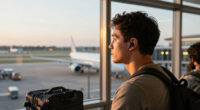
Prepare and use your wireless earbuds for travel by checking their fit, charge, settings, and connection before you leave. This guide is for travelers with any level of experience who want to listen to music, podcasts, or downloaded audio on a flight, train, or other journey. Preparation takes about 15–30 minutes, though charging may take longer.

Get the latest gadgets delivered free with Prime
- Fast, free delivery on millions of items
- Prime Video, Amazon Music and more included
- Member-only deals all year

Soundcore P30i Noise Cancelling Earbuds with Charging Case Phone Stand
- ✔ Connectivity: Bluetooth 5.4
- ✔ Noise control: Adaptive ANC and transparency mode
- ✔ Driver size: 10 mm

JBL Vibe Beam – True Wireless Earbuds – Black
- ✔ Sound: JBL Deep Bass Sound with 8 mm drivers
- ✔ Playtime: Up to 8 hours in earbuds; 24 additional hours with case
- ✔ Quick charge: 10 minutes for up to 2 hours of use

Soundcore by Anker P20i True Wireless Earbuds, with Big Bass, 30H Playtime
- ✔ Connectivity: Bluetooth 5.3
- ✔ Noise control: Passive noise cancellation
- ✔ Driver size: 10 mm
Difficulty: Beginner | Time: 15–30 minutes to prepare; allow extra time if charging or updating is needed
What You’ll Need
Tools & Materials:
- Wireless earbuds and their charging case
- Phone, tablet, or other compatible playback device
- Charging cable or charger compatible with the case
- Optional: airplane adapter compatible with your earbuds, if you plan to use the seat-back entertainment system
Knowledge:
- Basic ability to use Bluetooth settings on your phone or playback device
Charge the earbuds and case before travel. Check the airline’s current rules for Bluetooth devices and the seat-back entertainment system; requirements can differ by airline and aircraft. Download audio in advance if you may not have reliable internet access.
Soundcore P30i Noise Cancelling Earbuds with Charging Case Phone Stand
For travelers who want to shape how much of the outside world they hear, the Soundcore P30i is the strongest all-rounder in this lineup. Adaptive active noise cancelling can help reduce the steady background sound of a journey, while transparency mode gives us a way to hear announcements or speak briefly without taking the earbuds out. That flexibility sets it apart from the P20i, which lists passive noise cancellation rather than ANC, and from the Vibe Beam, whose supplied description highlights Smart Ambient features but does not clearly specify active cancellation.The battery figures need context: the P30i is rated for up to 45 hours with its case, but ANC-on listening is listed at up to 6 hours per charge and up to 25 hours with the case. That makes it a good fit for a trip with charging breaks, yet less reassuring for a long stretch of uninterrupted ANC use. Its case can double as a phone stand, a handy extra for watching downloaded videos in a seat, although that function does not make the case smaller. Choose it for adjustable noise control and travel flexibility; skip it if you want the simplest pocket setup or need long single-charge ANC sessions.
Pros:
- Adaptive ANC and transparency mode address both noisy travel and awareness needs.
- Up to 45 hours of stated total playtime with the case.
- Quick charge provides up to 2 hours of use from a 10-minute charge.
- Case phone stand adds a convenient way to prop up a device.
Cons:
- ANC-on runtime is listed at up to 6 hours per charge.
- The phone stand feature adds a function that may not suit travelers prioritizing a minimal case.
Best for: Travelers who want ANC and a transparency mode for switching between focused listening and announcements.
Not ideal for: People who need long ANC-on listening between charging opportunities or want the smallest possible case.
Bottom line: The P30i is our most versatile travel pick when adjustable noise control matters more than maximizing ANC-on time per charge.
“The P30i is our most versatile travel pick when adjustable noise control matters more than maximizing ANC-on time per charge.”
JBL Vibe Beam – True Wireless Earbuds – Black
The JBL Vibe Beam suits travelers who want a straightforward pair for music, calls, and everyday movement without leaning on a long list of app features. JBL describes a stick-closed design intended to fit securely and exclude some external sound, which may make listening feel more contained than with the compact P20i. Its up to 32 hours of total battery life is also useful across a day of connections, and a 10-minute speed charge is listed to add up to two hours when we need a quick top-up.Its travel limitation is noise control. Smart Ambient includes TalkThru and Ambient Aware functions for hearing people or surroundings, but the supplied details do not clearly confirm active noise cancellation. That leaves it behind the P30i for reducing cabin noise, even though the Vibe Beam offers more total playtime than the P20i’s stated 30 hours. Bass-forward JBL tuning and a closed fit are appealing for entertainment, but travelers should consider whether an in-ear closed design feels comfortable over extended wear. This is the uncomplicated endurance pick, not the best choice for anyone whose main goal is active cabin-noise reduction.
Pros:
- Up to 32 hours of total playtime with the case.
- A 10-minute speed charge is listed to add up to two hours of use.
- Closed stick design is described as comfortable and secure.
- Smart Ambient features include TalkThru and Ambient Aware.
Cons:
- The supplied description does not clearly confirm active noise cancellation.
- A closed in-ear fit may not suit everyone during long listening sessions.
Best for: Listeners who want a comfortable closed fit, long total battery life, and a quick charge for varied daily travel.
Not ideal for: Frequent flyers who specifically want clearly specified active noise cancellation.
Bottom line: The Vibe Beam is a practical everyday travel option for battery life and simple ambient controls, but not our first pick for noisy flights.
“The Vibe Beam is a practical everyday travel option for battery life and simple ambient controls, but not our first pick for noisy flights.”
Soundcore by Anker P20i True Wireless Earbuds, with Big Bass, 30H Playtime
When bag space is tight, the Soundcore P20i makes the most sense of these three. Its compact, lightweight case has an attached lanyard, so we can clip it to a bag or keys instead of losing it at the bottom of a pocket. That is a distinct travel advantage over the P30i, whose standout case feature is a phone stand, and over the Vibe Beam, which focuses more on its closed fit and ambient functions. The P20i also has app controls, 22 EQ presets, and a Find My Earbuds feature that can make small earbuds easier to manage on the go.The compromise is substantial for flights: the P20i specifies passive noise cancellation, not active noise cancellation. It can help with fit-based isolation, but it does not offer the same stated approach to background noise as the P30i. Its up to 30 hours of case-supported playtime is enough for many travel days, though it trails both alternatives on their stated totals. The boosted bass may suit music and downloaded entertainment, while adjustable EQ gives us a way to tailor the sound. Pick it for pocketability and customization; look elsewhere if cabin noise reduction or the longest battery reserve comes first.
Pros:
- Compact case with an attached lanyard for easier carrying.
- App offers 22 EQ presets and customizable controls.
- Find My Earbuds can help locate a misplaced earbud.
- Quick charging provides up to 2 hours of use from 10 minutes.
Cons:
- Noise control is listed as passive, without active ANC.
- Up to 30 hours total playtime is below the P30i and Vibe Beam figures.
Best for: Travelers who prioritize a small carry case, adjustable sound, and a lanyard for keeping earbuds close at hand.
Not ideal for: Frequent flyers seeking active noise cancellation or the longest case-supported playtime in this group.
Bottom line: The P20i is the easiest pick to carry compactly, provided we are willing to trade active noise control and some battery reserve for portability.
“The P20i is the easiest pick to carry compactly, provided we are willing to trade active noise control and some battery reserve for portability.”
As an Amazon Associate we earn from qualifying purchases.
Before You Start
Keep the case somewhere easy to reach, such as a personal item or seat pocket. Do not assume the seat-back screen supports Bluetooth: many systems require a wired connection, and some may not support personal earbuds at all. If you use noise cancellation, stay aware of announcements and crew instructions.
Step-by-Step Instructions
Step 1: Charge the earbuds and case
Place both earbuds in the case and charge the case using its compatible cable or charger. Check the case or companion app for battery indicators, then top up until the charge is sufficient for the trip. If the app offers a firmware update, install it at home while the earbuds and phone have stable power and internet.
Tip:Charging speed and battery indicators vary by model. Use the manufacturer’s instructions to interpret lights or percentages.
Check: The case and earbuds show a charge level suitable for your expected listening time.
Step 2: Check the fit and controls
Try each earbud at home and select an ear tip size that sits securely without causing pain. Use the companion app’s fit test if your model provides one. Practice pausing playback, adjusting volume, switching noise control modes, and answering or ending a call using the earbud controls or your device.
Tip:A secure fit can improve comfort and passive noise reduction. Do not force an ear tip into your ear; try another size if it feels uncomfortable.
Check: You can wear the earbuds comfortably and operate the controls without searching through settings.
Step 3: Prepare audio for offline listening
Open your music, podcast, audiobook, or video app and download the content you plan to use. Confirm that the downloads appear in the app and play while your device is in airplane mode or disconnected from Wi-Fi and mobile data.
Tip:Some services require a paid plan or periodic internet access to keep downloads available. Check the app’s download rules before departure.
Check: At least one selected item plays without an internet connection.
Step 4: Pair the earbuds with your device
Open Bluetooth settings on your phone or playback device. Put the earbuds into pairing mode according to the manufacturer’s instructions, select their name in the available-device list, and accept the pairing prompt. Play a short audio clip, then pause it and reconnect once to confirm the connection is stable.
Tip:If the earbuds connect automatically to another device, disconnect them there or turn Bluetooth off on that device while pairing.
Check: The device shows the earbuds as connected, and audio plays through both earbuds.
Step 5: Set noise control and volume
Choose a noise control mode that fits your surroundings. Try noise cancellation in a safe, quiet place before relying on it in a busy terminal. Set a comfortable listening volume and test transparency or ambient mode if you may need to hear announcements.
Tip:Noise cancellation does not replace attention to safety announcements. Pause audio and remove or adjust an earbud when staff are speaking to you.
Check: You can hear your chosen audio clearly at a comfortable level and know how to switch modes or pause it.
Step 6: Check entertainment system compatibility
If you want to use seat-back entertainment, check whether the system supports Bluetooth pairing. Follow the on-screen instructions if it does. If it only provides a headphone socket, use a compatible airplane audio adapter and wired connection only if your earbud model supports wired playback. Otherwise, use your own device and downloaded audio.
Tip:Seat-back sockets and adapters vary. Avoid buying an adapter based only on appearance; check the connector type and your earbud’s supported inputs.
Check: You have a confirmed way to listen, either through the entertainment system or your own device.
Step 7: Pack the earbuds for access and protection
Put the earbuds in their case before packing. Place the case in an accessible pocket of your personal item, along with the charging cable and any adapter you need. Keep the case closed when the earbuds are not in use so they stay protected and do not connect accidentally.
Tip:Do not leave loose earbuds in a seat pocket or on a tray table; they can be easy to forget.
Check: You can reach the case and accessories without unpacking your bag, and both earbuds are stored inside it.
Step 8: Use and store the earbuds during the trip
Connect to your device when you are ready to listen, then start downloaded audio or another source. Pause playback and check announcements during boarding, safety instructions, and crew requests. After listening, return both earbuds to the case and confirm they begin charging before putting it away.
Tip:If you use one earbud at a time to stay more aware, check your model’s instructions for single-ear use and keep the other earbud in the case.
Check: Audio plays from the intended device, you can pause promptly, and the earbuds return to the case for charging and safekeeping.
Common Mistakes to Avoid
- Leaving with a low case or earbud battery. — Charge both before departure and check their levels in the case or companion app.
- Assuming the seat-back screen pairs with Bluetooth earbuds. — Check the screen or airline information in advance, and plan to use downloaded audio from your own device if needed.
- Relying on streaming when the trip has limited connectivity. — Download audio and test it offline before leaving.
- Turning on noise cancellation and missing announcements. — Learn the pause and ambient-mode controls, and listen for crew instructions.
Troubleshooting
Problem: The earbuds do not appear in the Bluetooth device list.
Solution: Put them back in the case, then follow the model’s pairing-mode instructions. Turn off Bluetooth on nearby devices that may reconnect to them, and try pairing again. If they still do not appear, consult the manufacturer’s reset instructions.
Problem: Only one earbud plays audio.
Solution: Check that both earbuds are charged and seated correctly in the case. Clean charging contacts according to the manufacturer’s care instructions, reconnect the earbuds, and check your device’s audio balance setting.
Problem: The connection drops or audio stutters.
Solution: Keep the playback device near you, move away from sources of interference where possible, and disconnect other devices from the earbuds. Reconnect Bluetooth and test downloaded audio to rule out a weak internet connection.
Problem: The airline screen does not connect to the earbuds.
Solution: Check whether the screen supports Bluetooth and whether it is in pairing mode. If it only has a headphone socket, use a compatible adapter and wired input if your earbuds support them; otherwise switch to your own device.
What Success Looks Like
You are ready to travel when the earbuds and case have enough charge, the earbuds fit comfortably, your device pairs with them, and downloaded audio plays offline. You should know how to pause playback, change noise control, and store the earbuds safely. If using seat-back entertainment, confirm its connection method before relying on it.
Next Steps
After the trip, recharge the case and earbuds, wipe them with a soft dry cloth as directed by the manufacturer, and store them in the case. Before your next journey, check the battery, confirm your device still pairs, refresh offline downloads, and pack any adapter you need.
Frequently Asked Questions
Can I use wireless earbuds on a plane?
Bluetooth earbuds are commonly used in flight, but follow the airline’s instructions and crew announcements. The rules for Bluetooth and personal devices may vary, so check the airline guidance for your trip.
Can I connect wireless earbuds to an airplane’s entertainment screen?
Only if the screen supports Bluetooth pairing or your earbuds support a compatible wired connection. Check the screen’s instructions and your earbud specifications before relying on this option.
Should I download music or podcasts before traveling?
Yes. Offline downloads work when internet access is unavailable or unreliable. Test a download with your device disconnected from the internet before departure.
How can I keep my earbuds charged during a long trip?
Start with a charged case, return the earbuds to it between listening sessions, and carry the compatible charging cable. Check the case’s battery level before the trip; a power bank may help if you can charge the case from it.
Is noise cancellation enough to block announcements?
Noise cancellation can reduce background sound, but it may not block every announcement. Keep the pause and ambient-mode controls accessible and follow crew instructions.