
📊 Full opportunity report: Acoustic Dampening, Placement, and the “Rig in the Closet” Setup on ThorstenMeyerAI.com — validation score, market gap, and execution plan.

Get the latest gadgets delivered free — and shop member deals
- Fast, free delivery on millions of items
- Access to Prime Big Deal Days deals on October 6–7
- Prime Video, Amazon Music and more included
TL;DR
This article explains how to significantly reduce noise from high-power AI workstations through strategic placement and acoustic methods. Moving the rig into another room, especially in a closet with proper ventilation, is often the most effective solution.
Placing a high-power AI workstation in a separate room, such as a closet with proper ventilation, is the most effective way to reduce noise, according to technical experts.
Experts emphasize that the most impactful method for noise reduction is to increase distance and isolation by relocating the rig away from the workspace. Using a network connection to operate the machine remotely allows the workstation to run in a different room, such as a closet, without affecting workflow.
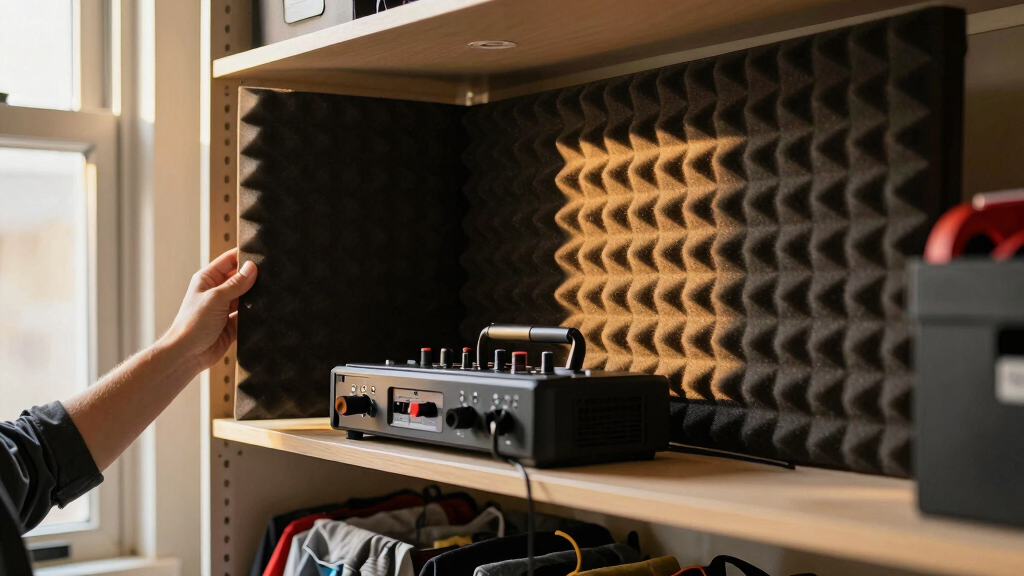
However, placing a hot, high-load machine in a sealed space can cause heat buildup, risking hardware damage. To prevent this, proper ventilation—passive vents or active exhaust fans—is essential. Purpose-built soundproof cabinets with integrated airflow solutions are also available, providing both noise suppression and heat dissipation.
Acoustic treatments like foam are less effective for preventing noise transmission and should be used in conjunction with barriers and physical separation. Mechanical decoupling, such as rubber feet, can reduce structure-borne noise, which foam alone cannot address.
Acoustic dampening
& the rig in the closet.
The most powerful noise fix isn’t a material — it’s a floor plan. A rig you can’t hear because it’s in another room beats any amount of foam. Tap the approaches in Part 1 to see what actually works.
(another room)
(levers 1–4)
(door / barrier)
(acoustic foam)
Contain the noise, not the heat
Why Moving the Rig Matters for Noise Management
Relocating the AI workstation to another room or closet can dramatically decrease noise levels in the primary workspace, improving comfort and productivity. This approach reduces the need for extensive acoustic treatment and addresses both airborne and structure-borne noise effectively. It also allows users to operate high-power rigs without disturbing their environment, making it a practical solution for shared or noise-sensitive spaces.
As an affiliate, we earn on qualifying purchases.
Background on Noise Reduction Strategies for AI Workstations
Traditionally, noise mitigation focused on acoustic foam and internal case dampening, which are often ineffective alone. Experts highlight that the hierarchy of noise reduction prioritizes distance and isolation over absorption. The concept of placing rigs in separate rooms or closets has gained popularity, especially as AI hardware becomes more powerful and generates more heat and noise.
Previous guidelines stressed cooling and airflow management, but recent insights emphasize that physical separation combined with proper ventilation offers the best results. Purpose-built soundproof enclosures have become more common, integrating noise suppression with heat management systems.
"The most effective way to reduce noise is to move the rig into another room, ideally in a closet with proper ventilation. Foam alone won't cut it."
— Thorsten Meyer, AI workstation expert
As an affiliate, we earn on qualifying purchases.
Remaining Questions About Enclosed Placement and Heat Management
While the benefits of relocating rigs are clear, the optimal design of soundproof enclosures with integrated cooling remains a developing area. The effectiveness of various ventilation solutions and cost considerations for custom cabinets are still being evaluated. Additionally, the impact on hardware longevity and real-world noise reduction levels in different environments require further study.
As an affiliate, we earn on qualifying purchases.
Next Steps in Implementing Quiet AI Workstations
Users should assess their workspace and consider moving high-power rigs into separate rooms or closets with proper ventilation. Manufacturers are expected to develop more integrated, cost-effective soundproof enclosures with advanced cooling solutions. Further research will refine guidelines for balancing noise reduction and heat dissipation, making these setups more accessible and reliable.
As an affiliate, we earn on qualifying purchases.
Key Questions
Is placing my AI rig in a closet enough to eliminate noise?
Placing your rig in a closet can significantly reduce noise if combined with proper ventilation. However, without airflow management, heat buildup can damage hardware and reduce performance.
What are the best ventilation options for enclosed setups?
Passive vents with ducting, active exhaust fans, and purpose-built soundproof cabinets with integrated airflow are effective. The choice depends on your noise and heat management needs.
Does acoustic foam help if I move the rig away?
Acoustic foam is less effective for preventing noise transmission between rooms. It is more useful for reducing echo within a space rather than blocking sound from escaping.
Are soundproof cabinets worth the investment?
Yes, especially for high-power, heat-generating rigs. They combine noise suppression with proper cooling, preventing heat buildup and hardware damage.
Source: ThorstenMeyerAI.com
Evergreen bestsellers Picks
bestsellers
As an affiliate, we earn on qualifying purchases.