📊 Full opportunity report: One Place To Track Your TRT Labs And Daily Symptoms on IdeaNavigator AI — validation score, market gap, and execution plan.

Get the latest gadgets delivered free — and shop member deals
- Fast, free delivery on millions of items
- Access to Prime Big Deal Days deals on October 6–7
- Prime Video, Amazon Music and more included
TL;DR
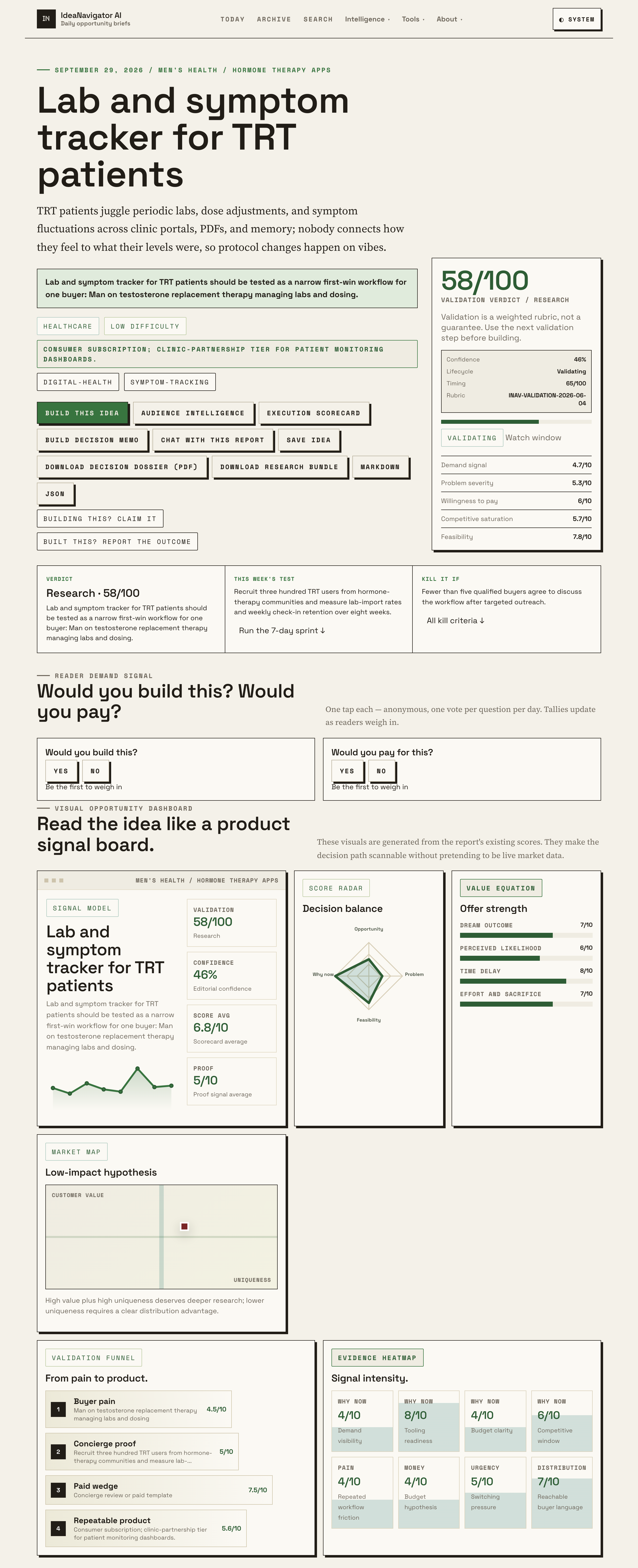
IdeaNavigator AI has published a product concept for a lab and symptom tracker aimed at men on testosterone replacement therapy. The proposed app would import lab PDFs, chart hormone panels against dose changes and symptom check-ins, and generate clinic-visit summaries. The concept is unvalidated and would be tested with 300 TRT users over eight weeks.
IdeaNavigator AI has published a product concept for a dedicated lab and symptom tracker for men on testosterone replacement therapy (TRT), proposing an app that charts hormone panels over time against dose changes and daily symptom check-ins. The concept targets a single narrow buyer — a man managing his own TRT labs and dosing — and is pitched explicitly as a small, testable first product rather than a broad health platform. The proposal has not been built or validated; its recommended test is an eight-week study with 300 TRT users.
The core problem the concept identifies is fragmentation. TRT patients, according to IdeaNavigator AI, juggle periodic labs, dose adjustments, and symptom fluctuations spread across clinic portals, PDF files, and memory. Because no tool connects how a patient feels to what his hormone levels actually were, the concept argues, protocol changes happen “on vibes” rather than on correlated data.
The proposed minimum viable product has four functions. It would import lab results from PDFs, a format IdeaNavigator AI describes as the common currency of lab reporting. It would then chart hormone panels over time alongside dose changes and daily symptom check-ins, giving users a single timeline. It would generate trend summaries designed to be brought to clinic visits, and it would flag values drifting outside target ranges.
On the business side, the concept proposes a consumer subscription as the base revenue model, with a second clinic-partnership tier that would give providers patient-monitoring dashboards. The target market is identified as men’s health and hormone-therapy apps. According to IdeaNavigator AI, the timing argument rests on a surge in TRT prescriptions and telehealth clinics, which has created a large population of patients who manage much of their own care across multiple providers.
Why Self-Managing TRT Patients Are the Target
The concept matters because it addresses a real gap in how hormone therapy is monitored. Telehealth TRT clinics often operate independently of a patient’s primary care provider, and lab results may arrive as PDFs that patients must interpret and retain themselves. A tool that links symptoms to lab values on one timeline could change the quality of conversations patients have with their prescribers — replacing vague recollections with printed trend summaries.
The narrow scope is also the point. IdeaNavigator AI frames the tracker as a “first-win workflow”: a deliberately small product for one buyer, rather than a general-purpose health app competing in a crowded market. If the concept holds up, the clinic-partnership tier points toward a business-to-business revenue path alongside consumer subscriptions, which matters for the sustainability of any app handling sensitive health data.
Telehealth Growth Behind the TRT App Idea
Testosterone replacement therapy has moved increasingly online over recent years, with telehealth clinics prescribing TRT after remote consultations and periodic blood work. IdeaNavigator AI’s timing argument is that this shift has produced patients who are, in effect, coordinating their own care by design: labs come from one provider, prescriptions from another, and symptom tracking from nowhere in particular.
The men’s health app market already includes testosterone trackers and general symptom logs, but the concept’s differentiator is the explicit pairing of imported lab data with dose-change history and daily check-ins in a single view. That combination — rather than manual entry alone — is what the proposal says is missing from existing tools.
What Is Unproven in the Concept
This is a product concept, not a shipped app. No company, development team, or launch date is identified in the proposal, and the naming rule of the concept itself means no founders or vendors can be named. Whether the app gets built at all depends on someone acting on the idea.
Several practical questions are unresolved. Lab PDF formats vary widely between laboratories, and the concept does not specify how reliably imports would parse them. The “flags values drifting outside target ranges” feature skirts the line between information display and medical advice, and the proposal does not address regulatory or clinical-safety considerations, such as whether out-of-range alerts would require review by qualified professionals. Pricing, subscription costs, and data-privacy handling for sensitive health information are also unspecified.
Most importantly, demand is untested. The proposed eight-week validation — 300 users recruited from hormone-therapy communities, measuring lab-import rates and weekly check-in retention — is a plan, not a result. Whether patients will sustain daily check-ins, the behavior the whole product depends on, is unknown.
Testing the Tracker With Real Users
If the concept moves forward, the immediate next step is the validation study IdeaNavigator AI describes: recruiting 300 TRT users from hormone-therapy communities and running them through the app for eight weeks. The two metrics to watch are lab-import rates — whether the PDF parsing actually works at scale — and weekly check-in retention, which would show whether daily symptom logging survives contact with real routines.
A successful test would presumably be followed by a paid consumer subscription launch and, later, outreach to telehealth clinics for the partnership tier. A weak result on either metric would suggest the concept needs rethinking before any build-out. For now, the idea exists only as a published proposal awaiting an implementer.
Source: IdeaNavigator AI
Key Questions
Does this TRT tracker app exist yet?
No. IdeaNavigator AI has published a product concept only. No app has been built, and no developer, company, or launch date has been announced.
What would the app actually do for a TRT patient?
According to the concept, it would import lab PDFs, chart hormone panels over time against dose changes and daily symptom check-ins, generate trend summaries for clinic visits, and flag values drifting outside target ranges.
How would the app make money?
The proposal identifies two revenue streams: a consumer subscription for individual patients and a clinic-partnership tier offering providers patient-monitoring dashboards.
How would anyone know if patients want this?
IdeaNavigator AI recommends recruiting 300 TRT users from hormone-therapy communities and measuring lab-import rates and weekly check-in retention over eight weeks. This validation has not been conducted.
Is a symptom tracker a substitute for medical advice?
No. The concept positions the app as a record-keeping and trend-summary tool to support clinic conversations. It does not replace a prescriber, and the proposal does not specify how out-of-range flags would be clinically reviewed.
Source: IdeaNavigator AI
Fall Picks
fall essentials
As an affiliate, we earn on qualifying purchases.