To size an air purifier correctly, you need to match its CADR rating to your room’s size by calculating your space’s volume. Measure the length, width, and ceiling height, then find the total volume. Decide how many air changes per hour you want, usually 4-6, and multiply this by your room volume. This math helps you pick a purifier that works efficiently—you’ll learn more details to make certain your air stays clean every day.
Key Takeaways
- Calculate room volume by multiplying length, width, and ceiling height to determine needed CADR.
- Match the CADR rating to the room’s volume and desired air changes per hour for effective cleaning.
- Use CADR formulas: (Room Volume in cubic feet) x (Air changes per hour) ÷ 60 to find required CADR.
- Consider room size, pollutant levels, and noise preferences when selecting an air purifier with appropriate CADR.
- Avoid oversizing or undersizing by accurately measuring room dimensions and understanding CADR to optimize performance.
What Is CADR and Why Is It Important?

Have you ever wondered how to determine if an air purifier can effectively clean your space? That’s where CADR, or Clean Air Delivery Rate, comes in. CADR measures how quickly an air purifier filters air, directly impacting your air quality. A higher CADR indicates better filtration efficiency, meaning the device can remove more pollutants in less time. It helps you compare different models and choose one suited for your room size. Without considering CADR, you might select a purifier that’s too weak or too strong for your space, wasting energy or underperforming. Understanding air filtration efficiency ensures you get an air purifier that matches your needs, providing cleaner air and improving overall air quality. It’s a simple yet crucial metric for making an informed choice, especially when considering appropriate device sizing for your environment.
How to Measure Your Room Size for Air Purifier Sizing
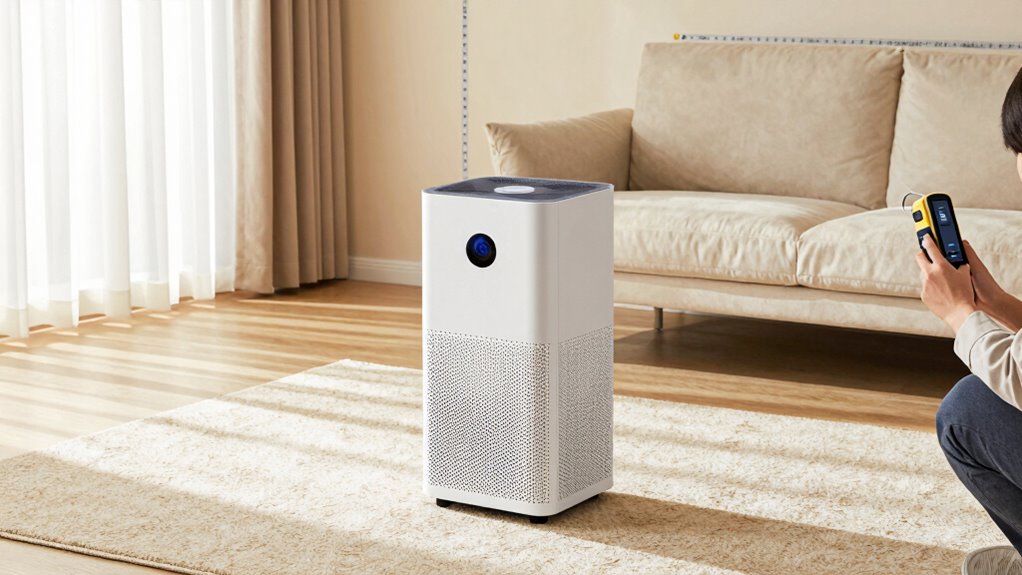
To size your air purifier correctly, start by measuring your room’s length and width. Then, calculate the total square footage to determine the right capacity. Don’t forget to take into account ceiling height, as it affects the overall volume of air in the space. Additionally, understanding your Room Volume can help you choose an air purifier with an appropriate Clean Air Delivery Rate (CADR). Knowing your room size ensures optimal performance and air quality. For a more precise assessment, consider using deep‑sky imaging techniques to visualize airflow patterns and identify potential circulation issues within your space. Incorporating auditory processing considerations can also improve the effectiveness of your environment, especially if sensitive to noise or airflow sounds. Being aware of ventilation design principles can further enhance air circulation and purifier efficiency.
Measure Room Dimensions
Measuring your room dimensions accurately is the first step in choosing the right air purifier. To do this, measure the length, width, and height of your space in feet or meters. Write down each measurement carefully, guaranteeing you’re precise. Knowing your room dimensions helps you understand the size of the area you want to improve air quality in. Larger rooms require a more powerful purifier, while smaller spaces need less. Avoid assumptions—use a tape measure or laser device for accuracy. Keep in mind that air quality can vary depending on room size, so accurate measurements ensure you select a device that can handle your space effectively. Precise room dimensions are essential for calculating the correct airflow needs and improving overall air quality. Additionally, understanding air purifier capacity helps ensure your chosen model effectively covers your room size. When selecting an air purifier, always consider the recommended coverage area to match your room size for optimal performance. Knowing your essential oil benefits, such as those for respiratory health and congestion relief, can also help you choose air purifiers with features that support healthier indoor environments. Moreover, understanding how air quality indicators work can assist in monitoring your indoor air and maintaining a healthier space. Being aware of body piercing aftercare tips can also help prevent issues like infections that might affect indoor air quality.
Calculate Square Footage
Wondering how to determine your room’s size accurately? Measuring square footage is key to choosing an air purifier that improves air quality and maintains filtration efficiency. To do this effectively:
- Measure the length of your room in feet.
- Measure the width of your room in feet.
- Multiply these two numbers to get the square footage.
- Repeat if your room has irregular shapes and add the areas together.
Accurate measurements ensure you select an air purifier with the right CADR rating, optimizing filtration efficiency. Knowing your square footage helps match the purifier’s capacity to your space, leading to better air quality. Keep in mind, precise room sizing is essential for effective air purification results.
Consider Ceiling Height
Since ceiling height affects the total volume of your room, it’s important to include it when sizing your air purifier, especially in spaces with higher or vaulted ceilings. Standard square footage calculations only consider floor area, but taller ceilings increase the room’s volume, requiring a more powerful purifier to maintain ventilation efficiency. Measure your ceiling height accurately, then multiply it by the room’s length and width to find the total volume in cubic feet. A larger volume means you’ll need a unit with a higher Clean Air Delivery Rate (CADR) to effectively filter air. Ignoring ceiling height can lead to underperforming purifiers that struggle to clean the air efficiently, compromising your indoor air quality and ventilation efficiency. Understanding room volume is essential for selecting the right air purifier capacity. Additionally, considering air exchange rate helps ensure your purifier can keep up with your room’s airflow needs for optimal air quality. To optimize your air purifier’s performance, it’s also helpful to understand the air circulation patterns within your space. Knowing your room’s actual volume can lead to better decisions about purifier size and placement, ultimately enhancing air quality. Moreover, accounting for airflow distribution can improve overall air purification efficiency by ensuring the air circulates properly throughout the space.
How to Calculate the CADR You Need for Your Space

To determine the right CADR (Clean Air Delivery Rate) for your space, you need to take into account the size of the room and how quickly you want the air to be cleaned. First, calculate the room’s square footage. Then, decide how many air changes per hour you desire—higher for sensitive air quality needs. To find your ideal CADR:
- Multiply your room’s square footage by ceiling height to get volume.
- Decide on the recommended air changes per hour (usually 4-6).
- Divide the total volume by 60 to convert minutes to hours.
- Multiply this value by your chosen air changes per hour for your CADR.
- Remember that understanding the CADR math is essential for selecting an air purifier that effectively improves your indoor air quality. Incorporating thermal behavior principles can also help optimize your air purification setup for better efficiency. Additionally, considering the airflow dynamics within your space can further enhance the effectiveness of your purification system. Recognizing the importance of room airflow patterns can lead to more effective placement of your purifier for optimal results.
Key Factors That Affect Your Ideal Air Purifier Size
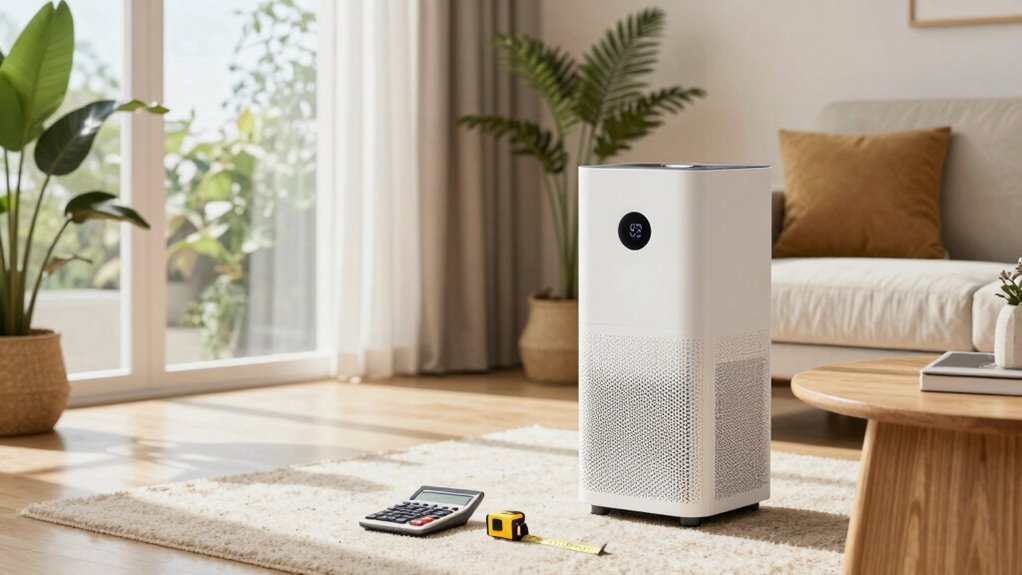
Several key factors influence the ideal size of your air purifier, shaping how effectively it can clean your indoor air. One important consideration is filter replacement frequency; larger units often have bigger filters, which last longer and maintain efficiency longer. Noise levels also matter, as bigger purifiers may produce more sound, potentially disturbing your environment. Conversely, smaller units might be quieter but less powerful, requiring more frequent filter changes to stay effective. Your room size, air quality, and specific pollutants also impact the ideal size. Balancing these factors helps you choose a purifier that provides thorough air cleaning without excessive noise or maintenance. Additionally, filter capacity plays a crucial role in determining how well your purifier can handle continuous air purification over time. Understanding air exchange rates can further optimize your choice and ensure your indoor air remains clean and healthy. Recognizing how air quality fluctuates in different environments can also guide you in selecting the most suitable purifier size for your needs. Considering room volume helps tailor your choice to achieve optimal air turnover and purification efficiency.
How to Match CADR Ratings to Your Air Purifier Choices
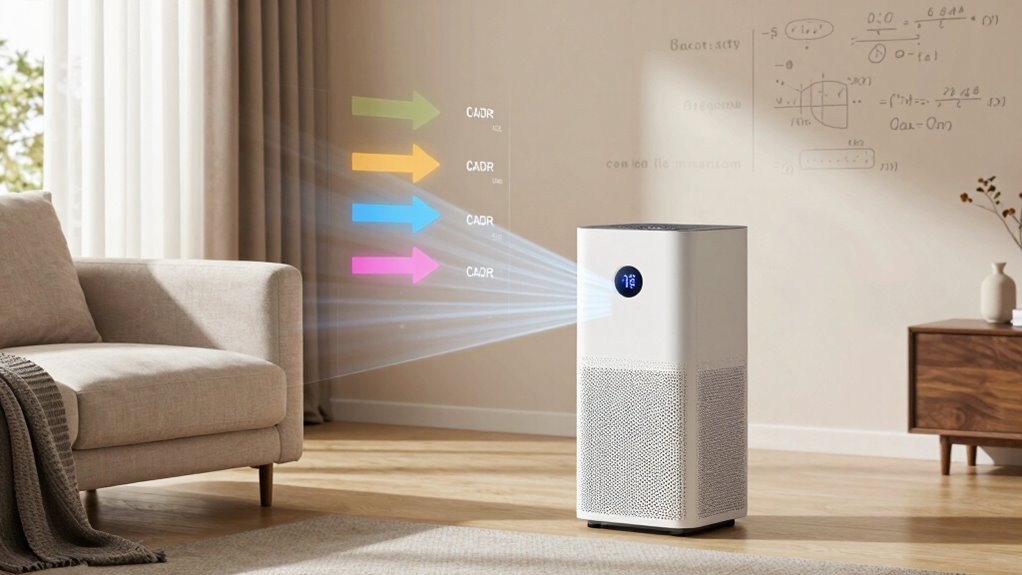
Matching CADR ratings to your air purifier choices guarantees you select a model that effectively cleans your indoor air space. To do this:
Matching CADR ratings to your air purifier ensures effective, hassle-free indoor air cleaning.
- Determine your room’s size and find a CADR rating that corresponds with or exceeds that area.
- Check the air purifier’s recommended coverage to ensure it suits your space.
- Consider maintenance needs—higher CADR models may require more frequent filter replacement.
- Keep in mind that a well-matched purifier simplifies air purifier maintenance, keeping your device running efficiently.
- Refer to cost‑of‑ownership considerations to ensure the ongoing expense aligns with your budget.
Choosing the right CADR rating ensures maximum effectiveness and minimizes the need for over- or under-sized units. Proper matching makes filter replacement easier and more cost-effective, keeping your indoor air clean without unnecessary hassle.
Common Mistakes When Sizing an Air Purifier and How to Avoid Them

One common mistake people make when sizing an air purifier is choosing a model based solely on its advertised CADR rating without considering their specific room conditions. This can lead to ineffective purification or unnecessary noise. Remember, larger CADR ratings often mean higher noise levels and more frequent filter maintenance. To visualize, consider this table:
| Room Size | CADR Needed | Noise Level |
|---|---|---|
| Small | Moderate | Quiet |
| Medium | High | Slightly noisy |
| Large | Very high | Noisy |
If you select a purifier with a CADR that’s too high, you may experience disruptive noise and increased filter maintenance. Conversely, too low a rating reduces effectiveness. Balance your needs with noise levels and filter upkeep for ideal results.
How to Test and Verify Your Air Purifier’s Effectiveness
To guarantee your air purifier is working effectively, you should perform air quality tests regularly. Using a particle counter lets you measure the level of airborne pollutants before and after running your device. This way, you can verify whether it’s truly improving your indoor air quality.
Conduct Air Quality Tests
Wondering if your air purifier is truly making a difference? Conducting air quality tests helps you verify its effectiveness. Start by using air quality sensors to monitor pollutant levels before and after running your purifier. This gives you a clear picture of improvements. Next, guarantee proper filter maintenance; a dirty filter can reduce performance. Here are some steps to follow:
- Place air quality sensors in key rooms to track pollutant levels.
- Record baseline air quality readings before turning on the purifier.
- Operate the purifier for a set period, then measure again.
- Compare the data to see if levels have decreased markedly.
Regular testing confirms your purifier’s impact, helping you adjust settings or schedule filter changes for continued effectiveness.
Use Particle Counters
How can you accurately measure your air purifier’s performance? Using particle counters is your best option for precise air quality monitoring. These devices measure particle concentration in real time, providing clear data on how well your purifier reduces airborne pollutants. To verify effectiveness, compare particle counts before and after running your purifier. Here’s a simple overview:
| Step | Action | Purpose |
|---|---|---|
| Measure baseline | Use particle counters to record initial air quality | Establish starting point |
| Run purifier | Operate your air purifier for a set time | Observe changes |
| Re-measure | Check particle levels again | Confirm reduction in airborne particles |
This process guarantees you’re effectively gauging your air purifier’s performance through accurate particle measurement, enhancing your air quality monitoring.
Tips for Ensuring Your Air Purifier Delivers Clean Air Every Day

Ensuring your air purifier consistently delivers clean air requires regular attention and proper maintenance. Start by understanding different air filter types to select the best fit for your needs. Next, stick to recommended maintenance schedules—changing filters when needed keeps performance ideal. Here are some tips to help:
- Regularly check and replace filters based on manufacturer guidelines.
- Use the correct air filter types for your specific model.
- Clean vents and exterior surfaces to prevent dust buildup.
- Monitor air quality and adjust settings as necessary.
Frequently Asked Questions
Can a Higher CADR Always Mean Better Air Quality?
A higher CADR doesn’t always mean better air quality. While it indicates faster particle removal, in a CADR comparison, other factors like filter durability matter. A purifier with a very high CADR might have a less durable filter, leading to more frequent replacements and potentially lower overall effectiveness. Consider your room size and filter lifespan when choosing; a balanced CADR guarantees efficient cleaning without compromising filter longevity.
How Often Should I Replace or Clean My Air Purifier Filters?
You should replace or clean your air purifier filters based on the filter lifespan recommended by the manufacturer, typically every 3 to 6 months. Regular maintenance frequency guarantees maximum air quality and prevents strain on the device. Check the filter indicator or manufacturer’s guidelines for specific timing. By staying consistent with filter maintenance, you maintain your purifier’s efficiency and keep your indoor air clean.
Does Room Layout Affect Air Purifier Effectiveness?
Think of your room like a vintage vinyl record—layout matters. Your room’s layout, including furniture placement, directly impacts air circulation and how effectively your purifier works. Cluttered spaces or obstructed vents can hinder airflow, reducing purification efficiency. To maximize performance, position your air purifier in a central spot, keep vents clear, and arrange furniture to promote unobstructed air circulation, ensuring cleaner air throughout your space.
Are Portable or Fixed Air Purifiers More Reliable?
You’ll find that fixed air purifiers are generally more reliable because they are permanently installed and less prone to displacement or damage. Portable units offer flexibility and convenience but may require more maintenance and occasional repositioning, which can affect their reliability. Ultimately, if you want consistent, long-term performance, fixed air purifiers tend to be the better choice, though portable options suit those needing mobility and easy setup.
How Does Humidity Influence Air Purifier Performance?
Humidity effects can considerably influence your air purifier’s performance. High moisture impact, especially in humid environments, can cause mold growth and reduce filter efficiency, making it harder to purify air effectively. Conversely, low humidity can dry out filters faster. To optimize your device, monitor humidity levels and consider using a dehumidifier or humidifier as needed, ensuring your air purifier operates efficiently regardless of moisture fluctuations.
Conclusion
Choosing the right air purifier isn’t just about numbers; it’s about creating a healthier space. While matching CADR ratings to your room size seems straightforward, overlooking factors like airflow and placement can undermine your efforts. Think of it like tuning an instrument—you want harmony, not just the right notes. By understanding the math and avoiding common pitfalls, you’ll breathe easier, knowing your air is genuinely clean, even in the busiest, dustiest days.