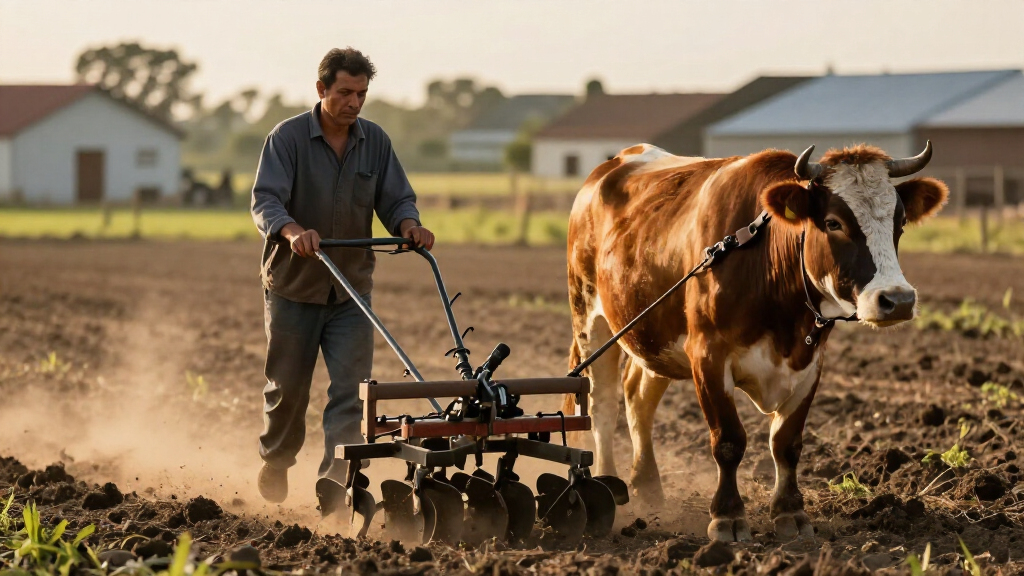

🔍 Read the full analysis: 26.7 Million Working Animals: The Cost Of Mechanized Farming on ThorstenMeyerAI.com

Get the latest gadgets delivered free with Prime
- Fast, free delivery on millions of items
- Prime Video, Amazon Music and more included
- Member-only deals all year
TL;DR
A ThorstenMeyerAI.com report traces the decline of working horses and mules on U.S. farms, from a peak of 26.7 million in 1918 to 3.1 million in 1960, as tractors and other machines spread. The change freed substantial cropland from growing animal feed, while farm employment fell and workers moved toward jobs in cities. The report presents the horse as a historical comparison for automation, not a prediction that human workers will follow the same path.
A November 4 report from ThorstenMeyerAI.com recounts how tractors and other machinery displaced most working horses and mules on U.S. farms: their combined number fell from a peak of 26.7 million in 1918 to 3.1 million by 1960. The shift freed farmland previously used to grow animal feed and changed agricultural work, offering a historical case study in mechanization—but not proof that machines will affect human workers in the same way.
The report bases its historical figures on the U.S. Census Bureau’s 1975 volume, Historical Statistics of the United States, Colonial Times to 1970, which reproduces Agriculture Department estimates. Horses alone peaked at 21.4 million in 1915; the combined horse-and-mule count reached 26.7 million on January 1, 1918. In 1915, about 93 million acres of harvested cropland—more than a quarter of the total—was used to grow feed for the animals.
Tractor numbers rose as the animal population declined. The report lists about 1,000 tractors in 1910, 246,000 in 1920, and 4.69 million in 1960. Farm horses and mules numbered 25.7 million in 1920, 7.8 million in 1950 and 3.1 million in 1960. Around 1955, tractors outnumbered horses and mules for the first time, according to the figures cited. The report says the feed acreage had fallen to about five million acres by 1960.
Mechanization extended beyond tractors. Combine harvesters, which cut, thresh and clean grain in one pass, increased from about 4,000 on U.S. farms in 1920 to 1.042 million in 1960, the report says. Agriculture Department estimates cited in the report put the number of people supplied by one farm worker at 7.1 in 1910 and 47.1 in 1970; that measure includes people abroad supplied through exports. U.S. farm employment, meanwhile, fell from a reported peak of 13.6 million in 1916 to 4.5 million in 1970, even as the national labor force doubled.
Mechanization Reshaped Farms and Work
The decline of working animals was part of a broader economic reorganization, not simply a change in farm equipment. As tractors replaced animal power, land once devoted to oats, corn and hay could be used for crops with other purposes. The report describes this release of farmland as a hidden dividend of mechanization, though the figures show land use rather than how those gains were distributed among farmers or consumers.
The labor figures also show why the comparison matters to readers considering automation. Farm employment dropped substantially while the wider labor force grew, and the report says new jobs were concentrated in cities, requiring many people to move. That history points to the importance of where new work emerges and whether workers can reach it; it does not establish that displaced workers automatically found equivalent jobs or that today’s automation will produce the same outcome.
Products Worth Considering

Logitech MX Brio Ultra HD 4K Webcam, Graphite

Bose SoundLink Flex Bluetooth Speaker (2nd Gen) – Portable Outdoor Speaker with Hi‑Fi Audio, Waterproof and Dustproof, USB‑C, Up to 12 Hours

LG UltraGear 34GX90SA-W 34-inch WQHD Curved OLED Gaming Monitor
As an affiliate, we earn on qualifying purchases.
From Animal Power to Tractors
Tractors existed before World War I, but the report says early models were heavy, expensive and better suited to large farms. It identifies Ford’s 1917 Fordson as a turning point. The Henry Ford museum describes the Fordson as “the first mass-produced and inexpensive lightweight tractor,” designed “to meet the needs of small farmers,” and says it rapidly became America’s most popular tractor. The 100,000th Fordson left the assembly line on February 21, 1920.
The report also places the U.S. experience alongside developments in China, Germany and Japan, but the supplied material gives detailed figures only for the United States and one recent China statistic. It says China reported that about 74% of ploughing, sowing and harvesting was mechanized in 2023. For modern equipment, it cites John Deere’s February 2025 16-camera autonomy kit, which performs tillage on selected large tractors. These examples show that agricultural automation continues, while also indicating that current autonomous systems are described as having a limited, specific role.
The horse comparison has also appeared in economic debate. In 1983, economist Wassily Leontief compared workers with horses replaced by tractors, according to the report. The report emphasizes a limit Leontief himself identified: horses could not vote. Human workers can participate in politics and shape policy, making the historical analogy informative but incomplete.
““The first mass-produced and inexpensive lightweight tractor””
— The Henry Ford museum, as quoted in the ThorstenMeyerAI.com report
Limits of the Horse Comparison
The historical counts document a major change in U.S. farm technology and employment, but they do not settle what automation will mean for workers now. The report does not provide comparable employment or displacement data for China, Germany and Japan, despite mentioning those countries as part of its wider discussion. Nor does the supplied material quantify the economic gains from converting feed acreage to other uses or explain how those gains were shared.
The modern examples are also narrow. The cited John Deere system is described as doing tillage on selected large tractors, not as performing every farm task autonomously. The report gives China’s 74% mechanization figure for ploughing, sowing and harvesting in 2023, but the supplied text does not specify the calculation method or how mechanization is divided among those tasks. These gaps limit direct comparisons between historical farm animals, present-day machinery and human employment.
The source material describes the report as an episode in a series but does not provide a separate publication timetable for further data or a detailed forecast. The historical analogy should therefore be read as a question about economic change, not as a confirmed prediction about the scale or timing of future job losses.
Track Automation and Rural Jobs
The report’s next step is analytical: it proposes examining how the transition affected people who worked alongside horses, how similar changes unfolded in other countries, and what current driverless tractors can and cannot do. For readers following the issue, the clearest evidence to watch is whether new machinery expands beyond specialized tasks and how farm employment, productivity and rural job opportunities change alongside adoption.
Further comparisons will need clearly dated figures and consistent definitions. In particular, future reporting could clarify what share of farm work autonomous systems perform, how adoption varies by farm size, and whether workers displaced from agricultural roles can access jobs elsewhere. The historical data establishes the scale of the earlier shift; the effects of today’s farm automation remain developing.
Key Questions
How many horses and mules worked on U.S. farms at the peak?
The combined total peaked at 26.7 million on January 1, 1918, according to estimates reproduced in the U.S. Census Bureau’s 1975 historical statistics volume. Horses alone had peaked at 21.4 million in 1915.
How much did the number of farm horses and mules fall?
The count declined from 26.7 million in 1918 to 3.1 million in 1960, a fall of almost 90%, according to the figures cited by ThorstenMeyerAI.com.
Why were tractors attractive to farmers?
The report says horses required feed year-round, while a tractor needed fuel when it was in use. Replacing animal power also reduced the acreage needed to grow feed: the report cites about 93 million acres in 1915 and about five million in 1960.
Does the horse analogy predict what will happen to human workers?
No. The report treats it as an analogy, not a law or forecast. It notes that human workers differ from horses, including because people can vote and influence policy, and that the historical record alone does not establish the effects of present-day automation.
What farm automation examples does the report cite today?
It cites John Deere’s February 2025 16-camera autonomy kit, which the report says performs tillage on selected large tractors, and China’s reported figure that about 74% of ploughing, sowing and harvesting was mechanized in 2023.
Source: ThorstenMeyerAI.com