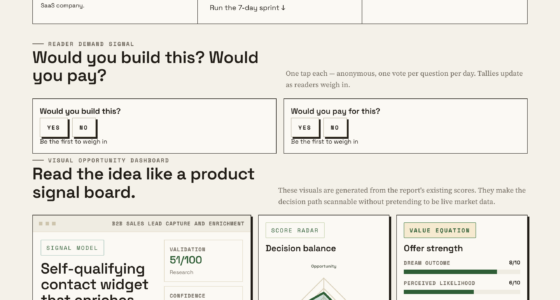

📊 Full opportunity report: The Local-First Agentic Operator on ThorstenMeyerAI.com — validation score, market gap, and execution plan.
TL;DR
A new approach enables a single person, leveraging agentic AI, to create and operate diverse software products across domains. This shift reduces reliance on organizations, emphasizing local control and vendor independence.
A single operator, empowered by agentic AI, has built and manages a portfolio of 18 complex software products, demonstrating that what once required a full organization can now be done by one person. This development challenges traditional notions of software creation and operation, emphasizing local control, vendor independence, and human-AI collaboration.
The portfolio includes diverse tools such as content engines, validation systems, decision platforms, and intelligence analysis tools. Each product embodies four core principles: local-first, provider-agnostic, built by a non-developer using agentic AI, and edited by subtraction. These principles enable a single operator to build, run, and adapt complex systems across domains without organizational overhead.
This approach relies on owning hardware and data, avoiding vendor lock-in through swappable models, and leveraging AI as a power tool for human judgment and editing. The portfolio demonstrates that these principles are not theoretical but practically achievable, even for highly specialized products like satellite ISR platforms or regulated-QA systems.
While the portfolio’s scope is broad, it is intended as evidence that a new operational model is possible: one person, working with AI, can replace what previously required teams and infrastructure.
The Local-First Agentic Operator
Eighteen products that looked like a sprawl were never eighteen things. They were one thing, built eighteen times. This is the thesis underneath all of them — named.
- Not “solo beats funded team.” Depth still wins most single contests. The narrower, truer claim: the floor moved — one person can now do what recently took many.
- Breadth is strength and risk. Eighteen products is resilience and a focus problem; several are seeds, not trees.
- The AI part is assisted, not autonomous. Strip away human judgment and subtraction and you get faster mediocrity, not a portfolio.
- A pattern, not a prescription. This fit one operator, one skill set, one moment. The honest version of any manifesto includes “this worked for me.”
A synthesis and a statement of one operator’s working philosophy — independent commentary, produced with AI assistance under human editorial oversight. The views are the author’s own and may change. This is not business, financial, legal, or technical advice, and the four-facet framing is a personal operating pattern, not a prescription or a claim of results. Individual products carry their own terms, disclaimers, and limitations in their respective articles; several are early- or positioning-stage. Product, model, and company names are trademarks of their respective owners; mention does not imply endorsement.
Implications for Software Development and Organizational Structures
This development signifies a potential shift in how software is built and managed, reducing the need for large teams and organizational complexity. It suggests that individual operators, equipped with agentic AI, can now produce and sustain complex systems, challenging the traditional startup and corporate models. This could democratize software creation, lower costs, and increase resilience by emphasizing local control and vendor independence.
However, it also raises questions about the scalability of this approach, the skills required, and how widespread adoption might impact existing tech industry structures.

Local LLM Inference Optimization: A Comprehensive Guide to Quantization, Hardware Acceleration, and Efficient Private AI Deployment
As an affiliate, we earn on qualifying purchases.
As an affiliate, we earn on qualifying purchases.
Evolution of AI-Assisted Software Building
Over the past few years, advances in agentic AI have shifted from supporting individual tasks to enabling the creation of entire products by non-developers. The series from Thorsten Meyer AI illustrates this trend, showing a portfolio of 18 diverse products built over 18 days by a single operator. Historically, such projects required large teams and extensive coordination. The current development suggests that the operational floor has moved, making it feasible for a single person to build and manage complex systems across domains.
This is part of a broader movement toward decentralization and democratization of software development, driven by AI tools that augment human decision-making and craftsmanship.
“The unit isn’t ‘the startup.’ It’s ‘the person, amplified.'”
— Thorsten Meyer

Self-Hosted AI Assistant for Beginners: Build a Private Open-Source Workflow with OpenClaw
As an affiliate, we earn on qualifying purchases.
As an affiliate, we earn on qualifying purchases.
Unanswered Questions About Scalability and Adoption
It is not yet clear how scalable this model is beyond the initial portfolio or how it will perform in highly regulated or mission-critical environments. The long-term sustainability of single-operator models and their ability to handle evolving complexity remains uncertain. Additionally, the skills required for operators to effectively leverage agentic AI at this level are still being defined.

THE AI GOVERNANCE ARCHITECT: BUILDING MODEL RISK MANAGEMENT AND COMPLIANCE FRAMEWORKS: A Practitioner's Blueprint for Auditable MLOps, Systemic Traceability, and Scaling Trust in Regulated Enterprise
As an affiliate, we earn on qualifying purchases.
As an affiliate, we earn on qualifying purchases.
Next Steps for Broader Validation and Adoption
Further experimentation and case studies are expected to explore how this model can be scaled or integrated into existing organizational structures. Industry observers will watch for adoption patterns, potential limitations, and whether this approach influences broader software development practices. Continued development of agentic AI tools tailored for individual operators is likely.

TinyLab Starter Kit Works with Arduino and 20 Modules. Coding Learning Guide, Electronics Kit for Beginners, Single Board Computer for Makers
- Includes TinyLab Prototyping Device: Compatible with Arduino and ATmega32u4
- Comprehensive Electronics Kit: 20 modules and components included
- Arduino-Based Prototyping: Access to essential modules and sensors
As an affiliate, we earn on qualifying purchases.
As an affiliate, we earn on qualifying purchases.
Key Questions
Can a single operator truly replace a full organization?
While the portfolio demonstrates significant capabilities, it remains to be seen whether this model can scale to all types of complex or mission-critical systems. Currently, it shows promise for specialized and moderate-scale projects.
What skills does an operator need to manage these systems?
An operator should have a good understanding of AI tools, data management, and domain expertise. Technical skills are less about traditional coding and more about guiding and editing AI-generated outputs.
Are there risks or limitations to this approach?
Potential risks include over-reliance on AI, challenges in managing complex dependencies, and difficulties scaling beyond initial prototypes. Regulatory and security considerations also pose challenges in sensitive sectors.
How might this change the industry landscape?
If widely adopted, this model could reduce barriers to software creation, democratize innovation, and alter organizational structures by empowering individual operators rather than large teams.
Source: ThorstenMeyerAI.com