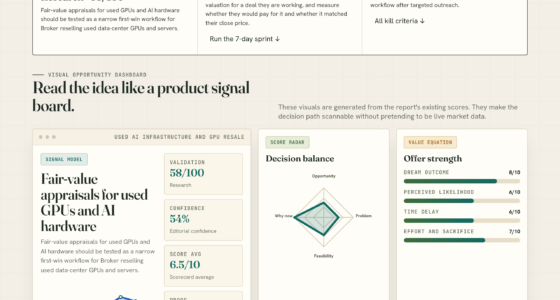

📊 Full opportunity report: The Model Is Only 10%: The Real Lesson of the New SDLC on ThorstenMeyerAI.com — validation score, market gap, and execution plan.

Get the latest gadgets delivered free with Prime
- Fast, free delivery on millions of items
- Prime Video, Amazon Music and more included
- Member-only deals all year
TL;DR
A recent whitepaper from Google emphasizes that in AI-assisted software engineering, the core value lies in how systems are configured and verified, not just in the AI models themselves. The model’s influence is only about 10%, shifting focus to harness and context engineering.
Google’s latest whitepaper on the Software Development Lifecycle (SDLC) with AI coding agents states that the AI model itself accounts for only about 10% of system behavior. The key takeaway: the harness, configuration, and verification surrounding the model are where most of the value and control lie. This shifts the traditional focus from model advancements to system design and management, impacting how organizations approach AI integration in software development.
The whitepaper, authored by Addy Osmani, Shubham Saboo, and Sokratis Kartakis, underscores that the dominant factor in AI-assisted coding is not the model, but the surrounding scaffolding — including prompts, tools, rules, and context management. Evidence from benchmarks shows that changing only the harness can significantly improve performance, even with the same model.
Furthermore, the authors differentiate between vibe coding, which involves minimal structure and quick prompts, and agentic engineering, which incorporates formal specs, automated tests, and oversight. They argue that the costs and risks associated with unstructured, vibe-like approaches are high, while disciplined, configuration-focused methods offer better long-term value and security.
The model is only 10%
A Google whitepaper argues software’s biggest shift is from writing code to expressing intent. Its sharpest claim: the model you obsess over is the smallest part of the system — the scaffolding around it does the real work.
The clearest map yet of how serious AI development works — and mostly tool-agnostic. But it’s a Google funnel: the concepts are neutral, the on-ramps point to Gemini, Jules & the ADK. If the harness is 90% and it’s yours, your moat and your costs both live there — so own your scaffolding, route across models, and remember: AI amplifies whatever engineering culture it lands in.
Why Focus on Harness and Configuration Matters
This shift in understanding impacts how organizations should allocate resources for AI development. Emphasizing the harness, context, and verification over the model itself means companies can achieve significant performance gains and cost savings by investing in system design, testing, and configuration management. It also underscores the importance of systematic verification to prevent vulnerabilities and maintain quality in AI-generated code.
As an affiliate, we earn on qualifying purchases.
Evolution of AI in Software Development
As of early 2026, AI coding agents are used by 85% of professional developers, with 51% using them daily, and roughly 41% of all new code is AI-generated, according to industry reports. Previously, the focus was on adopting the latest models, but recent research suggests that system configuration and management play a far more critical role. This perspective is a response to the rapid proliferation of AI tools and the need for scalable, secure, and cost-effective AI integration.
“The true value in AI-assisted SDLC isn’t in the model itself but in how you configure, verify, and control it.”
— Addy Osmani, co-author of the whitepaper
As an affiliate, we earn on qualifying purchases.
Unclear Aspects of the Harness and Verification Approach
While evidence suggests that configuration and harness design are critical, it remains unclear how organizations can best standardize these practices across diverse teams and projects. The long-term impacts of this shift on AI model development and the evolution of industry standards are still developing, and further empirical research is needed to quantify cost savings and security improvements.
As an affiliate, we earn on qualifying purchases.
Next Steps for Organizations Adopting AI Coding Practices
Organizations should prioritize building robust harnesses, including tools, prompts, and verification protocols, to optimize AI performance. Future developments may include standardized frameworks for system configuration, best practices for verification, and industry benchmarks to measure harness effectiveness. Continued research and case studies will clarify how to implement these insights at scale.
As an affiliate, we earn on qualifying purchases.
Key Questions
Why is the model only 10% of system behavior?
The whitepaper shows that most of an AI agent’s behavior depends on how it is configured, prompted, and integrated with tools and rules, not just the underlying model.
How can companies improve AI performance according to the new insights?
By focusing on designing and managing the harness — prompts, context, tools, and verification systems — rather than solely upgrading models.
Does this mean model development is less important?
Model development remains vital, but the whitepaper emphasizes that system configuration and verification have a greater impact on real-world performance and security.
What are the risks of ignoring harness design?
Ignoring harness design can lead to higher costs, security vulnerabilities, and unpredictable behavior, undermining AI’s reliability and efficiency.
What should organizations do next to adapt to this shift?
Invest in building strong configuration practices, develop verification protocols, and focus on system-level management of AI agents.
Source: ThorstenMeyerAI.com
Halloween Picks
halloween
As an affiliate, we earn on qualifying purchases.