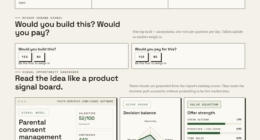

📊 Full opportunity report: Outcome-First Decisions: Keep, Change, or Kill on ThorstenMeyerAI.com — validation score, market gap, and execution plan.

Get the latest gadgets delivered free — and shop member deals
- Fast, free delivery on millions of items
- Access to Prime Big Deal Days deals on October 6–7
- Prime Video, Amazon Music and more included
TL;DR
Outcome-First is a decision framework that guides organizations to evaluate projects by their current outcomes, recommending to keep, change, or kill. It aims to improve portfolio health by focusing on results rather than sunk costs.
The Outcome-First framework, designed to help organizations decide whether to keep, change, or kill ongoing projects based on their current results, has been publicly released as open source. This approach emphasizes outcome-based evaluation over sunk costs, aiming to improve portfolio efficiency and reduce resource drain.
The framework, built around the concept of the Worth Filter, prompts decision-makers to assess initiatives solely on their present outcomes and future potential, ignoring past investments. It produces three possible verdicts: keep, change, or kill. The primary goal is to eliminate projects that no longer justify their costs, freeing up capacity for more valuable efforts.
Outcome-First is designed as a final decision node in portfolio management, closing the loop after ideas are proposed and plans are executed. It runs locally on owned hardware, is provider-agnostic, and is licensed under AGPL-3.0, ensuring open access and transparency. Its proponents argue that this discipline is crucial for avoiding portfolio bloat and maintaining focus on high-impact initiatives.
However, experts caution that outcome measurement can be flawed, and the framework’s effectiveness depends on accurate metrics and honest assessment. There is also concern that the bias toward killing may prematurely end slow-start projects that could prove valuable over time.
Outcome-First Decisions — keep, change, or kill
The hardest decision isn’t what to start — it’s what to stop. Judge every initiative by the outcome it produces now, not the effort already spent.
Independent commentary, produced with AI assistance under human editorial oversight. The views are the author’s own and may change. Outcome-First Decisions is open source under AGPL-3.0, provided “as is” without warranty; see the repository LICENSE. The framework’s verdicts are reasoning aids based on the inputs given and may be wrong — decision support, not decisions; verify independently before acting. Product and company names are trademarks of their respective owners; mention does not imply endorsement.
Implications for Portfolio Management Efficiency
This framework could significantly improve how organizations manage their project portfolios by encouraging disciplined pruning based on current results, rather than emotional attachment or sunk cost fallacies. It promotes a culture of continuous evaluation, helping prevent resource drain on underperforming initiatives and enabling faster reallocation to higher-value efforts.
Adopting Outcome-First could lead to more agile decision-making and better alignment of projects with strategic goals. However, it also raises questions about measurement accuracy and the potential for premature termination of promising but slow-start projects, which could impact innovation and long-term growth.
As an affiliate, we earn on qualifying purchases.
Background on Portfolio Pruning Challenges
Organizations often struggle with the ‘long tail’ of ongoing projects that neither succeed nor are formally terminated, consuming attention, capital, and focus without delivering meaningful results. Traditional decision-making tends to favor continuation due to emotional biases, past investments, or organizational inertia.
The need for a systematic approach to stop projects that no longer produce value has led to the development of frameworks like Outcome-First. The concept aligns with the broader trend of adopting outcome-based evaluation methods in management, but its practical adoption remains in early stages.
Previously, portfolio reviews often relied on backward-looking metrics or subjective judgments, which can perpetuate inefficiencies. Outcome-First shifts the focus forward, emphasizing current and projected outcomes to guide decisions.
“Outcome-First institutionalizes the single hardest and highest-leverage discipline an operator has — stopping.”
— Thorsten Meyer, source of the framework
portfolio management decision software
As an affiliate, we earn on qualifying purchases.
As an affiliate, we earn on qualifying purchases.
Uncertainties in Outcome Measurement and Application
It remains unclear how organizations will implement and calibrate the Worth Filter to ensure accurate outcome assessments. The framework’s success heavily depends on honest, precise measurement of current results, which can be challenging in complex or slow-moving projects.
Additionally, the risk exists that organizations may misuse the framework to justify premature kills, especially if outcomes are mismeasured or manipulated. The framework does not inherently provide judgment or courage to override data-driven conclusions when emotional or strategic considerations suggest otherwise.
Further, how the framework will be adopted across different industries and organizational cultures remains to be seen, including whether it can be integrated into existing decision processes smoothly.
performance metrics tracking software
As an affiliate, we earn on qualifying purchases.
As an affiliate, we earn on qualifying purchases.
Next Steps for Adoption and Validation
Organizations interested in Outcome-First are encouraged to review the open-source implementation and adapt it to their portfolio management processes. Pilot programs could help test its effectiveness and refine outcome metrics.
Further development may include creating standardized outcome measurement tools and integrating the framework with existing project management systems. Industry experts will likely monitor early adopters for lessons learned and best practices.
Research and case studies are expected to emerge, providing insights into how Outcome-First influences portfolio health, decision speed, and resource allocation over time.
decision-making frameworks for organizations
As an affiliate, we earn on qualifying purchases.
As an affiliate, we earn on qualifying purchases.
Key Questions
How does Outcome-First differ from traditional project evaluation methods?
Unlike traditional methods that often emphasize past investments or effort, Outcome-First focuses solely on current and projected outcomes to decide whether to keep, change, or kill initiatives.
What are the main risks of using the Outcome-First framework?
The primary risks include mismeasurement of outcomes, premature termination of slow-start but valuable projects, and potential misuse to justify cuts without proper evaluation.
Is Outcome-First suitable for all types of organizations?
While designed to be provider-agnostic and flexible, its effectiveness depends on an organization’s ability to accurately measure outcomes and its willingness to embrace disciplined pruning.
Can Outcome-First help organizations reduce portfolio bloat?
Yes, by systematically evaluating ongoing projects based on current results, it promotes eliminating underperforming initiatives and reallocating resources more effectively.
Will adopting Outcome-First impact innovation?
Potentially, yes. While it encourages pruning, there’s a risk that slow-start innovations may be cut prematurely unless outcome metrics are carefully designed to recognize long-term potential.
Source: ThorstenMeyerAI.com
Evergreen bestsellers Picks
bestsellers
As an affiliate, we earn on qualifying purchases.