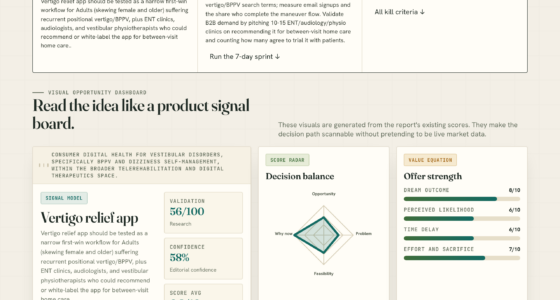

📊 Full opportunity report: DeepSeek-V4-Flash-High’s Ninth Point: The Future Of Affordable AI Validation on ThorstenMeyerAI.com — validation score, market gap, and execution plan.

Get the latest gadgets delivered free — and shop member deals
- Fast, free delivery on millions of items
- Access to Prime Big Deal Days deals on October 6–7
- Prime Video, Amazon Music and more included
TL;DR
DeepSeek-V4-Flash-High has shown significant performance gains through post-training adjustments, maintaining the same cost and architecture. This shift suggests a new, cost-effective approach to AI model validation, impacting AI development strategies.
DeepSeek-V4-Flash-High has demonstrated a 145-point increase in its Arena score following a post-training update, despite unchanged architecture and cost, marking a significant development in AI model validation. This update, announced on 31 July 2026, underscores the growing importance of post-training tuning as an affordable method to enhance AI capabilities, especially under MIT licensing conditions.
The update to DeepSeek-V4-Flash-High involved a re-post-training process that improved its Arena rating from 1432 to 1577 points, a gain of approximately 145 points. This occurred without altering the model’s architecture, parameters, or price, which remains at $0.25 per million tokens, and with no change to the context window size. The update supports native OpenAI Responses API compatibility and Codex-style coding, indicating a focus on practical deployment enhancements.
According to official sources, the post-training process leverages the same architecture and weights, but applies additional tuning, resulting in performance improvements. The move is notable because it challenges the common assumption that capability jumps require new models or architectures. Instead, it highlights the potential of post-training adjustments as a cost-effective way to improve AI performance, especially when models are licensed under MIT, allowing unrestricted commercial use and modification.
An MIT-licensed mixture-of-experts sits nine points behind the second-best model on the board at roughly one fifteenth of its price — and 128 points behind the leader at roughly one eighty-second. The rating is one day old and marked preliminary. The shape of the curve is the story anyway.
▲ Preliminary rating · ±18 · 1,319 of 510,194 votesSix models nothing else beats on both score and price at once. The horizontal axis is logarithmic — every gridline is roughly a tenfold price increase.
Both checkpoints sit on the board simultaneously — a rare clean record of what re-post-training alone is worth on frozen weights at a frozen price.
- Original public release
- Chat Completions API
- Re-post-trained for agentic work
- Native Responses API, Codex-adapted
- MIT weights on Hugging Face, DSpark module attached
Arena reports a conservative rating — mu minus three sigma — and the row is one day old. The bias cuts both ways.
Nothing here should be read as a settled ranking. The durable claim is narrower: at the price actually published, a model of this class being on the frontier at all is the fact worth recording.
A 284B MoE with 13B active, expert weights in FP4, is approximately the shape of model that already runs on high-memory Apple silicon.
- MIT means MIT. Commercial use, modification, redistribution — no bespoke licence to interpret, no acceptable-use policy to monitor.
- Runnable in principle. FP4 experts and 13B-active sparsity put per-token compute near a mid-size dense model, within reach of a 512GB unified-memory machine.
- Post-training is the cheap lever. +145 points on frozen weights signals more gains of this kind, from every open-weight lab.
- Vendor benchmarks are vendor benchmarks. Terminal-Bench, Cybergym and DeepSWE numbers come from DeepSeek’s own harness; agent scores are harness-sensitive.
- One task family. Frontend code voting is not a general capability measure, and sub-boards disagree with the Overall board.
- Self-hosting buys sovereignty, not savings. At $0.25 per million blended, the hosted API undercuts your own electricity and depreciation for most workloads.
For the first time, the model asking the question carries an MIT licence.
Implications of Post-Training Improvements for AI Validation
This development signifies a potential shift in how AI models are validated and improved. The ability to enhance model performance through post-training tuning, without additional parameters or costs, could reduce barriers for smaller labs and organizations aiming to deploy high-performing models affordably. It also emphasizes that the real constraint in AI capability may increasingly lie in post-training processes rather than in the initial training or model size, which could democratize advanced AI development.
As an affiliate, we earn on qualifying purchases.
Background on DeepSeek-V4-Flash-High and Recent Updates
DeepSeek-V4-Flash-High was initially released on 24 April 2026, as part of the V4-Flash series, a sparse mixture-of-experts model with 284 billion parameters. Its API pricing remains at $0.14 per million input tokens and $0.28 per million output tokens. On 31 July 2026, a post-training update was released, improving its Arena rating significantly without any change to the model's core architecture or parameters. This update was accompanied by the release of the weights on Hugging Face and added support for OpenAI-compatible APIs, indicating a focus on practical usability.
Prior to this, improvements in AI performance were often linked to new models or larger architectures, with costs rising accordingly. The recent performance jump suggests that post-training techniques can serve as a low-cost alternative to achieve substantial capability gains, challenging existing development paradigms.
"The 145-point increase through post-training alone indicates that the real frontier in AI capability may be in how we tune models after pre-training, not just in the size or architecture."
— Thorsten Meyer, AI researcher
As an affiliate, we earn on qualifying purchases.
Uncertainties Surrounding Post-Training Performance Gains
It remains unclear how sustainable these post-training improvements are over time and whether they generalize across different tasks or only specific benchmarks. The current rating is preliminary, with a stated uncertainty of ±18 points, and the rating could shift as more votes are collected. The long-term impact of such tuning on model robustness and reliability is also not yet established, and further validation is needed.
affordable AI performance enhancement
As an affiliate, we earn on qualifying purchases.
As an affiliate, we earn on qualifying purchases.
Next Steps for Validating and Applying Post-Training Enhancements
Further testing across diverse tasks and benchmarks will be necessary to confirm the robustness of post-training improvements. Developers may explore applying similar tuning techniques to other models, and the AI community will likely examine the limits of post-training adjustments. Monitoring updates from Arena and other leaderboard platforms will provide additional insights into how widespread and effective this approach can become.
As an affiliate, we earn on qualifying purchases.
Key Questions
Does the performance increase require retraining from scratch?
No, the improvement was achieved through post-training tuning, without retraining or changing the model architecture.
Will this approach work for all AI models?
It is not yet clear if all models can benefit similarly; current evidence suggests it works well for DeepSeek-V4-Flash-High, but broader validation is ongoing.
What are the licensing implications of this update?
The model's weights are licensed under MIT, allowing unrestricted commercial use, modification, and redistribution, facilitating broader adoption of post-training tuning techniques.
How does this affect AI development costs?
This approach could significantly reduce costs by enabling performance improvements without additional training or larger architectures, making advanced AI more accessible.
Source: ThorstenMeyerAI.com
Fall Picks
fall essentials
As an affiliate, we earn on qualifying purchases.