📊 Full opportunity report: Backyard ADUs: Real Estate Context And Construction Choices on IdeaNavigator AI — validation score, market gap, and execution plan.

Get the latest gadgets delivered free — and shop member deals
- Fast, free delivery on millions of items
- Access to Prime Big Deal Days deals on October 6–7
- Prime Video, Amazon Music and more included
TL;DR
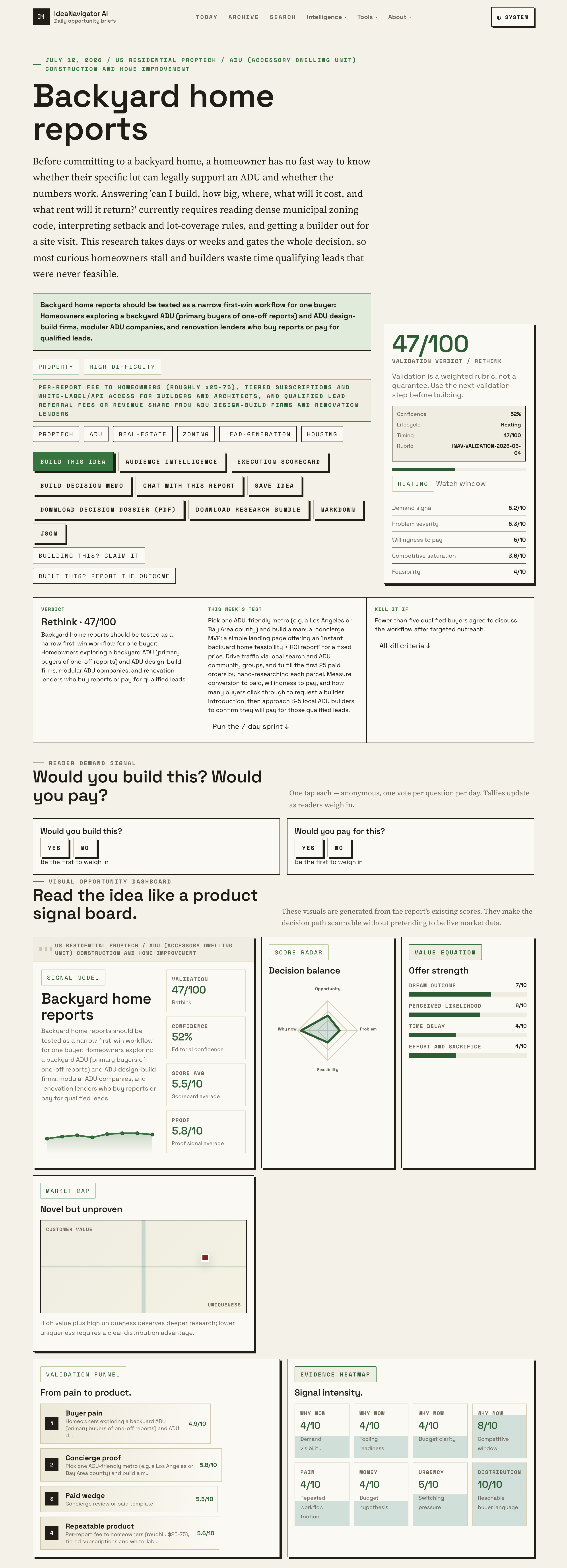
A proposal for paid backyard ADU feasibility reports would give homeowners address-specific estimates of local rules, potential building area, construction costs and rental income. The concept has not been shown to be a launched service or a validated business; its first test would involve manually researching 25 paid orders in one metro area.
IdeaNavigator AI has outlined a proposed service that would sell homeowners a paid report estimating whether their property could support a backyard accessory dwelling unit, or ADU, and what the project might cost and earn. The concept targets a time-consuming early decision in home construction, but no operating product, customer results or builder commitments are reported.
The proposed web app would let a homeowner enter a property address and receive a property-specific PDF. The report would draw on county parcel data, including lot boundaries, lot size and existing building footprint, then compare the property with state ADU law and a curated set of local zoning rules. Planned estimates include permitted ADU types, maximum size, setbacks, lot coverage and a potential buildable area.
The report could also give a construction cost range and projected rental income based on nearby rent comparisons. The proposal suggests charging homeowners about $25 to $75 per report. Potential additional revenue includes subscriptions or white-label and API access for builders and architects, along with referral fees or revenue sharing from ADU firms and renovation lenders.
The suggested first step is deliberately local: choose one ADU-friendly metro, manually research zoning rules, and fulfill the first 25 paid orders as a concierge service. The team would track purchases and requests for builder introductions, then ask three to five local builders whether they would pay for qualified leads. No results from that proposed test are available.
A Faster First Check for Homeowners
An address-specific estimate could help a homeowner decide whether to spend time and money on a site visit, design work or permit application. The concept addresses a practical gap: answering “Can I build, how big, and at what cost?” can require reading local rules and arranging professional review. A preliminary report could help homeowners identify questions earlier and give builders a more informed starting point.
For construction firms and lenders, a report that screens properties could reduce time spent on inquiries that do not fit a site’s constraints. But its value depends on reliable local data and clear limits. A zoning-based estimate is not a permit decision, construction quote or guarantee of rental income. Errors in parcel records, code interpretation or cost assumptions could lead users to overestimate what is feasible.
The business case is also unproven. The proposed price range and revenue channels are hypotheses, and the plan itself calls for testing whether homeowners will pay and whether builders will buy introductions. Until those tests are completed, the idea describes a possible service and market need rather than demonstrated demand or commercial traction.
Rules Vary Across Local Markets
ADUs are secondary homes on residential properties, often located in a backyard or created within an existing home. The proposal points to California’s statewide legalization of ADUs beginning in 2016 and subsequent rule changes as part of the market’s development. It says other states and cities are also following, while emphasizing that the rules homeowners face depend on their location.
As evidence of activity, the proposal cites more than 45,000 ADUs permitted in Los Angeles County in 2023 and says ADUs account for roughly one in five new housing units produced in California. Those figures are presented as part of the proposal’s market rationale; no underlying dataset or calculation details are supplied here. The concept also points to a US housing shortage estimated in the millions, but does not specify an estimate, date or methodology.
The proposed technology combines parcel records with a manually curated local rule set, with language models potentially helping parse codes. Its stated approach does not assume that software can reliably interpret every jurisdiction from the outset. Instead, it recommends launching in a limited area, such as a few California counties, and checking the first reports by hand.
Accuracy and Demand Still Untested
No product launch, completed feasibility reports, customer interviews, paid conversions or builder agreements are described. It is unclear which metro would be chosen, how the proposed report would handle conflicting or recently changed rules, or how often its local data would be refreshed. The proposal also does not provide a method for calculating construction cost bands or rental projections, or explain how those estimates would account for site conditions and project-specific choices.
The distinction between an early screening estimate and an official determination would matter to buyers. A report could flag likely constraints, but the available description does not establish that it could replace planning department guidance, professional design or a builder’s inspection. The cited permitting and housing figures also lack methodological detail in the proposal, so their precise comparison basis cannot be assessed here.
A 25-Order Pilot Would Test Interest
The proposed next milestone is a manual pilot in one metro area, promoted through local search and ADU community groups. The operator would offer a fixed-price report, research each of the first 25 properties by hand and record whether customers pay and ask to meet a builder. It would then approach three to five local ADU firms to test whether qualified introductions have value to them.
Those results could show whether homeowners will pay for an early feasibility screen and whether local firms see a useful source of leads. Until the pilot is run and its results are reported, the proposal’s central questions—accuracy, willingness to pay and builder demand—remain open.
Source: IdeaNavigator AI
Key Questions
Is the backyard ADU report service available now?
The described service is a proposal. No launch date or available product is reported.
What would a report estimate?
It would estimate local ADU rules, possible building size and area, construction costs and rental income for a specific property.
Would the report confirm that a homeowner can build?
No such guarantee is established. The proposal describes an early estimate based on parcel data and curated rules, not an official permit decision or site inspection.
How would the idea be tested?
The proposed pilot would manually research 25 paid orders in one metro, measure purchases and builder-introduction requests, and ask three to five local firms whether they would pay for qualified leads.
Source: IdeaNavigator AI
Fall Picks
fall essentials
As an affiliate, we earn on qualifying purchases.