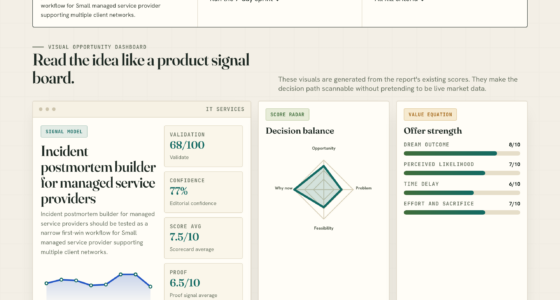

📊 Full opportunity report: Are Undetected Market Moves Threatening AI Tokens? on ThorstenMeyerAI.com — validation score, market gap, and execution plan.
TL;DR
Recent declines in AI tokens appear to be driven by market mispricing and unseen demand in open-source and private labs. The fundamental demand for AI compute remains strong, but the market struggles to measure it accurately.
AI tokens have experienced a significant sell-off, dropping 40 to 60 percent from their recent highs, despite evidence of accelerating fundamental demand in AI compute and open-source developments, according to industry expert Thorsten Meyer.
This divergence suggests that the market is mispricing the underlying activity in the AI economy. The decline is primarily driven by a shift in where value is created and consumed, especially in open-source inference models and private frontier labs, which are not reflected in public market data.
Thorsten Meyer emphasizes that a token’s cost is largely independent of whether it originates from a frontier or open-weight model. When open-source models take share, demand for compute does not decrease; instead, margins shift from high-cost, oligopolistic providers to infrastructure layers, making tokens cheaper and more widely used. This results in increased total token consumption, contrary to market fears of demand destruction.
The speculative AI names fell 40–60% from their highs in a month. Every fundamental I can measure accelerated in the same weeks. My view: the market is selling a layer of the stack it was never able to see — and panicking about the two risks that matter least.
▲ Opinion & analysis · not investment adviceOpen source taking share spooked the market as demand destruction. That’s backwards. Producing a token costs the same compute whoever emits it — so open weights don’t destroy demand, they move margin and grow the pie.
The acceleration is happening where public equities have almost no telemetry. You infer the layer from its gravitational pull on the gauges you can read.
- A handful of listed hyperscalers
- The chipmakers
- Quarterly filings, weeks late
- Private frontier labs
- Open-source inference clouds monetizing served tokens
- Its pull: GPU scarcity, rising rents, memory spot, token growth — none on a balance sheet
The two things everyone panicked about are the two I worry about least. The risks worth respecting are quieter.
For the buildout to pay for itself, trillions in new operating cash flow must appear. It can come from exactly two places.
The truth, as usual, is still getting its boots on.
The current market decline does not reflect a fundamental slowdown in AI development but highlights a disconnect: the most dynamic growth is happening in private labs and open-source inference clouds, which are invisible in public data. Recognizing this 'dark matter' of the AI economy is vital for investors and industry stakeholders to understand the true demand trajectory and avoid misinterpreting market signals.

Intel NCS2 Movidius Neural Compute Stick 2, Perfect for Deep Neural Network Applications (DNN)
- Processor: Intel Movidius Myriad X VPU
- Supported Frameworks: TensorFlow and Caffe
- Connectivity: USB 3.0 Type-A
As an affiliate, we earn on qualifying purchases.
As an affiliate, we earn on qualifying purchases.
Unseen Growth in Private and Open-Source AI Markets
Over recent months, AI tokens have sharply declined, yet fundamental indicators such as GPU availability, rental prices, and token growth suggest robust activity. The rapid adoption of open-source models and multi-model routing, which improve efficiency and reduce costs, are central to this unseen expansion. These shifts are not captured in traditional financial metrics, leading to mispricing and market volatility.
"The demand for compute is not falling; it's shifting margins and increasing total consumption through cheaper tokens and orchestration."
— Thorsten Meyer

LOCAL LLM DEPLOYMENT: Training, Fine-Tuning, & Offline Inference: The Complete Developer’s Guide to Building, Training, and Running Private Open-Source AI Offline (with full source code)
As an affiliate, we earn on qualifying purchases.
As an affiliate, we earn on qualifying purchases.
Unmeasured Demand and Market Mispricing
While the analysis suggests that fundamental demand remains strong, the precise scale of activity in private labs and open inference clouds is unknown. No direct data currently captures this growth, and the market's perception may continue to lag or misinterpret these signals.
As an affiliate, we earn on qualifying purchases.
Monitoring Private Market Activity and Token Dynamics
Investors and industry observers should focus on indirect indicators such as GPU prices, cloud rental rates, and token consumption patterns. Future developments may include better transparency from private labs or new metrics to measure open-source AI activity, which could realign market perceptions.
As an affiliate, we earn on qualifying purchases.
Key Questions
Why are AI tokens declining despite strong fundamental demand?
The decline is mainly due to market mispricing caused by unmeasured activity in private labs and open-source inference clouds, where demand is shifting margins rather than shrinking.
What does open-source AI development mean for the market?
Open-source AI models are increasing total compute usage and lowering token costs, which can boost overall demand but are not yet reflected in public market data.
Is this market decline a sign of a slowdown in AI innovation?
No, the fundamental activity appears to be accelerating; the decline reflects a misperception based on limited visibility into private and open-source sectors.
How can investors better gauge true AI demand?
By monitoring indirect signals such as GPU prices, cloud rental rates, and token consumption trends, which hint at underlying activity outside public disclosures.
What are the risks of relying on public market data alone?
Public data may miss significant activity in private labs and open-source sectors, leading to misjudgments about the health and growth of the AI economy.
Source: ThorstenMeyerAI.com