📊 Full opportunity report: Relationship-Focused Sales Success Starts With Pre-Call Memory Cards on IdeaNavigator AI — validation score, market gap, and execution plan.

Get the latest gadgets delivered free with Prime
- Fast, free delivery on millions of items
- Prime Video, Amazon Music and more included
- Member-only deals all year
TL;DR
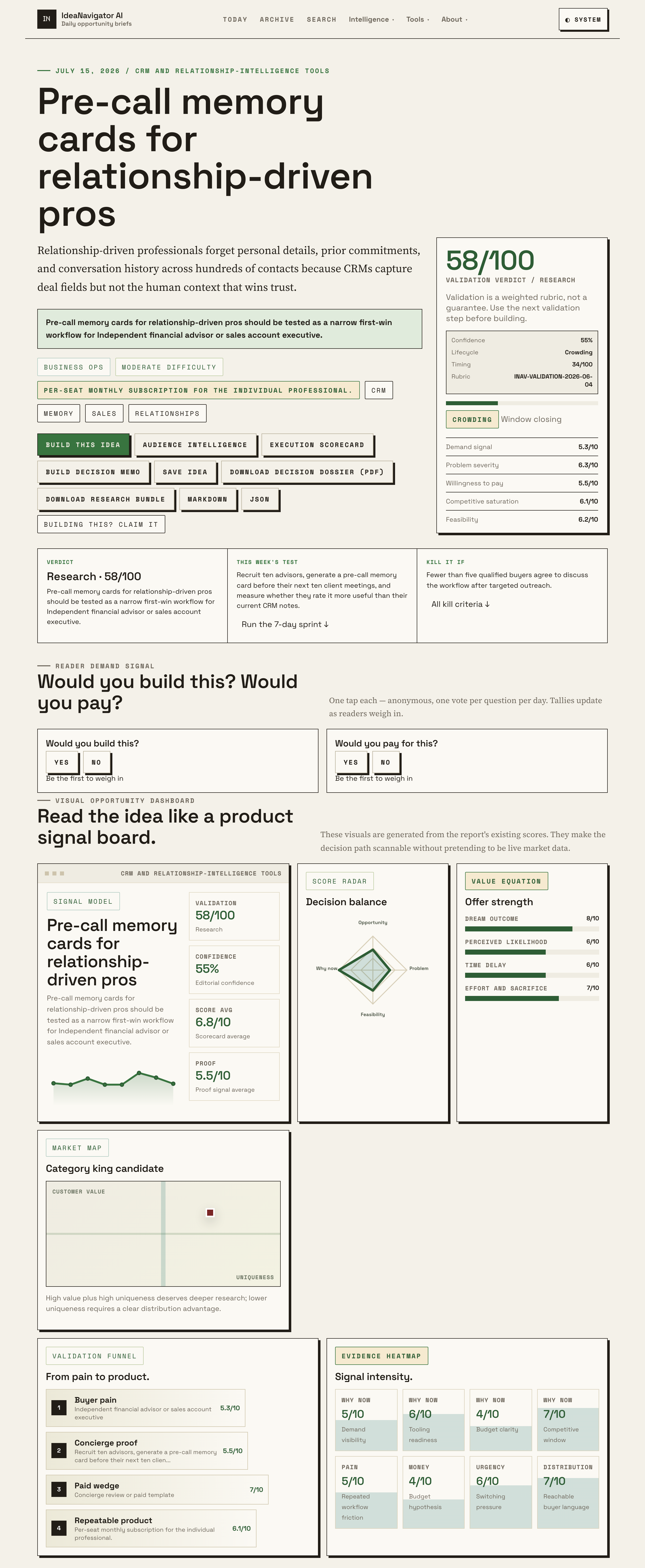
Pre-call memory cards are being tested as a new workflow for relationship-driven sales professionals, aiming to enhance client trust by better recalling personal details and conversation history. Early validation involves advisors generating these cards before client meetings to measure usefulness.
Pre-call memory cards for relationship-driven professionals are being tested as a targeted workflow to improve client interactions by capturing essential personal details and conversation history. This development is significant for independent financial advisors and sales account executives seeking to strengthen trust and recall during client meetings, especially as traditional CRMs lack the human context that fosters relationships.
The concept involves generating a one-page pre-call brief that consolidates a client’s past emails, notes, and commitments, providing the professional with a quick, searchable snapshot of who the client is and what was last discussed. This approach leverages recent advances in large-language-model summarization, making it feasible to distill lengthy conversation histories into concise, durable memory aids.
Early validation plans include recruiting ten advisors to generate pre-call memory cards before their next ten client meetings. The goal is to assess whether these cards improve the advisors’ perception of meeting quality and relationship depth compared to their current CRM notes. The subscription-based model targets individual professionals within the CRM and relationship intelligence market.
Potential Impact on Relationship-Driven Sales Effectiveness
If successful, pre-call memory cards could significantly enhance how professionals manage client relationships by reducing forgetfulness of personal details and open commitments. This could lead to increased trust, better client retention, and more personalized service. The approach addresses a known gap in traditional CRMs, which often focus on deal fields but overlook the human context that builds rapport. As AI summarization becomes more affordable and accurate, integrating these tools into daily workflows could transform relationship management across various sectors.
As an affiliate, we earn on qualifying purchases.
Emergence of AI Tools in Relationship Management
Recent advances in large-language models have made it possible to automatically summarize lengthy conversation histories and emails into concise, searchable notes. This technological development comes amid a broader trend of integrating AI into CRM and relationship intelligence tools, aiming to help professionals recall key details without manual note-taking. The idea of pre-call memory cards builds on this trend, offering a practical application to improve client interactions.
Prior to this, CRMs primarily captured deal-specific data, often neglecting the nuanced human elements that influence trust and loyalty. Early testing of memory cards reflects a shift towards more personalized, context-aware relationship management, which is increasingly seen as a competitive advantage in fields like finance and sales.
“Using AI to generate pre-call summaries could redefine how professionals prepare for client meetings, making interactions more meaningful and personalized.”
— an anonymous researcher
As an affiliate, we earn on qualifying purchases.
Unclear Effectiveness and Adoption Challenges
It remains uncertain how significantly pre-call memory cards will improve client trust or sales outcomes, as validation is still in early stages. The actual usefulness of these cards depends on their accuracy, ease of use, and integration into existing workflows. Adoption hurdles, such as resistance from professionals or technical limitations, are also yet to be fully understood.
As an affiliate, we earn on qualifying purchases.
Next Steps in Testing and Validation
The initial testing phase involves recruiting ten advisors to generate and use pre-call memory cards over their next ten meetings. Results will assess perceived usefulness and impact on relationship quality. If positive, broader deployment and refinement will follow, potentially leading to wider adoption across relationship-driven sectors.
client conversation history summarizer
As an affiliate, we earn on qualifying purchases.
As an affiliate, we earn on qualifying purchases.
Key Questions
How do pre-call memory cards differ from traditional CRM notes?
Pre-call memory cards are concise, AI-generated summaries focused on personal details and open threads, designed to be quickly reviewed before meetings. Traditional CRM notes often lack this streamlined, human-centric context.
What technology underpins the creation of these memory cards?
Large-language-model summarization tools are used to distill lengthy email and note histories into brief, searchable memory aids.
Who can benefit most from using pre-call memory cards?
Relationship-driven professionals such as independent financial advisors, sales account executives, and client managers seeking to improve trust and recall in client interactions.
Are there any risks or downsides to using AI-generated memory cards?
Potential risks include inaccuracies in summaries, over-reliance on AI at the expense of personal intuition, and resistance to adopting new workflows. These issues are being evaluated during initial testing.
When will this workflow be widely available?
Widespread adoption depends on the results of early validation. If successful, broader rollout could occur within the next year, with iterative improvements based on user feedback.
Source: IdeaNavigator AI
Halloween Picks
halloween
As an affiliate, we earn on qualifying purchases.