
🔍 Read the full analysis: AI For Kelp Restoration: What Google And CSIRO Have Shown In Tasmania on ThorstenMeyerAI.com

Get the latest gadgets delivered free with Prime
- Fast, free delivery on millions of items
- Prime Video, Amazon Music and more included
- Member-only deals all year
TL;DR
Google says a kelp-trained version of its DeepVariant tool helped CSIRO analyze DNA from 600 wild giant kelp specimens collected at 40 Tasmanian coastal sites. Two Australian reference genomes underpin the work and were published in peer-reviewed research, but the sample analysis has not yet been published, and whether selectively bred kelp can withstand warmer seas remains untested.
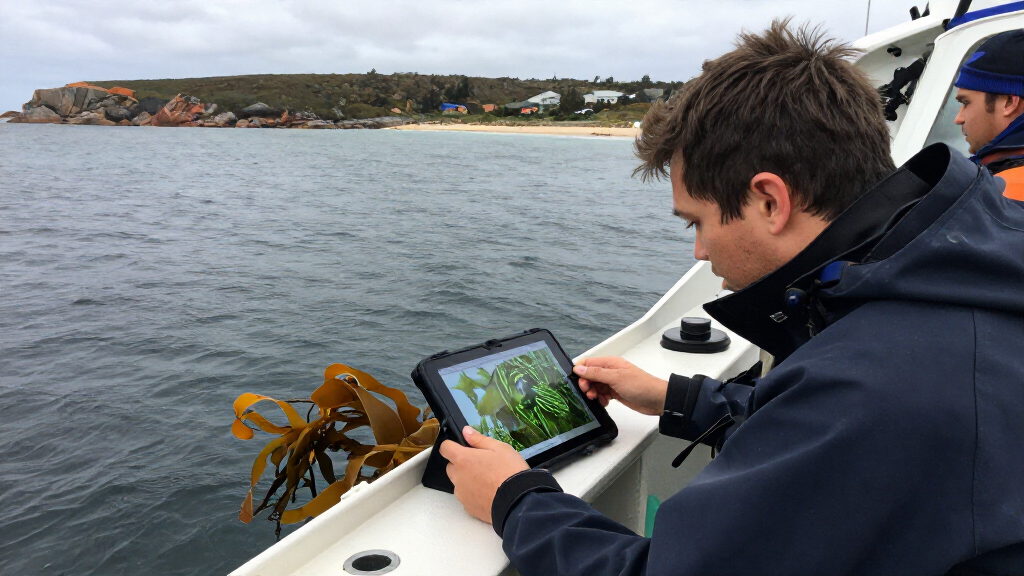
Google says CSIRO used a kelp-trained version of its DeepVariant AI tool to analyze DNA from 600 wild giant kelp specimens collected at 40 sites along Tasmania’s coast. The announcement describes a potential aid to selective breeding, as the region’s kelp forests have declined sharply, but the 600-sample findings have not yet been presented in a paper or dataset identified in the available source material, and the kelp’s survival in warmer seas has not been tested.
The work builds on two Australian giant kelp reference genomes published in BMC Genomics in June 2026. CSIRO researchers and a Google researcher are among the paper’s authors, and the genome data is public. The study assembled genomes from specimens collected in Victoria and Tasmania, providing a local comparison point instead of relying only on the previously available Californian reference.
The paper reports that the two Australian genomes differ from one another by 0.2% and from the Californian genome by 1.5%. It placed 98–99% of each genome into 35 pseudo-chromosomes. Google’s accompanying video says DeepConsensus and DeepPolisher helped correct errors in raw genetic reads. The published genome research is distinct from Google’s later account of analyzing the 600 wild specimens.
According to Google’s November 12 post and video, researchers adapted DeepVariant, whose standard models are trained on human data, to analyze the kelp samples. Google says the analysis found that remaining Tasmanian patches are genetically isolated. The project’s stated next research step is to cross genetically distinct native survivors in the lab and grow young kelp for planting on reefs. This is selective breeding, not genetic modification.
Giant kelp · Tasmania · CSIRO with Google AI
From the reef to the lab and back: where the AI fits
Five steps, as described by CSIRO and Google. The AI works in steps 2 and 3; people do the diving, the lab work and the planting.
1Reef
Collect wild kelp
600 wild specimens from 40 sites along the Tasmanian coast, according to Google.
2Lab + AI
Build a local reference
Long-read DNA plus Google’s DeepConsensus and DeepPolisher: two Australian reference genomes, published in BMC Genomics.
AI step3AI
Read each plant
A version of DeepVariant trained for kelp finds where each specimen’s DNA differs.
AI step4Lab
Choose and cross
Distinct survivors with genetic variation and heat-tolerant traits are crossed. Selective breeding, not genetic modification.
5Reef
Replant and watch
Young kelp is attached to rocky reef in pilot tests. Warm summers show which plants survive.
Sources: Google blog post, Nov 12, 2026, and Google Research video; Scharfenstein et al., BMC Genomics, 2026; CSIRO, 2024, and CSIRO on Google Arts & Culture. The scene is a schematic, not a map or real data.
Graphic: Powered by Thorsten Meyer AI
A Genetic Tool for Kelp Recovery
The project addresses a conservation problem with both ecological and practical stakes. Giant kelp forests have declined by about 95% around Tasmania, according to CSIRO, and provide habitat for marine life including fish, octopuses, sea stars and sea lions. CSIRO says the East Australian Current has carried warmer, nutrient-poor water and sea urchins farther south, adding pressure to the forests.
AI’s role here is specific: it helps researchers interpret genetic variation, not restore the habitat directly or establish that a plant will tolerate heat. If the reported genetic differences can guide breeding, scientists may be able to select crosses from surviving native kelp for further tests. That could inform restoration planning, but the project has not shown that such crosses will survive in the ocean or reverse the broader environmental pressures.
The work also illustrates why a species-specific reference genome matters. The published study found a larger difference between Australian and Californian giant kelp genomes than between the two Australian specimens. A locally relevant reference may give researchers a better basis for comparing Australian samples, while the AI analysis could help extend that comparison across many wild plants.
Products Worth Considering

DJI Mini 3 Drone with DJI RC and 3‑Axis Mechanical Gimbal

Apple MacBook Air 15-inch Laptop with M5 Chip, 16GB Memory, 512GB SSD, Midnight

Logitech MX Master 4 Ergonomic Wireless Mouse with Haptic Feedback, Graphite
As an affiliate, we earn on qualifying purchases.
From Reference Genomes to Field Tests
Google Australia and CSIRO first announced a broader kelp collaboration in February 2024, with the University of Tasmania’s Institute for Marine and Antarctic Studies, The Nature Conservancy, the Great Southern Reef Foundation and the Kelp Forest Alliance also involved. The original project had two strands: mapping kelp using satellite imagery and developing genomic research. Google’s November update concerns the genomics strand.
The earlier mapping plan proposed using Google Earth Engine and Vertex AI to search more than 7,000 square kilometres of satellite imagery for remaining kelp. The current source material does not provide a completed mapping result. In the genomic work, the reference genomes were built from one Victorian and one Tasmanian plant using long-read DNA sequencing. Their publication supplies a peer-reviewed foundation; the reported analysis of the additional 600 specimens remains, so far, a company-announced result.
CSIRO describes the loss as occurring alongside changes in water conditions and the spread of sea urchins. The source material says warming in the Tasman Sea is twice the global average and notes that giant kelp forest is listed as an endangered marine community type. Those pressures mean genetic selection would be one part of a recovery effort, not a substitute for addressing conditions in the habitat.
“We trained a version of our AI model DeepVariant to analyze our wild samples.”
— Google, in a video accompanying its November 12, 2026 announcement
The 600-Sample Findings Await Publication
The 600-specimen analysis and genetic-isolation finding are reported in Google’s post and video. The source material says no paper or dataset for those results had been identified, so their methods, detailed results and independent review are not yet available there. The peer-reviewed genome paper supports the existence of the two Australian reference genomes, but it should not be treated as independent confirmation of every later claim about the 600 samples.
It is also unknown whether kelp selected through breeding will withstand warmer summers, persist after planting or help restore forest cover at scale. The available material does not give a timetable for reef planting, trial locations, survival targets or results from field tests. Nor does the AI itself measure heat tolerance: researchers conduct laboratory tests and relate those outcomes to genetic data.
Breeding and Reef Trials Ahead
Researchers plan to cross genetically distinct native survivors in laboratory selective-breeding work, then plant young kelp on reefs. The next meaningful evidence will include published methods and results for the reported 600 specimens, followed by findings from laboratory tests and field trials. Those tests will need to show whether selected kelp can survive warm summer conditions in its marine environment.
Until those results are available, the project is best understood as a genetic research effort that may help inform restoration choices. The reference genomes are published and public; the AI-assisted sample analysis and the performance of any bred kelp remain developing parts of the work.
Key Questions
What did Google and CSIRO report?
Google said CSIRO used an adapted version of DeepVariant to analyze DNA from 600 wild giant kelp specimens collected at 40 sites along Tasmania’s coast. Google also reported that the remaining patches are genetically isolated.
What part of the work has been peer reviewed?
Two Australian giant kelp reference genomes were published in BMC Genomics in June 2026. The source material says the later analysis of the 600 specimens has not yet been located in a paper or dataset.
Does the AI test whether kelp can tolerate heat?
No. The AI is used to analyze genetic data. Laboratory tests assess traits such as heat tolerance, and researchers can then relate those test results to genetic variation.
Is the project genetically modifying kelp?
The next step described is selective breeding: crossing distinct native survivors in the lab. The source material does not describe genetic modification.
Has bred kelp survived warmer Tasmanian summers?
That remains unknown. The source material says the decisive test—whether bred kelp survives warmer summers in the sea—has not happened yet.
Source: ThorstenMeyerAI.com