📊 Full opportunity report: Parent Advocacy 101: Rehearsing IEP Negotiations By Simulator on IdeaNavigator AI — validation score, market gap, and execution plan.

Get the latest gadgets delivered free — and shop member deals
- Fast, free delivery on millions of items
- Access to Prime Big Deal Days deals on October 6–7
- Prime Video, Amazon Music and more included
TL;DR
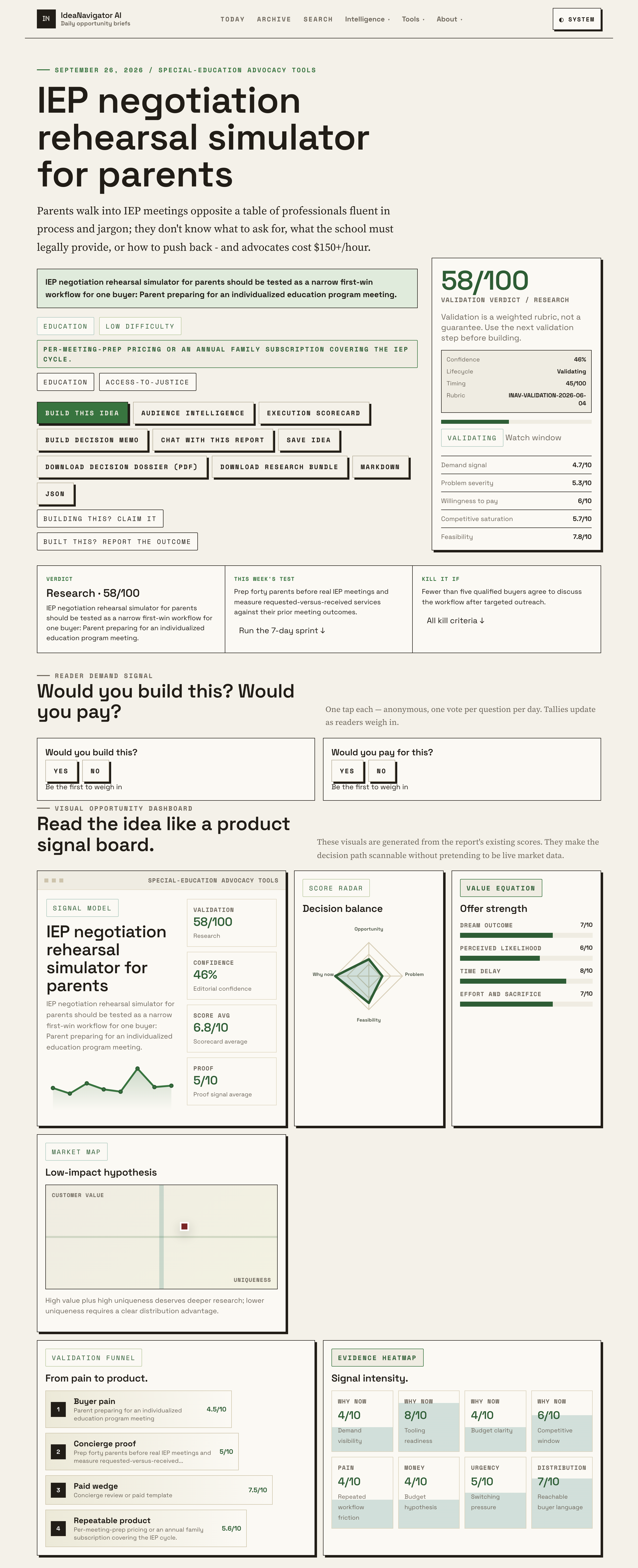
IdeaNavigator AI describes a proposed simulator to help parents prepare for individualized education program meetings by reviewing their documents, generating requests and practicing conversations. The concept has not been reported as a launched product or tested service, and no outcome data are provided.
IdeaNavigator AI has proposed a simulator that would help parents prepare for individualized education program (IEP) meetings by explaining documents, drafting service requests and rehearsing conversations with school staff. The proposal describes an early product concept and a plan to test it with 40 parents; it does not report that the tool has launched or that the test has taken place.
The proposed workflow would let a parent upload a current IEP and evaluation reports. The simulator would then explain the documents in plain language, generate a list of requests with legal grounding, and role-play a meeting that includes realistic pushback. The stated aim is to help parents practice holding their positions before meeting with school staff.
The concept targets a specific user: a parent preparing for an IEP meeting. Its proposal says parents can face professionals familiar with education procedures and terminology, while independent advocates may cost $150 or more per hour. That figure is presented as part of the opportunity case; no survey, location, or pricing source is included.
For an initial validation, the proposal recommends preparing 40 parents before real meetings and comparing the services they request with those they receive, alongside their outcomes in earlier meetings. It does not specify how participants would be recruited, how prior outcomes would be recorded, or what comparison method would be used. Per-meeting preparation fees and an annual family subscription are listed as possible business models, not established prices.
A Practice Tool Before IEP Meetings
If developed and shown to work, a rehearsal tool could give parents a way to organize questions and practice explaining their requests before an IEP meeting. The proposed approach combines document review with role-play, addressing both understanding the plan and responding during a live discussion.
The proposal also raises a practical question about access to preparation support. It identifies advocate fees as a barrier, but provides no evidence that a simulator would replace professional advice, reduce costs, or improve the services students receive. Those outcomes would need to be measured rather than assumed.
The suggested test focuses on the gap between services parents request and services they receive. That could provide an initial measure of meeting outcomes, but it would not by itself show that the simulator caused any change. A useful evaluation would need to account for differences among students, school districts, meeting circumstances and families’ earlier experiences.
Top picks for "parent advocacy rehears"
As an affiliate, we earn on qualifying purchases.
From Product Idea to Pilot
The proposal presents the simulator as a narrow first product for one buyer: a parent preparing for an IEP meeting. It argues that language-model role-play may now be capable of simulating realistic exchanges and points to rising special-education identification rates and tighter district resources as reasons to explore the idea. No data or references accompany those claims in the proposal.
An IEP is a plan for a student receiving special education services. The concept would use a family’s existing education documents as the basis for preparation, then help the parent practice making requests and responding to questions. Its proposed sequence is document upload, plain-language explanation, request generation and meeting rehearsal.
The next step described is validation with parents preparing for actual meetings, rather than a reported product release. The proposal does not identify a developer, a participating district, a schedule, or an existing trial.
Pilot Design and Advice Limits
No product launch, pilot findings or participant feedback are reported. The 40-parent exercise is a suggested validation plan, and the proposal gives no timeline for carrying it out.
It is also unclear how the simulator would support its legal explanations across different jurisdictions, keep uploaded education records private, or handle incomplete or outdated documents. The proposal does not describe how it would prevent inaccurate guidance or tell users when to seek help from a qualified advocate or attorney. Those details matter because a parent’s rights and available services depend on the facts of the student’s case and applicable law.
The proposal’s statements about technology capability, increasing identification rates, district resources and advocate costs are not accompanied by supporting evidence here. They should be treated as the rationale for exploring the idea, not as independently established findings.
Testing With Meeting Outcomes
The next stated milestone is a test preparing 40 parents ahead of real IEP meetings. The proposed measure is whether requested services are received, compared with each participant’s earlier meeting outcomes.
No dates, recruitment plans or evaluation protocol have been announced in the proposal. Any future results would need to explain how outcomes were measured and whether differences could be linked to the simulator. Until a pilot is reported, the concept’s effectiveness, business model and practical safeguards remain open questions.
Key Questions
Has the IEP simulator launched?
No launch is reported. The proposal describes a product concept and a possible test.
What would the proposed tool do?
It would review an uploaded IEP and evaluation reports, explain them in plain language, suggest requests with legal grounding and let parents rehearse a meeting role-play.
Has the simulator been shown to improve meeting outcomes?
No outcome data are provided. The proposal suggests a test with 40 parents but does not say that it has happened.
How might families pay for it?
The proposal lists per-meeting preparation fees and an annual family subscription as possible models. It gives no prices or confirmed subscription plans.
Source: IdeaNavigator AI
Fall Picks
fall essentials
As an affiliate, we earn on qualifying purchases.