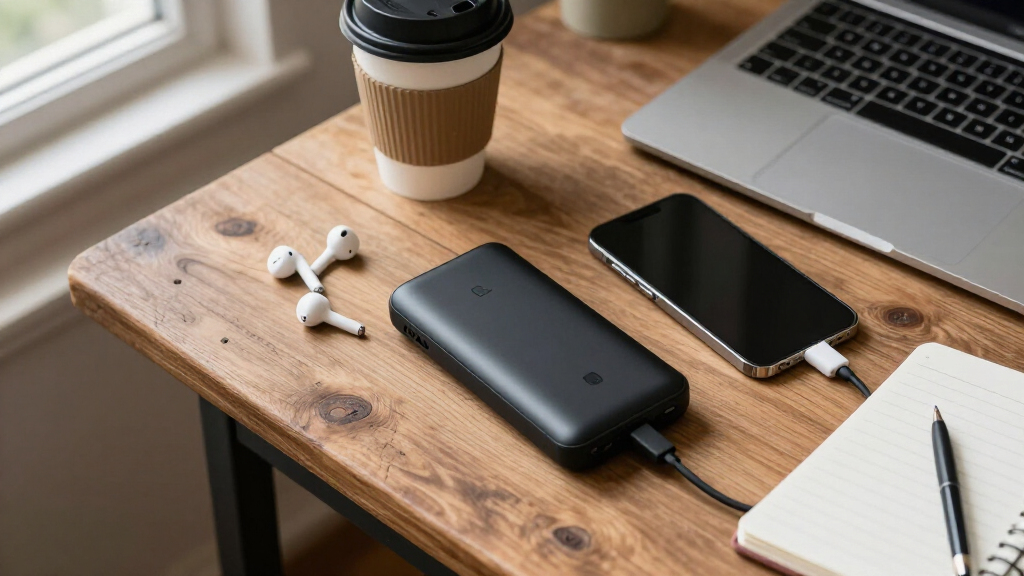

The best portable power bank for most people is the Anker Power Bank 20,000mAh with Built-in USB-C Cable, because it balances capacity, brand reliability, and travel-friendly size without carrying cables separately. If budget rules the decision, the Miady 2-Pack 10000mAh delivers two competent chargers for the price of one, while the Anker Prime 26,250mAh 300W is the pick for laptops and multi-device charging marathons. The core tradeoff in this category is simple: capacity versus pocketability — 10000mAh units slip into a pocket, while 50000mAh and 60000mAh bricks demand a bag and patience when recharging themselves. There’s also a second decision layer this year: whether a power bank is enough, or whether you actually need a small power station like the Jackery Explorer 300 with AC outlets. Read on for the full breakdown of all 15 models and who each one suits best.
Get ready for Prime Big Deal Days — try Prime free
Exclusive member deals on October 6–7, plus fast free delivery. Cancel anytime.
Start your free trialAs an affiliate, we earn on qualifying purchases.
Complete the kit



Key Takeaways
- The 20000mAh Anker with built-in cable beat larger banks because cable integration and reliable output matter more day-to-day than raw capacity.
- The 50000mAh-plus category (OHOVIV, IAPOS, ZZI) is crowded with near-identical specs — built-in wall plugs and cable counts were the only meaningful differentiators.
- Power banks with AC outlets (Daran, Jackery Explorer 300) serve a different buyer entirely: they replace a wall outlet, not a phone charger, and shouldn’t be compared on mAh alone.
- Two-pack budget options like the Miady 10000mAh won on cost-per-charger, but they lack fast charging for tablets and laptops.
- Charging wattage was the biggest hidden differentiator: 45W INIU and 300W Anker Prime can charge laptops, while 22.5W models top out at phones and small tablets.
| Charmast Portable Charger Power Bank with Built-in 4 Cables, 10000mAh |  | Best for Cable-Free Convenience | Battery Capacity: 10000mAh | Built-in Cables: USB-C, USB-A, Micro-USB | Output Ports: 3 | VIEW LATEST PRICE | See Our Full Breakdown |
| Daran Portable Power Station 89.6Wh LiFePO4 Battery 100W Solar Power Bank |  | Best Compact Power Station | Battery Capacity: 89.6Wh | Battery Type: LiFePO4 | Output Power: 100W max | VIEW LATEST PRICE | See Our Full Breakdown |
| Miady 2-Pack Portable Charger 10000mAh Power Bank |  | Best Value Pick | Capacity: 10000mAh per unit | Number of Units: 2 | Ports: 2 USB-A, 1 USB-C | VIEW LATEST PRICE | See Our Full Breakdown |
| Jackery Explorer 300 Portable Power Station, 292Wh |  | Best for Camping and Emergencies | Capacity: 292Wh | Outlets: 2 AC, 1 USB-C PD, 2 USB-A, 1 car port | Battery Chemistry: LiFePO4 | VIEW LATEST PRICE | See Our Full Breakdown |
| OHOVIV Portable Charger Power Bank 50000mAh, PD 22.5W Battery Pack |  | Best High-Capacity Travel Bank | Capacity: 50000mAh | Output Power: 22.5W (PD/QC) | Ports: 2 USB-A, 1 USB-C output, 1 USB-C input | VIEW LATEST PRICE | See Our Full Breakdown |
| IAPOS 60000mAh 22.5W Fast Charge Portable Power Bank |  | Best for Group Travel | Battery Capacity: 60,000mAh | Output Power: 22.5W | Ports: 2 USB-A, 1 USB-C, 3-in-1 cable | VIEW LATEST PRICE | See Our Full Breakdown |
| Anker Power Bank 10,000mAh PowerIQ USB-C Battery Pack |  | Best Slim Everyday Pick | Capacity: 10,000mAh | Ports: USB-C (input/output) | Dimensions: 5.99 × 2.81 × 0.61 inches | VIEW LATEST PRICE | See Our Full Breakdown |
| OHOVIV Portable Charger Power Bank 50000mAh with 4 Built-in Cables | 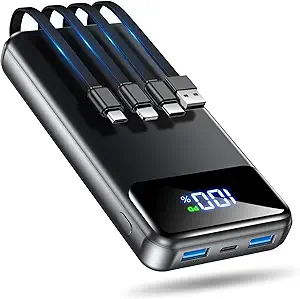 | Best Cable-Free Convenience | Battery Capacity: 50,000mAh | Output Power: 22.5W | Ports: 3 (USB-A, USB-C) | VIEW LATEST PRICE | See Our Full Breakdown |
| Anker Power Bank 20,000mAh with Built-in USB-C Cable |  | Best for Laptops | Capacity: 20,000mAh | Power Output: 87W | Built-in Cable: USB-C (bidirectional) | VIEW LATEST PRICE | See Our Full Breakdown |
| Anker Power Bank 10,000mAh 30W with USB-C Portable Charger |  | Best Compact Traveler | Battery Capacity: 10,000mAh | Power Output: 30W | Input: 20W | VIEW LATEST PRICE | See Our Full Breakdown |
| Anker Prime Power Bank, 26,250mAh, 300W Fast Charging |  | Best for Laptop Users | Battery Capacity: 26,250mAh | Total Output Power: 300W | Max Single-Port Output: 140W | VIEW LATEST PRICE | See Our Full Breakdown |
| INIU Portable Charger 20000mAh 22.5W Fast Charging Power Bank |  | Best All-Around Travel Pick | Battery Capacity: 20,000mAh | Output Power: 22.5W fast charging | Ports: 3 (including 2 USB-C) | VIEW LATEST PRICE | See Our Full Breakdown |
| INIU 10000mAh 45W Fast Charging Portable Charger, Compact Travel Power Bank |  | Best Compact Pick | Battery Capacity: 10,000mAh | Output Power: 45W | Size: 40% smaller and 36% lighter than conventional chargers | VIEW LATEST PRICE | See Our Full Breakdown |
| Portable Charger 50000mAh Power Bank with Built-in Cables and Wall Plug |  | Best for Emergency Kits | Capacity: 50,000mAh | Fast Charging Power: 22.5W | Wall Recharge Time: 6 hours | VIEW LATEST PRICE | See Our Full Breakdown |
| ZZI Portable Charger Power Bank 60000mAh, 22.5W PD Fast-Charge Battery Pack |  | Best for Camping Trips | Battery Capacity: 60,000mAh | Output Power: 22.5W PD | Number of Ports: 3 | VIEW LATEST PRICE | See Our Full Breakdown |
| portable power bank | Weight | Dimensions | Battery Capacity |
|---|---|---|---|
| Charmast Portable Charger Powe | 170g | 5.67 x 2.64 x 0.71 inches | 10000mAh |
| Daran Portable Power Station 8 | 2.54 lbs | — | 89.6Wh |
| Miady 2-Pack Portable Charger | 7.68 oz per unit | 5.5 x 2.6 x 0.6 inches | — |
| Jackery Explorer 300 Portable | 7.5 lbs | — | — |
| OHOVIV Portable Charger Power | 613g | 13.4 x 7 x 3.4 cm | — |
| IAPOS 60000mAh 22.5W Fast Char | 15.5 oz | 15 x 7.5 x 2.8 cm | 60,000mAh |
| Anker Power Bank 10,000mAh Pow | 8.6 oz | 5.99 × 2.81 × 0.61 inches | — |
| OHOVIV Portable Charger Power | 390 g | 5.82 x 1.18 x 2.83 inches | 50,000mAh |
| Anker Power Bank 20,000mAh wit | 15.5 oz | 6.2 × 2.9 × 1.0 inches | — |
| Anker Power Bank 10,000mAh 30W | — | 4.32 x 2.58 x 0.98 inches | 10,000mAh |
| Anker Prime Power Bank | — | — | 26,250mAh |
| INIU Portable Charger 20000mAh | 320 g | 4.1 x 2.8 x 1.2 inches | 20,000mAh |
| INIU 10000mAh 45W Fast Chargin | — | — | 10,000mAh |
| Portable Charger 50000mAh Powe | — | — | — |
| ZZI Portable Charger Power Ban | — | 5.8 x 2.9 x 1.1 inches | 60,000mAh |
More Details on Our Top Picks
Charmast Portable Charger Power Bank with Built-in 4 Cables, 10000mAh
Charmast’s 10000mAh power bank solves the most common travel frustration: forgotten cables. With USB-C, USB-A, and Micro-USB cables built right into the chassis, this option makes sense for anyone tired of stuffing loose cords into a carry-on. Compared with the Miady 2-Pack, which requires you to bring your own cables, Charmast trades raw value for grab-and-go simplicity — and it can charge up to six devices at once from a single unit.
The tradeoffs are real, though. At 10,000mAh, it delivers roughly two phone charges, well short of the OHOVIV 50000mAh for multi-day trips. The integrated cables also can’t be replaced if they fray, and fast charging isn’t guaranteed across every port. This pick makes the most sense for short trips and daily commutes where pocketability beats capacity.
Pros:- Built-in cables for USB-C, Micro-USB, and iPhone eliminate loose cords
- Slim 170g body slips into a pocket or bag
- Charges up to six devices simultaneously
- Three recharge options add flexibility
Cons:- Fixed built-in cables will wear out and can’t be swapped
- 10,000mAh capacity is modest for tablets or multi-day use
- Fast charging not confirmed across all ports
Best for: Commuters and short-trip travelers who want one slim charger with no extra cables to carry
Not ideal for: Multi-day off-grid travelers — 10,000mAh runs dry after about two phone charges
- Battery Capacity:10000mAh
- Built-in Cables:USB-C, USB-A, Micro-USB
- Output Ports:3
- Input Ports:3
- Weight:170g
- Dimensions:5.67 x 2.64 x 0.71 inches
- Battery Type:Lithium Polymer
Our verdict“Buy this if you value a single self-contained charger over maximum capacity; skip it for extended off-grid trips.”
Daran Portable Power Station 89.6Wh LiFePO4 Battery 100W Solar Power Bank
The Daran 89.6Wh power station sits in an unusual middle ground: more capable than any phone-charging power bank here, yet far lighter than the Jackery Explorer 300. At just 2.54 pounds with AC outlets and seven total ports, this model is better suited to car campers and van lifers who need to run a laptop, camera, or mini-fridge for an evening without hauling a full-size station.
Its LiFePO4 chemistry rated for 3,500+ cycles means it will outlast cheaper lithium-polymer banks like the Charmast by years. The catch: 89.6Wh is genuinely small — expect one laptop charge plus a few phone top-ups. And while it accepts solar input, the panel costs extra. Compared with the Jackery, you give up two-thirds of the capacity in exchange for a package you can actually carry in a backpack all day.
Pros:- AC outlets plus seven ports in a 2.54-pound package
- LiFePO4 battery rated for 3,500+ charge cycles
- Recharges via wall, USB-C PD, car, or solar
- Silent operation with 12-layer safety protection
Cons:- Solar panel sold separately
- 100W output ceiling limits larger appliances
- Capacity too small for heavy multi-day power needs
Best for: Backpackers and car campers who need AC power for laptops or small devices without the weight of a full power station
Not ideal for: Household backup power — 89.6Wh won’t run appliances or bridge a long outage
- Battery Capacity:89.6Wh
- Battery Type:LiFePO4
- Output Power:100W max
- Ports:7 (including AC outlets)
- Charging Methods:AC wall, USB-C PD, car, solar
- Weight:2.54 lbs
- LED Display:Yes
Our verdict“The right choice when a power bank isn’t enough but a big station is too heavy — just know 89.6Wh disappears fast under real loads.”
Miady 2-Pack Portable Charger 10000mAh Power Bank
Two power banks for the price of one is the entire pitch here, and it’s a good one. The Miady 2-Pack makes the most sense for households or couples: keep one in the car, one in a bag, and nobody fights over a dying phone. Each slim unit offers dual USB-A plus USB-C and can charge three devices at once — matching the Charmast’s versatility without relying on built-in cables that might fray.
The tradeoffs reflect the price. Unlike the INIU 20000mAh, there’s no advertised fast charging, so big phones refill slowly. No Lightning cable ships in the box, which stings for iPhone households. And 10,000mAh per unit means each bank suits a day out, not a weekend away — for that, the OHOVIV 50000mAh covers far more ground, if you accept the weight. As a budget backup strategy, though, redundancy beats capacity.
Pros:- Two complete power banks at a low per-unit price
- Each unit charges up to three devices simultaneously
- Slim 7.68 oz design with bidirectional USB-C
- Wide compatibility with phones, tablets, and laptops
Cons:- No fast-charging support advertised
- No Lightning cable included
- 10,000mAh per unit is limiting for power-hungry devices
Best for: Budget-minded families or couples who want chargers in multiple bags, cars, or emergency kits
Not ideal for: Speed-focused users — no fast charging means modern phones and tablets recharge slowly
- Capacity:10000mAh per unit
- Number of Units:2
- Ports:2 USB-A, 1 USB-C
- Input/Output:USB-C bidirectional
- Weight:7.68 oz per unit
- Dimensions:5.5 x 2.6 x 0.6 inches
Our verdict“The smart buy when you need dependable backup power in more than one place and can live without fast charging.”
Jackery Explorer 300 Portable Power Station, 292Wh
The Explorer 300 is the serious option in this lineup — nearly three times the capacity of the Daran 89.6Wh and built around a LiFePO4 cell rated for over 4,000 charge cycles, which translates to roughly a decade of regular use. With two AC outlets, USB-C PD, dual USB-A, and a car port, this model covers weekend camping, CPAP machines, drone batteries, and short home outages in a way no power bank here can match.
Compared with high-capacity banks like the OHOVIV 50000mAh (about 185Wh), the Jackery costs more but adds real AC outlets and a rugged carry handle. The limitations are predictable: at 7.5 pounds, it’s a car-and-campsite tool, not a pocket companion, and the 300W ceiling rules out kettles or power tools. The solar panel is also extra, though a 100W panel recharges it in under three hours.
Pros:- 292Wh capacity with two AC outlets for real appliances
- LiFePO4 battery rated for 4,000+ cycles
- Fast solar recharge in about 2.8 hours with a 100W panel
- Lightweight for its class with integrated handle
Cons:- Solar panel sold separately
- 300W output limit excludes high-draw appliances
- Heavy and bulky compared with any power bank in this roundup
Best for: Campers, RV owners, and households wanting reliable emergency backup for laptops, medical devices, and small appliances
Not ideal for: Daily commuters and air travelers — at 7.5 lbs with AC outlets, it’s overkill and far too heavy to carry
- Capacity:292Wh
- Outlets:2 AC, 1 USB-C PD, 2 USB-A, 1 car port
- Battery Chemistry:LiFePO4
- Charge Cycles:Over 4,000
- Solar Recharge Time:Approx. 2.8 hours with 100W panel
- Weight:7.5 lbs
Our verdict“If your needs go beyond phones — camping weekends or blackout insurance — this is the capacity and durability worth paying for.”
OHOVIV Portable Charger Power Bank 50000mAh, PD 22.5W Battery Pack
50,000mAh is festival-and-family-trip territory — enough for roughly ten phone charges or several tablet refills from a single pack. This OHOVIV model stands out for pairing that capacity with 22.5W fast charging across multiple ports, so devices actually refill quickly rather than trickling the way they do on the Miady 2-Pack. The smart LED display showing exact remaining percentage is a genuine quality-of-life upgrade over the guesswork four-dot indicators on cheaper banks.
The price for that endurance is weight and rules. At 613g, it’s more than three times the heft of the Charmast, and the 100Wh airline limit means this bank cannot fly — it’s strictly a road-trip and base-camp tool. Compared with the similar IAPOS 60000mAh, this version is lighter, but capacity-hungry buyers should weigh whether the extra 10,000mAh is worth the added bulk.
Pros:- Massive 50000mAh capacity for roughly ten phone charges
- 22.5W fast charging via PD and QC protocols
- Charges three devices simultaneously
- LED display shows precise remaining charge
Cons:- Banned from air travel due to exceeding the 100Wh limit
- Heavy at 613g and bulky for pockets or small bags
- Slow to fully recharge given the large capacity
Best for: Road-trippers, festivalgoers, and families who need many days of device charges far from an outlet
Not ideal for: Air travelers and everyday commuters — it exceeds airline battery limits and weighs over 1.3 lbs
- Capacity:50000mAh
- Output Power:22.5W (PD/QC)
- Ports:2 USB-A, 1 USB-C output, 1 USB-C input
- Input:USB-C 18W
- Weight:613g
- Dimensions:13.4 x 7 x 3.4 cm
- Display:Smart LED percentage display
Our verdict“The clear pick when outlet-free endurance matters more than portability — as long as you’re traveling by car, not plane.”
IAPOS 60000mAh 22.5W Fast Charge Portable Power Bank
This option stands out for sheer endurance: 60,000mAh is enough to keep a family of four topped up across a long weekend without ever touching a wall outlet. Compared with the OHOVIV 50000mAh, it trades built-in cables for a higher cell count and broader protocol support (PD, QC, SCP, FCP, AFC), which matters if your group carries a mix of Android and Apple devices. The digital battery display removes the guesswork of estimating remaining charge across five simultaneous outputs. The catch is portability — at 15.5 oz and 2.8 cm thick, this belongs in a backpack, not a pocket, and it costs noticeably more than slim alternatives like the Anker 10,000mAh PowerIQ. This pick makes the most sense for campers and group travelers who prioritize capacity over weight.
Pros:- Massive 60,000mAh capacity for multiple full charges per device
- Charges up to 5 devices at once with broad protocol support
- Digital display shows exact remaining battery
- Durable, scratch-resistant shell for outdoor use
Cons:- Heavy at 15.5 oz and bulky in a pocket or purse
- Premium price driven by the large cell count
- No built-in cables, so you still carry your own
Best for: Families and camping groups who need to recharge several phones and tablets repeatedly over multiple days
Not ideal for: Daily commuters or anyone who wants a pocketable charger — the weight and thickness make it impractical to carry around town
- Battery Capacity:60,000mAh
- Output Power:22.5W
- Ports:2 USB-A, 1 USB-C, 3-in-1 cable
- Dimensions:15 x 7.5 x 2.8 cm
- Weight:15.5 oz
- Charging Protocols:PD, QC, SCP, FCP, AFC
- Safety Features:Overcharge, short-circuit, temperature regulation
Our verdict“Buy this if you’re powering a group off-grid for days; skip it if you just need a daily top-up.”
Anker Power Bank 10,000mAh PowerIQ USB-C Battery Pack
Where the IAPOS 60000mAh is built for expeditions, this Anker model is built for jacket pockets. At just 0.61 inches thick and 8.6 oz, it slides into a bag without changing its shape, and the drop-resistance certification means it survives the knocks of daily life better than most budget chargers. The tradeoff is obvious: 10,000mAh covers roughly two phone charges, so anyone with a tablet habit will want the Anker 20,000mAh with built-in cable instead. Compared with the Anker 30W 10,000mAh, this one lacks a built-in cable and faster charging speeds, but it undercuts it on price and feels more pocket-friendly. This model is better suited to buyers who value reliability and brand trust over raw specs — and who remember to pack their own USB-C cable.
Pros:- Ultra-slim 0.61-inch profile fits any pocket or bag
- USB-C port handles both input and output
- Drop-resistant certified build quality
- Trusted Anker reliability at an accessible price
Cons:- No fast-charging technology beyond PowerIQ
- Charging cable not included
- Capacity limits it to roughly two phone charges
Best for: Reliability-focused buyers who want a trusted brand for daily phone top-ups in a slim pocketable form
Not ideal for: Tablet or heavy phone users who need multiple full charges — the capacity runs out quickly
- Capacity:10,000mAh
- Ports:USB-C (input/output)
- Dimensions:5.99 × 2.81 × 0.61 inches
- Weight:8.6 oz
- Technology:PowerIQ
- Durability:Drop-resistance certified
Our verdict“The safe, slim choice for everyday phone backups — just don’t expect it to power a tablet-heavy trip.”
OHOVIV Portable Charger Power Bank 50000mAh with 4 Built-in Cables
This model solves the problem every other pick in this roundup ignores: forgetting your cables. With four built-in cables plus three ports, it can feed up to six devices at once with nothing extra to pack — a genuine advantage over the IAPOS 60000mAh, which requires you to bring your own. At 390 g it’s heavy, but the capacity justifies it: over ten smartphone charges per fill. Compared with the Charmast 10,000mAh with built-in cables, this is the long-haul version — same tangle-free philosophy, roughly five times the endurance. The 22.5W output keeps phones charging quickly, though it won’t push a laptop the way the Anker 87W 20,000mAh does. Factor in the missing wall adapter and this pick makes the most sense for cable-losing travelers who charge phones, not laptops.
Pros:- Four built-in cables eliminate the need to pack accessories
- 50,000mAh capacity delivers over ten phone charges
- Charges up to 6 devices simultaneously
- Digital display tracks remaining battery
Cons:- Heavy at 390 g for pocket carry
- Wall charger block not included
- Only 3 output ports despite 6-device claim via built-in cables
Best for: Travelers who constantly misplace cables and want one self-contained charger for the whole family’s phones
Not ideal for: Laptop users — 22.5W output can’t meaningfully charge higher-power devices
- Battery Capacity:50,000mAh
- Output Power:22.5W
- Ports:3 (USB-A, USB-C)
- Built-in Cables:4
- Battery Cell Type:Lithium Polymer
- Dimensions:5.82 x 1.18 x 2.83 inches
- Weight:390 g
Our verdict“The most self-contained option here — ideal if your packing style is ‘grab one thing and go.’”
Anker Power Bank 20,000mAh with Built-in USB-C Cable
87W of output is what separates this charger from everything else in the mid-capacity tier — it can genuinely top up a USB-C laptop, something the IAPOS and OHOVIV big-capacity banks simply can’t do despite their larger cells. The built-in USB-C cable doubles as the recharging input, so there’s nothing to lose, and the 20,000mAh capacity stays airline approved, making it a natural companion for business trips where a wall outlet isn’t guaranteed. The tradeoff is singular ports: unlike the OHOVIV’s six-device setup, this charges essentially one or two devices at a time, and 87W won’t satisfy gaming laptops that pull 100W+. Compared with the Anker 10,000mAh PowerIQ, this is the grown-up version — heavier, pricier, but capable of keeping a MacBook alive.
Pros:- 87W output fast-charges laptops, not just phones
- Built-in USB-C cable doubles as recharge input
- Airline-approved capacity for carry-on travel
- 20,000mAh balances endurance and size
Cons:- Limited ports for charging multiple devices at once
- 87W ceiling insufficient for power-hungry laptops
- 15.5 oz is heavy for the capacity class
Best for: Business travelers and students who need to keep a USB-C laptop charged away from outlets
Not ideal for: High-power laptop owners — 87W falls short of gaming machines that demand 100W or more
- Capacity:20,000mAh
- Power Output:87W
- Built-in Cable:USB-C (bidirectional)
- Dimensions:6.2 × 2.9 × 1.0 inches
- Weight:15.5 oz
- Travel Approval:Airline approved
Our verdict“The pick for anyone whose laptop, not just phone, needs to survive a travel day.”
Anker Power Bank 10,000mAh 30W with USB-C Portable Charger
This model occupies the sweet spot between the two other Anker picks: faster than the 10,000mAh PowerIQ thanks to 30W output, yet far lighter than the 87W 20,000mAh laptop charger at a similar size to a deck of cards. The built-in USB-C cable and bi-directional fast charging mean the bank itself refills quickly too — an underrated benefit when you’re rotating between hotel stays. Three ports give it more flexibility than the single-port PowerIQ model, though 10,000mAh still means roughly two phone charges before it needs its own refill. This option stands out for anyone whose trips are measured in hours rather than days. There’s no wireless charging here, so Qi-dependent buyers should look elsewhere in the roundup instead.
Pros:- 30W fast charging refills phones quickly
- Built-in USB-C cable means one less thing to pack
- Bi-directional fast charging recharges the bank itself fast
- Three ports offer more flexibility than single-port rivals
Cons:- 10,000mAh limits it to about two phone charges
- No wireless charging support
- Older devices may need separate cables
Best for: Weekend travelers and commuters who want fast phone charging without carrying extra cables
Not ideal for: Multi-day off-grid trips — two phone charges won’t last, so a larger bank is the better tool
- Battery Capacity:10,000mAh
- Power Output:30W
- Input:20W
- Number of Ports:3
- Built-in Cable:USB-C
- Battery Type:Lithium Polymer
- Dimensions:4.32 x 2.58 x 0.98 inches
Our verdict“The best balance of speed, size, and self-contained cables for short trips and daily commutes.”
Anker Prime Power Bank, 26,250mAh, 300W Fast Charging
Most power banks in this roundup exist to top off phones; the Anker Prime is built around a different job entirely — keeping a laptop alive away from an outlet. With 300W total output and single-port speeds up to 140W, it charges full-size notebooks at near wall-outlet pace, something the INIU 20000mAh simply cannot do with its 22.5W ceiling. The standout trick is 250W dual-input recharging: the bank itself goes from empty to 80% in about 39 minutes, so you spend less time babysitting the charger and more time working. App control adds granular output management that cheaper options like the ZZI 60000mAh don’t offer. The tradeoff is complexity and likely weight — this is a tech-forward brick for a briefcase, not a pocket.
Pros:- Up to 140W single-port output for fast laptop charging
- Recharges to 80% in roughly 39 minutes via dual-input
- App control for monitoring and adjusting output
- 26,250mAh capacity covers multiple full device charges
Cons:- Weight is not specified, and high-output banks like this tend to be heavy
- Not compatible with Starlink Mini, limiting appeal for off-grid connectivity setups
Best for: Remote workers and travelers who need to fast-charge a laptop plus a phone on long days away from outlets
Not ideal for: Minimalists who just want a cheap phone top-up — it’s expensive and overpowered for basic charging needs
- Battery Capacity:26,250mAh
- Total Output Power:300W
- Max Single-Port Output:140W
- Number of Ports:3
- Connectors:USB-A, USB-C
- Recharge Speed:80% in 39 minutes
- Battery Cell Type:Lithium Polymer
Our verdict“Buy this if a laptop is your primary device on the go; skip it if you only need phone charges.”
INIU Portable Charger 20000mAh 22.5W Fast Charging Power Bank
This INIU 20000mAh hits the sweet spot most travelers actually need: enough capacity for several phone charges, fast 22.5W output, and a built-in USB-C cable so you’re never caught cable-less at an airport gate. Compared with the Charmast 10000mAh, it doubles the capacity while staying genuinely pocketable at 4.1 x 2.8 x 1.2 inches. It’s also TSA-approved, which matters — unlike the ZZI 60000mAh, which is banned from flights outright. The detachable nylon lanyard and built-in flashlight are small conveniences that add up on the road. Be aware of the compromises: 320g is noticeable in a jacket pocket, there’s no wireless charging, and a full recharge takes about 5.4 hours, so plan ahead.
Pros:- 20000mAh capacity delivers multiple smartphone charges
- Built-in USB-C cable eliminates a separate accessory
- TSA-approved for air travel
- Compact dimensions fit easily in a bag or large pocket
Cons:- 320g weight is heavier than slim competitors like the INIU 10000mAh
- No wireless charging despite the price of similarly featured rivals
- Full recharge takes about 5.4 hours
Best for: Frequent flyers and commuters who want multiple phone charges plus a built-in cable in one carry-on-friendly package
Not ideal for: Laptop users — 22.5W output can’t meaningfully charge a notebook, and 320g feels heavy for slim pockets
- Battery Capacity:20,000mAh
- Output Power:22.5W fast charging
- Ports:3 (including 2 USB-C)
- Recharge Time:5.4 hours
- Dimensions:4.1 x 2.8 x 1.2 inches
- Weight:320 g
- Battery Cell Type:Lithium Polymer
Our verdict“The most balanced pick here for everyday travel charging — enough power without airline restrictions or excess bulk.”
INIU 10000mAh 45W Fast Charging Portable Charger, Compact Travel Power Bank
Where the INIU 20000mAh prioritizes capacity, this model flips the equation: it’s 40% smaller and 36% lighter than conventional chargers while pushing a surprising 45W — fast enough for tablets and even slow laptop top-ups, which puts it well ahead of the Anker 10,000mAh 30W on raw speed. That wattage-to-size ratio is the whole story here: you get big-bank charging pace in something that disappears into a jeans pocket. The detachable braided USB-C cable doubles as a carrying loop and survives bending better than fixed cables, though at 0.4ft it’s short, and anything non-USB-C needs its own cable. The obvious limit is 10,000mAh — roughly two phone charges, so multi-day travelers will want the 20000mAh sibling instead.
Pros:- 45W output charges tablets far faster than typical 10,000mAh banks
- Genuinely compact and lightweight form factor
- Detachable braided cable is durable and replaceable
- TSA-compliant and airline-safe
Cons:- 10,000mAh capacity limits it to roughly two phone charges
- Included cable is only 0.4ft and USB-C only
- Higher-wattage charging drains the small battery quickly
Best for: Daily commuters and hikers who want 45W speed in the smallest possible footprint for a phone and earbuds
Not ideal for: Multi-day travelers or heavy users — 10,000mAh runs dry after about two phone charges
- Battery Capacity:10,000mAh
- Output Power:45W
- Size:40% smaller and 36% lighter than conventional chargers
- Cable:Detachable braided USB-C (0.4ft)
- Compatibility:Smartphones, tablets, gaming devices
- Travel Approval:TSA-compliant and airline-safe
Our verdict“The pick for speed-per-gram — ideal when pocket space matters more than total capacity.”
Portable Charger 50000mAh Power Bank with Built-in Cables and Wall Plug
For a go-bag or glovebox, this 50,000mAh bank solves the problem its rivals ignore: built-in USB-C and iOS cables plus a wall plug mean it works as a self-contained charging station with nothing extra to remember. Unlike the INIU 20000mAh, which needs its own cable and wall adapter to recharge, this one plugs straight into the outlet and recharges itself in about 6 hours (4 via USB-C). Capacity is the headline — enough for roughly ten phone charges or a weekend of family devices across four simultaneous connections. The cost is everyday usability: it’s large, it’s heavy, and 22.5W output is modest for the size, so a laptop user should look at the Anker Prime instead. This is a power reservoir, not a daily carrier.
Pros:- 50,000mAh capacity covers roughly ten phone charges
- Built-in USB-C and iOS cables eliminate accessories
- Integrated wall plug recharges the bank without an adapter
- Charges up to four devices simultaneously
Cons:- Physically large and heavy for everyday carry
- Roughly 6-hour wall recharge time
- 22.5W output is slow relative to its capacity
Best for: Households and travelers who want a self-contained backup power kit with no cables or adapters to lose
Not ideal for: Air travelers and daily commuters — the size and 50,000mAh capacity make it impractical to carry regularly
- Capacity:50,000mAh
- Fast Charging Power:22.5W
- Wall Recharge Time:6 hours
- USB-C Recharge Time:4 hours
- Simultaneous Devices:4
- Built-In Cables:USB-C and iOS
Our verdict“A set-it-and-forget-it emergency reservoir best kept in a car or storm kit rather than a backpack.”
ZZI Portable Charger Power Bank 60000mAh, 22.5W PD Fast-Charge Battery Pack
The ZZI 60000mAh is the capacity king of this batch, built for situations where an outlet simply won’t appear for days. It charges up to five devices at once — more than the 50,000mAh wall-plug bank manages — and the bundled 3-in-1 braided cable covers USB-C, Lightning, and micro-USB users without a tangle of extras. The digital display showing exact remaining percentage is more useful than it sounds on a multi-day trip, where guessing wrong means a dead flashlight. The hard limit: it cannot fly, so unlike the TSA-friendly INIU 20000mAh, this is strictly a ground-based companion. Add a roughly 7-hour recharge and a 5.8-inch footprint, and the tradeoff is clear — raw endurance traded for portability and travel freedom.
Pros:- 60,000mAh capacity supports multiple days of device charging
- Charges up to five devices simultaneously
- Digital display shows real-time battery percentage
- Durable 3-in-1 braided cable covers most device types
Cons:- Banned from airplanes due to exceeding battery capacity limits
- Bulky at 5.8 x 2.9 x 1.1 inches
- Roughly 7-hour full recharge time
Best for: Campers, road-trippers, and festival-goers who need days of charging for a group without any outlet access
Not ideal for: Air travelers — the 60000mAh capacity exceeds airline limits and is prohibited on flights
- Battery Capacity:60,000mAh
- Output Power:22.5W PD
- Number of Ports:3
- Connectors:USB-A, USB-C
- Voltage:5V, 9V
- Amperage:3A
- Dimensions:5.8 x 2.9 x 1.1 inches
- Simultaneous Devices:5
Our verdict“Maximum endurance for offline adventures, as long as you never need to board a plane with it.”
How We Picked
I ranked these 15 portable power banks on four buyer-facing criteria: real-world capacity versus portability, charging output in watts, convenience features like built-in cables and wall plugs, and value per dollar. Capacity alone was never enough to win a top spot — a 60000mAh brick that takes ten hours to recharge itself and weighs over two pounds scores worse for most buyers than a 20000mAh bank you’ll actually carry. Output wattage carried heavy weight because it determines what a bank can charge: 22.5W handles phones comfortably, 30–45W covers tablets and some laptops, and 100W-plus opens up full laptop charging.
I also separated the lineup into distinct roles before ranking, because comparing a pocket charger to a power station is misleading. Jackery and Daran were judged as outlet replacements, the giant 50000–60000mAh models as group-trip or emergency banks, and the 10000–20000mAh models as everyday carry. Within each role, reliability signals — brand track record, warranty, and consistent stated-versus-actual output — broke ties. That’s why Anker and INIU models cluster at the top despite generic competitors matching them on paper specs.
Factors to Consider When Choosing Portable Power Banks
Before picking from the fifteen models above, it helps to understand the category’s underlying math and the mistakes that trip up most buyers. Portable power banks are sold on mAh numbers that don’t tell the whole story, and the wrong capacity choice is the most common — and most expensive — error.
Understand Real Capacity, Not the Number on the Box
The mAh figure on a power bank refers to its internal cell voltage, usually 3.7V, but your phone charges at 5V or higher — which means you lose roughly 30% to conversion losses before energy reaches your device. A 10000mAh bank realistically delivers about 6,000–6,600mAh to your phone, which is one to one-and-a-half full charges for most modern smartphones. This is why the 50000mAh and 60000mAh models in this roundup, despite sounding enormous, translate to roughly ten phone charges — impressive, but not the five-fold jump over a 10000mAh unit the labels imply. Buyers who buy giant banks expecting laptop-grade endurance are often disappointed. Match capacity to your actual device drain, not the biggest number you can afford.
Wattage Determines What You Can Actually Charge
The single most under-appreciated spec is output wattage, because it silently defines compatibility. A standard 22.5W bank will charge a phone quickly but will either refuse to charge a laptop or trickle-charge it so slowly it’s unusable. USB-C Power Delivery at 45W or higher is the threshold for laptop charging, and 100W is where full-size laptops charge at near-wall speeds. Another overlooked spec is the bank’s own input rating — a 60000mAh model with only 18W input can take the better part of a day to refill itself, which matters if you need it ready for consecutive days away from outlets. Check both directions: how fast it charges your devices, and how fast it charges itself.
Weight and Size: The Capacity You’ll Actually Carry
A power bank left at home because it’s too heavy has zero effective capacity. Anything over about 300 grams stops fitting comfortably in a pocket and shifts into bag territory, and the 50000mAh-plus models in this roundup all cross that line by a wide margin. The practical pattern I see repeatedly: people buy the biggest bank available, then find themselves leaving it behind and carrying nothing. Two smaller banks — like the Miady two-pack — often serve travelers better than one giant brick, because you can split them between bags and people. Be honest about whether you’re a pocket carrier, a backpack carrier, or a car-drawer keeper before choosing.
Built-in Cables, Ports, and the Convenience Tax
Integrated cables and wall plugs — featured on the Charmast, both OHOVIV models, and the generic 50000mAh pick — trade a small premium for eliminating the most forgotten accessory: the charging cable itself. A bank with a built-in USB-C cable and foldable wall plug can operate as a complete charging system with nothing else in your bag. The tradeoff is fragility: a built-in cable that fails can’t be replaced, whereas a standard USB-C port works with any cable you own. Port variety matters too — if you travel with a mix of USB-C phones, Lightning-era devices, and USB-A accessories, count the ports before buying. Fewer ports on premium banks sometimes means faster shared output, so check whether multi-port charging splits the wattage.
When You Actually Need a Power Station Instead
Several shoppers searching for power banks actually need a small power station like the Jackery Explorer 300 or the Daran 89.6Wh unit — and the distinction matters legally as well as practically. Power stations have AC outlets for cameras, drones, CPAP machines, small appliances, and camping gear that no USB bank can serve. They’re also built on different battery chemistry: the Daran’s LiFePO4 cells tolerate far more charge cycles than standard lithium-ion, which is why power stations last for years of heavy use. The downside is weight, price, and airline restrictions — anything over 100Wh generally cannot fly, which rules out both power stations here from carry-on luggage. If your devices all charge over USB, stay with a power bank; if any need a wall plug, this is your category.
Brand Reliability and the Generic-Bank Gamble
The power bank market is flooded with rebranded generic cells, and the 50000–60000mAh segment is where this is most visible — the OHOVIV, IAPOS, and ZZI models share near-identical specs and form factors. Capacity claims at this tier are the least trustworthy in the industry, and independent testing repeatedly finds some budget banks delivering 60–70% of their stated charge. Established brands like Anker and INIU cost more but back their claims with warranties, UL-certified cells, and consistent output under load. That said, generics aren’t always a bad buy — for occasional emergency use, the savings can be worth the risk. For a bank you’ll depend on daily or while traveling, the price difference between a generic and an Anker is rarely worth the uncertainty.
Frequently Asked Questions
Is 10000mAh, 20000mAh, or 50000mAh the right capacity for me?
For most people, 10000mAh is the sweet spot — it delivers one to one-and-a-half phone charges, recharges itself in a few hours, and fits in a pocket. Move to 20000mAh if you charge a phone and earbuds daily, travel overnight, or want weekend headroom; it’s the largest capacity still comfortable for everyday carry. The 50000–60000mAh class only makes sense for group trips, camping, power outages, or situations where you’ll be away from outlets for multiple days — these banks weigh well over a pound, need overnight recharging themselves, and are usually banned from checked luggage. A useful rule: buy for your worst realistic day, not your imagination’s worst-case apocalypse.
Can a portable power bank charge a laptop?
Only if it supports USB-C Power Delivery at 45W or higher — below that threshold, most laptops will charge extremely slowly or not at all. In this roundup, the Anker Prime at 300W and the INIU 10000mAh 45W are genuine laptop chargers, while the 22.5W models (INIU 20000mAh, ZZI, IAPOS) are phone-and-tablet banks. Check your laptop’s charger wattage before buying: a MacBook Air needs around 30–35W, while a full-size MacBook Pro or gaming laptop wants 65–100W. Also verify the bank’s output is per-port, not just a total figure split across all ports, because shared wattage can drop below your laptop’s requirement when other devices are plugged in.
Are power banks with built-in cables and wall plugs worth it?
They make the most sense for travelers and anyone who routinely forgets cables, because a bank like the Charmast or the 50000mAh model with a wall plug becomes a self-contained charging kit. The built-in wall plug is the bigger convenience win — you plug the whole bank straight into the wall with no cable at all, which is genuinely useful in airports and hotel rooms with limited outlets. The tradeoffs are real: a failed integrated cable can’t be swapped out, the foldable plugs add bulk, and these features typically add 20–30% to the price. If you’re organized and always carry a USB-C cable anyway, a standard-port bank from Anker or INIU gives you better reliability per dollar.
Why can’t I take the big 50000mAh+ power banks or power stations on a plane?
Airline rules cap lithium batteries at 100Wh in carry-on baggage, and require airline approval up to 160Wh — anything above that is prohibited entirely. A 50000mAh bank calculates to 185Wh at 3.7V, and the Jackery Explorer 300 is 292Wh, so both are firmly in the no-fly category. This catches many buyers off guard after purchasing a giant bank specifically for travel. For flying, stick to banks of roughly 27000mAh or less, which is exactly why the Anker Prime at 26,250mAh sits conspicuously just under the limit — that’s intentional design for air travelers. Always carry power banks in the cabin, never checked luggage, as most airlines prohibit them in checked bags regardless of size.
Do I need a LiFePO4 power bank like the Daran, or is standard lithium-ion fine?
For everyday phone charging, standard lithium-ion is completely fine and is what nearly every bank in this roundup uses. LiFePO4 chemistry matters when cycle life is the priority — the Daran’s cells tolerate 2,000–3,000 charge cycles versus roughly 500 for typical lithium-ion, which is why it’s built into a power station meant for years of camping and outage use. LiFePO4 also handles heat and deep discharge more safely, at the cost of lower energy density, meaning heavier banks for the same capacity. If you’re buying a USB power bank for phones, ignore chemistry and focus on brand reliability. If you’re buying an AC-outlet power station for repeated off-grid use, LiFePO4 is worth paying extra for.
Conclusion
After comparing all fifteen models, the right pick depends less on specs and more on how you actually live with a charger. Best overall goes to the Anker Power Bank 20,000mAh with Built-in USB-C Cable — it’s the model I’d point most people toward because it combines dependable capacity, laptop-capable output, and one less cable to carry. Best value is the Miady 2-Pack 10000mAh, which wins on sheer cost-per-charger and makes sense for families or anyone outfitting multiple bags. Best premium is the Anker Prime 26,250mAh 300W, sized deliberately under the flight limit and powerful enough to replace a laptop charger.
For beginners who just want something that works, the Anker 10,000mAh 30W or the Charmast with built-in cables removes every setup decision. Best for multi-day off-grid use is the OHOVIV or ZZI 60000mAh class, while best for camping and outlet replacement is the Jackery Explorer 300, with the Daran as the longer-lasting LiFePO4 alternative. Whatever you choose, match the bank to your real routine rather than the biggest number on the box — the best portable power bank is the one you actually have with you when the battery hits 5%.
NFL season / tailgating Picks
team gear
As an affiliate, we earn on qualifying purchases.