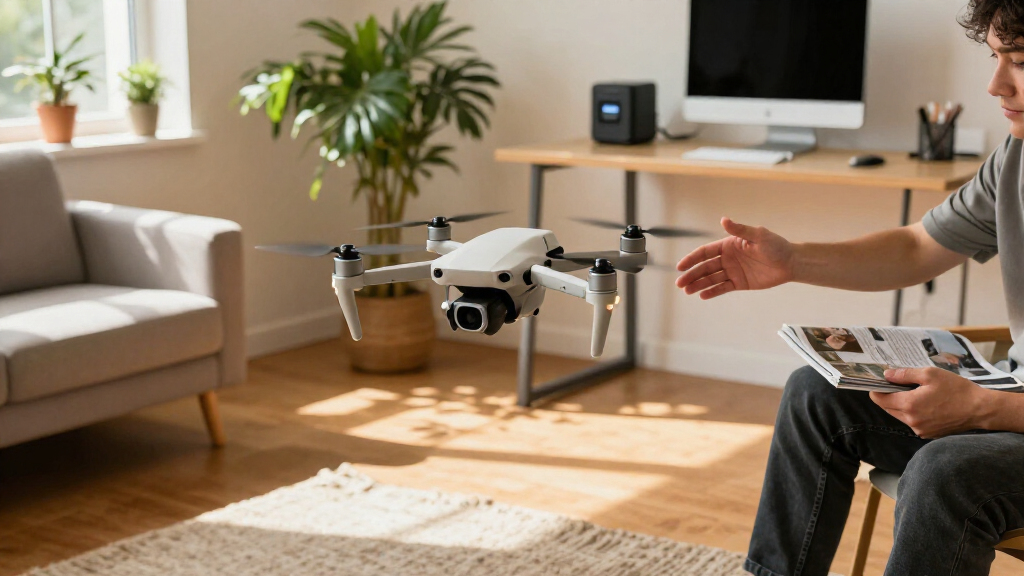
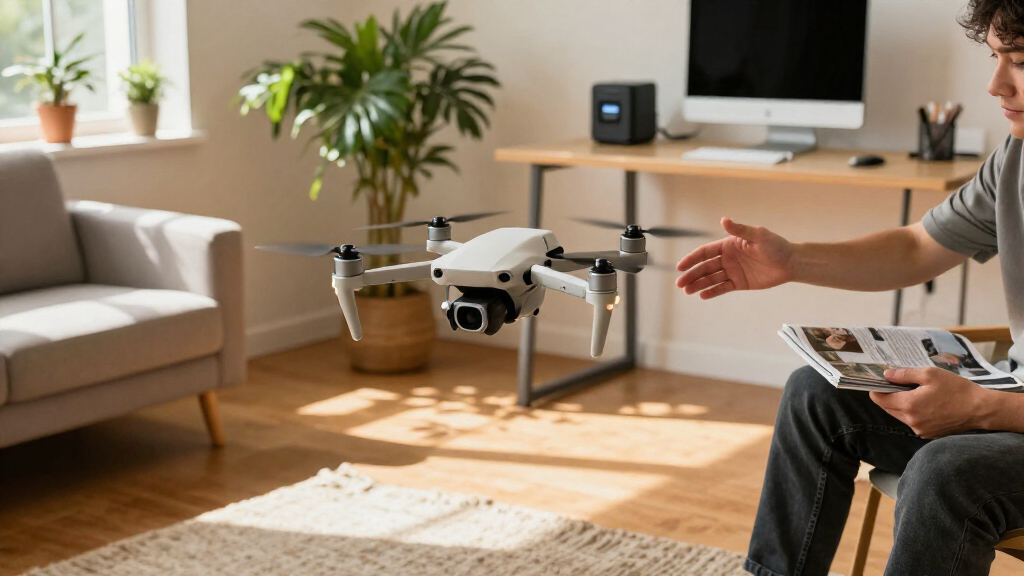
For most indoor pilots, I’d choose the SYMA X100 as the best all-around fit: its compact, guarded design suits practice in smaller spaces better than camera-focused models. The Holy Stone HS210FS stands out for beginner-friendly flying, while the DJI Neo Fly More Combo is the camera-led pick for buyers who also want outdoor capability. The main tradeoff is between protected, manageable flight and advanced features that need more room and skill. Hand-controlled toys are simpler to enjoy, but offer less precise piloting than remote-controlled drones. Read on for the full comparison and help choosing the right indoor flyer for your space and experience.

Get the latest gadgets delivered free with Prime
- Fast, free delivery on millions of items
- Prime Video, Amazon Music and more included
- Member-only deals all year
Complete the kit



Key Takeaways
- Small size and protection matter more indoors than camera resolution. The SYMA X100 and Holy Stone HS210FS are more directly suited to close-quarters practice than the DJI camera drones.
- The lineup divides into two different kinds of flying. The TrysGame and Force1 Scoot use hand interaction, while the SYMA, Holy Stone, HASAKEE, and Sky Viper models offer more conventional remote-controlled practice.
- Beginner-friendly features vary in usefulness. Altitude hold and headless mode can reduce early control demands, but they do not replace open space and a gradual learning curve.
- Camera capability brings a different set of tradeoffs. The DJI Neo Fly More Combo, DJI Neo 2, and HOVERAir X1 are better matches for aerial footage than for casual flights around furniture.
- Included batteries and bundles affect practice time. The HS210FS and HASAKEE Q9s include two batteries, making them more appealing for repeated learning sessions than a single-battery setup.
| SYMA X100 Indoor Drone for Kids |  | Best Overall for Beginner Indoor Flying | Brand and model: SYMA X100 | Skill level: Beginner | Controls: Remote control and gesture control | VIEW LATEST PRICE | See Our Full Breakdown |
| Holy Stone HS210FS Mini Drone Set for Kids and Beginners |  | Best for Two-Player Indoor Play | Brand and model: Holy Stone HS210FS | Quantity: Two drones | Controls: Remote control; two remotes included | VIEW LATEST PRICE | See Our Full Breakdown |
| TrysGame Hand-Controlled Mini Flying Drone with LED Lights, Blue |  | Best Compact Hand-Controlled Pick | Brand and model: TrysGame TSM005-B | Recommended age: 6 years and up | Controls: Gesture control | VIEW LATEST PRICE | See Our Full Breakdown |
| DJI Neo Fly More Combo Mini Drone with 4K UHD Camera |  | Best Premium Camera Drone for Open Indoor Spaces | Model: DJI Neo Fly More Combo | Weight: 135 g | Video and still resolution: 4K UHD video; 12 MP still images | VIEW LATEST PRICE | See Our Full Breakdown |
| HOVERAir X1 Foldable Self-Flying Drone with Camera |  | Best for Automated Follow-Me Clips | Video resolution: Up to 2.7K at 30 fps; HDR video at 1080p | Still image resolution: 12 MP | Automated flight modes: Follow, Orbit, Hover, and Bird’s Eye | VIEW LATEST PRICE | See Our Full Breakdown |
| Force1 Scoot Hand-Operated Indoor Drone with Motion Sensors, LEDs, and Rechargeable Battery (Blue) |  | Best for Hands-On, Screen-Free Play | Control type: Hand operated | Flight time: Up to 8 minutes | Charging time: 50 minutes | VIEW LATEST PRICE | See Our Full Breakdown |
| HASAKEE Q9s Kids RC Drone with Altitude Hold, Headless Mode, LED Lights, and Two Batteries |  | Best for Beginner Controls and Lighting | Model: Q9s | Battery capacity: 500mAh per battery | Included batteries: 2 | VIEW LATEST PRICE | See Our Full Breakdown |
| Holy Stone HS210 Mini Drone for Kids and Beginners, Blue |  | Best for Longer Beginner Sessions | Weight: 50 g | Dimensions: 3.15 × 3.15 × 1.18 in | Included batteries: 3 | VIEW LATEST PRICE | See Our Full Breakdown |
| DJI Neo 2 Lightweight 4K Drone with Camera |  | Best Premium Camera Pick | Weight: 151 g | Video resolution: 4K | Still image resolution: 12 MP | VIEW LATEST PRICE | See Our Full Breakdown |
| Sky Viper Dash Nano Performance RC Drone |  | Best for Fast, Tricky Indoor Flying | Model: 18774 | Weight: 7.68 oz | Dimensions: 5.75 × 2.52 × 9.06 in | VIEW LATEST PRICE | See Our Full Breakdown |
| indoor flying drone | Weight | Dimensions |
|---|---|---|
| SYMA X100 Indoor Drone for Kid | 58 g | 5.16 × 5.16 × 1.77 in |
| Holy Stone HS210FS Mini Drone | 59 g | 5.8 × 4.8 × 1.5 in |
| TrysGame Hand-Controlled Mini | 26 g | 3.7 × 3.7 × 1.5 in |
| DJI Neo Fly More Combo Mini Dr | 135 g | — |
| HOVERAir X1 Foldable Self-Flyi | — | — |
| Force1 Scoot Hand-Operated Ind | 1.12 oz | 4.7 × 4.7 × 2 in |
| HASAKEE Q9s Kids RC Drone with | — | 6.9 × 6.9 × 2 in |
| Holy Stone HS210 Mini Drone fo | 50 g | 3.15 × 3.15 × 1.18 in |
| DJI Neo 2 Lightweight 4K Drone | 151 g | 6.74 × 5.8 × 1.59 in |
| Sky Viper Dash Nano Performanc | 7.68 oz | 5.75 × 2.52 × 9.06 in |
More Details on Our Top Picks
SYMA X100 Indoor Drone for Kids
The SYMA X100 is my strongest all-around pick for a child learning to fly in a room, thanks to its mix of protective design and controls that lower the penalty for beginner mistakes. Its fully enclosed propeller guard and four-way infrared sensing help limit bumps and contact, while altitude hold and headless mode make steering less demanding. Compared with the TrysGame Hand-Controlled Mini Flying Drone, the X100 is larger and uses a conventional remote as well as gesture control, giving a new pilot a more familiar way to learn. Two batteries offer up to 20 minutes combined, though actual time varies and is modest beside the Holy Stone HS210FS set. The tradeoff is that this is an indoor-focused toy, not a drone for outdoor range or serious camera work.
Pros:- Fully enclosed propeller guard and durable ABS body suit close indoor flying.
- Four-way infrared sensing can help reduce collisions with nearby obstacles.
- Altitude hold, headless mode, and one-button takeoff and landing ease early learning.
- Two batteries and gesture control add play options beyond basic remote piloting.
Cons:- Up to 20 minutes of flight time is shared across both batteries and varies with use.
- Indoor-focused design limits use in open outdoor spaces.
- Obstacle sensing is described for nearby objects, not as a substitute for careful piloting.
Best for: Parents choosing a guarded first drone for a child who wants remote-control practice, simple flight modes, and playful stunts indoors.
Not ideal for: Buyers seeking outdoor flying, camera footage, or longer sessions without stopping to recharge.
- Brand and model:SYMA X100
- Skill level:Beginner
- Controls:Remote control and gesture control
- Obstacle sensing:Four-way infrared; detects obstacles within about 12 in
- Flight features:Altitude hold, headless mode, two speed modes, one-key takeoff and landing, 360° flips
- Weight:58 g
- Dimensions:5.16 × 5.16 × 1.77 in
- Batteries and flight time:Two rechargeable lithium-ion batteries; up to 20 minutes total, depending on use
Our verdict“Choose the SYMA X100 for a child’s first indoor drone when protective guards and straightforward controls matter more than camera features or extended flight time.”
Holy Stone HS210FS Mini Drone Set for Kids and Beginners
The Holy Stone HS210FS earns its place by making indoor flying a shared activity: the set includes two drones and two remotes, with infrared battle mode and a three-hit knockout system. That gives it a distinctly different purpose from the SYMA X100, which is the simpler choice for one child learning basic control. For first-time pilots, altitude hold, headless mode, one-key takeoff and landing, and three speed settings provide room to build skill; propeller guards and an emergency stop add practical protection during close play. Four batteries supply up to 32 minutes of combined flight time, but each battery lasts about eight minutes, so sessions involve swaps and charging. Pick this for sibling or friend play, not for someone who wants one compact drone with the longest uninterrupted flight.
Pros:- Two drones and two remote controls let two beginners fly together.
- Infrared battle mode and a three-hit knockout system give the set a clear play purpose.
- Altitude hold, headless mode, and three speed settings support new pilots.
- Four included batteries provide up to 32 minutes of total flight time.
Cons:- Flight time is about eight minutes per battery, so longer play requires battery changes.
- Two-drone play needs enough clear indoor space to reduce collisions.
- Indoor-focused design does not suit buyers looking for outdoor flying.
Best for: Families with two children or friends who want beginner-friendly indoor races and infrared drone battles.
Not ideal for: Solo buyers who want one drone, or pilots who prefer longer uninterrupted flights over swapping batteries.
- Brand and model:Holy Stone HS210FS
- Quantity:Two drones
- Controls:Remote control; two remotes included
- Flight features:Infrared battle mode, 360° flips, circle fly, high-speed rotation, altitude hold, headless mode
- Safety features:Propeller guards and emergency stop
- Weight:59 g
- Dimensions:5.8 × 4.8 × 1.5 in
- Batteries and flight time:Four lithium-polymer batteries; up to 32 minutes total, about eight minutes per battery
Our verdict“Choose the HS210FS when two beginners want shared indoor battle play and you are comfortable managing short flights between battery swaps.”
TrysGame Hand-Controlled Mini Flying Drone with LED Lights, Blue
The TrysGame TSM005-B is the most compact, hands-on option here: it responds to gesture control and pairs obstacle sensing with a light, enclosed shell that can also roll along the floor. That makes it a different kind of indoor toy from the remote-driven SYMA X100, which is better suited to practicing conventional piloting. At just 26 g and 3.7 inches wide, this model is easy to use in tighter rooms, while 12 LEDs add a visible show in dimmer spaces. Its lightweight PP body helps soften everyday bumps, but this is not the pick for someone who wants detailed flight controls or a remote-based learning path. Charging takes about 30–35 minutes, and the supplied data does not give a flight-time figure, so buyers should not assume long sessions.
Pros:- Gesture control makes play simple without a conventional remote.
- Obstacle sensing and an enclosed PP shell suit close-range indoor use.
- Compact 26 g body can fly and roll along the floor.
- Twelve LEDs create changing light patterns.
Cons:- Recharge time is approximately 30–35 minutes.
- No flight-time figure is supplied, making session length harder to judge.
- Gesture-focused control offers less conventional piloting practice than the SYMA X100.
Best for: Children aged six and up who want a small, hands-free indoor toy for gesture play, floor rolling, and light effects.
Not ideal for: Families seeking remote-control flight practice, quantified long flight sessions, or a drone suited to outdoor use.
- Brand and model:TrysGame TSM005-B
- Recommended age:6 years and up
- Controls:Gesture control
- Features:Obstacle avoidance, 360° flips, LED light show
- Material:Soft, high-resilience PP
- Weight:26 g
- Dimensions:3.7 × 3.7 × 1.5 in
- Recharge time:Approximately 30–35 minutes
Our verdict“Pick the TrysGame for compact, gesture-led play and lighting effects, but choose the SYMA X100 instead if learning remote piloting is the priority.”
DJI Neo Fly More Combo Mini Drone with 4K UHD Camera
The DJI Neo Fly More Combo is the camera-focused outlier in this group: stabilized 4K video, subject tracking, and eight QuickShots modes make it more suited to capturing people and planned clips than the toy-style Holy Stone HS210FS. Palm takeoff and landing, voice or app control, and an included RC-N3 provide several ways to launch and operate it; three batteries and a charging hub also support longer outings than a single-battery setup. For indoor use, though, its camera strengths do not erase the need for clear space and careful handling. The 135 g plastic-bodied drone is far less protected than the SYMA X100’s fully enclosed guard, even though propeller guards are included. Its listed maximum range is not a reason to fly it around furniture or in cramped rooms.
Pros:- Stabilized 4K video and 12 MP stills offer a major camera step up from the toy drones.
- Subject tracking and eight QuickShots modes reduce the need for constant manual framing.
- Palm takeoff and landing plus voice, app, and remote control offer flexible operation.
- Fly More Combo includes three batteries, a two-way charging hub, and propeller guards.
Cons:- Its camera-drone design is less forgiving in tight indoor spaces than the enclosed SYMA X100 or TrysGame.
- Plastic construction and included propeller guards do not provide a fully enclosed frame.
- The listed battery capacity has no unit, limiting how useful that specification is for comparison.
Best for: Content creators who want automated, stabilized 4K footage in spacious indoor venues and value multiple batteries and control methods.
Not ideal for: Young beginners or anyone flying in small, crowded rooms who needs a fully enclosed propeller cage and simple bump-tolerant play.
- Model:DJI Neo Fly More Combo
- Weight:135 g
- Video and still resolution:4K UHD video; 12 MP still images
- Camera features:Subject tracking and eight QuickShots modes
- Controls:Voice, mobile app, or RC-N3 remote
- Connectivity:Bluetooth and Wi-Fi
- Included components:Drone, RC-N3, three batteries, two-way charging hub, propeller guards
- Maximum range:10 km
Our verdict“Choose the DJI Neo for stabilized 4K indoor footage in a roomy setting, not as a child’s bump-proof starter drone.”
HOVERAir X1 Foldable Self-Flying Drone with Camera
The HOVERAir X1 is aimed at buyers who want a camera to follow them through a planned shot, rather than a drone for learning stick control. Its enclosed, foldable frame is better suited to close-range use than the more exposed camera-drone design of the DJI Neo, while automated Follow, Orbit, Hover, and Bird’s Eye modes keep operation straightforward. It records up to 2.7K at 30 fps with triple stabilization and 32 GB of internal storage, so no memory card is needed for basic recording. Compared with the DJI Neo’s 4K capture, the X1 gives up resolution and has a shorter listed flight time of about 11 minutes per battery. App-based control and monitoring also make it a weaker fit for pilots who want a dedicated remote or independent screen.
Pros:- Automated Follow, Orbit, Hover, and Bird’s Eye modes simplify self-filming.
- Enclosed foldable frame supports close-range flying and easier packing.
- Triple stabilization helps steady recorded footage.
- 32 GB of internal storage removes the need for a separate memory card.
Cons:- Approximately 11 minutes of flight time per battery limits each filming session.
- Video tops out at 2.7K at 30 fps, below the DJI Neo’s 4K capture.
- Control and live monitoring rely on the mobile app.
Best for: Solo creators aged 14 and older who want an enclosed, foldable drone for automated follow-me footage and short indoor clips.
Not ideal for: Buyers who need 4K video, longer flights, or a dedicated remote-control experience instead of app-based operation.
- Video resolution:Up to 2.7K at 30 fps; HDR video at 1080p
- Still image resolution:12 MP
- Automated flight modes:Follow, Orbit, Hover, and Bird’s Eye
- Follow-me speed:Up to 15 mph
- Frame:Enclosed and foldable
- Stabilization:Triple stabilization
- Internal storage:32 GB
- Flight time:Approximately 11 minutes per battery
- Control and compatibility:App control; Android 10.0 and above, iOS 12.1 and above
Our verdict“Choose the HOVERAir X1 for short automated follow-me clips and an enclosed foldable frame, but pick the DJI Neo if 4K video is the priority.”
Force1 Scoot Hand-Operated Indoor Drone with Motion Sensors, LEDs, and Rechargeable Battery (Blue)
The Force1 Scoot is the most approachable pick here for children who would rather guide a drone with their hands than learn a remote. Toss it to launch, then use hand movements to steer; its 360° obstacle-avoidance sensors and webbed shell help reduce bumps and propeller contact around furniture. That makes it a different kind of beginner option from the Holy Stone HS210, which uses a conventional remote and offers more flight tricks. The Scoot’s tradeoff is its brief up-to-8-minute flight time, followed by a 50-minute USB charge, and it is intended for indoor use. I’d choose it for short, casual play sessions, not for practicing piloting skills or capturing footage.
Pros:- Hand-operated steering avoids the learning curve of a conventional transmitter
- 360° obstacle-avoidance sensors respond to nearby objects
- Webbed shell helps shield hands and household surfaces from propellers
- Rechargeable by USB and fitted with bright flight LEDs
Cons:- Up to 8 minutes of flight per charge means frequent pauses
- A 50-minute charge is long relative to its flight time
- Indoor-only design limits where it can be flown
Best for: Children aged 8 and up who want simple, hands-guided indoor play without learning remote controls
Not ideal for: Buyers who want longer sessions, remote-control practice, or a drone for outdoor flying
- Control type:Hand operated
- Flight time:Up to 8 minutes
- Charging time:50 minutes
- Obstacle sensing:360° obstacle-avoidance sensors
- Dimensions:4.7 × 4.7 × 2 in
- Weight:1.12 oz
- Recommended age:8 and up
- Connectivity:USB
Our verdict“Choose the Scoot for short, screen-free indoor play where hand gestures and a protective shell matter more than flight time or piloting practice.”
HASAKEE Q9s Kids RC Drone with Altitude Hold, Headless Mode, LED Lights, and Two Batteries
The HASAKEE Q9s is a kid-focused remote-control quadcopter with training aids that make indoor practice less disorienting: altitude hold helps it stay at a steady height, while headless mode makes directional control easier for new pilots. One-button takeoff and landing further simplify starts and stops. Compared with the Force1 Scoot, this is a better fit for children who want to learn transmitter flying rather than steer by hand; its three LED modes, flips, and auto-rotation add variety too. The package includes two 500mAh batteries, though the listing does not specify flight time, so buyers should not assume a particular session length. Its listed 0.03-mile range is limited, but suits close indoor flying.
Pros:- Altitude hold helps beginners focus on steering instead of constant height corrections
- Headless mode and one-button takeoff and landing simplify early flights
- Two included batteries allow a swap between sessions
- Four propeller guards and ABS construction are suited to the bumps of beginner flying
Cons:- Listed maximum range is only 0.03 miles
- Each battery is 500mAh, and the supplied data gives no flight-time figure
- A 720p video specification is modest for buyers prioritizing camera detail
Best for: Children learning remote-control basics who want altitude assistance, simple takeoff, and visible flight modes
Not ideal for: Pilots seeking long-range flying, a stated extended flight time, or detailed camera use
- Model:Q9s
- Battery capacity:500mAh per battery
- Included batteries:2
- Maximum range:0.03 miles
- Video resolution:720p
- Dimensions:6.9 × 6.9 × 2 in
- Flight aids:Altitude hold, headless mode, one-button takeoff and landing
- Propeller guards:4
Our verdict“Pick the Q9s for a child learning basic remote piloting who values training aids and lighting more than range or camera performance.”
Holy Stone HS210 Mini Drone for Kids and Beginners, Blue
For a small indoor quadcopter that can stay in rotation longer, the Holy Stone HS210 has a practical advantage over the HASAKEE Q9s: it includes three batteries and lists up to 21 minutes of total flight time. Altitude hold and headless mode ease the first flights, while adjustable speed gives a beginner room to build confidence; flips and circle flight add play once basic control feels familiar. Its compact 3.15-inch body and propeller guards suit close-quarters flying better than larger options such as the Q9s. This is still a small indoor-focused drone, not a choice for open-sky use. Multiple units also need their drones and remotes paired separately to avoid frequency confusion, which may complicate group flying.
Pros:- Three included batteries support up to 21 minutes of listed flight time
- Altitude hold and headless mode reduce beginner control demands
- Adjustable speed lets new pilots progress at their own pace
- Compact body, propeller guards, and low-battery alarm suit indoor practice
Cons:- Small indoor design limits its suitability for outdoor flying
- Separate pairing is needed when using multiple drones and remotes
- Listed maximum range of 160 feet is modest compared with camera-oriented options
Best for: Beginner families who want a compact indoor quadcopter with spare batteries and room to progress through speed settings
Not ideal for: Buyers seeking outdoor capability, simple multi-drone group setup, or a camera-focused drone
- Weight:50 g
- Dimensions:3.15 × 3.15 × 1.18 in
- Included batteries:3
- Maximum flight time:Up to 21 minutes
- Maximum range:160 feet
- Control type:Remote control
- Flight aids:Altitude hold, headless mode, adjustable speed
- Protection:Propeller guards
Our verdict“Choose the HS210 for beginner indoor flying with useful battery backup and training features, but skip it if outdoor range or easy group operation is a priority.”
DJI Neo 2 Lightweight 4K Drone with Camera
The DJI Neo 2 is the camera-first choice in this group, pairing 4K video and 12 MP stills with palm takeoff, gesture control, and ActiveTrack. Full-coverage propeller guards and omnidirectional obstacle sensing make it more suited to close-range indoor filming than a basic practice quadcopter such as the Holy Stone HS210, which emphasizes beginner flight time and manual control instead. The tradeoff is a more involved, camera-led setup and only one included battery; the supplied details do not list flight time, so buyers cannot compare session length from these specs. Apple Watch support adds a way to view the live feed and adjust tracking. Android users should also note that the DJI Fly app must be downloaded from DJI’s website rather than Google Play.
Pros:- Captures 4K video and 12 MP still images
- Palm takeoff, gesture control, and ActiveTrack support hands-free shooting
- Full-coverage propeller guards and omnidirectional obstacle sensing suit close-range use
- Apple Watch support allows live-feed viewing and tracking adjustments
Cons:- Only one battery is included, and flight time is not specified in the supplied product data
- Android users must download the DJI Fly app from DJI’s website
- Camera and tracking features add complexity compared with beginner-focused models such as the HS210
Best for: Indoor creators who want high-resolution footage, hands-free tracking, and palm-based launch and landing
Not ideal for: Budget-minded learners seeking a simple practice drone, or Android buyers who want app installation through Google Play
- Weight:151 g
- Video resolution:4K
- Still image resolution:12 MP
- Obstacle sensing:Omnidirectional
- Flight controls:Palm takeoff and landing, gesture control, ActiveTrack
- Connectivity:Bluetooth, Wi-Fi
- Included batteries:1
- Dimensions:6.74 × 5.8 × 1.59 in
Our verdict“Choose the Neo 2 for indoor filming and tracking features; choose a simpler model like the HS210 if your priority is basic practice and multiple batteries.”
Sky Viper Dash Nano Performance RC Drone
The Sky Viper Dash Nano stands apart from the calmer beginner options by emphasizing speed and responsive tricks. Its flight-assist system corrects drift and helps maintain a hover, while one-touch 360° flips and multiple flight modes give a new pilot ways to move beyond basic takeoff and landing. The listed speed of up to 25 mph makes it a more spirited choice than the Holy Stone HS210, whose adjustable speeds and three-battery package are better suited to measured practice. That speed is also a drawback indoors: it calls for open room and attentive control. The Dash Nano includes one rechargeable 100mAh battery, so the supplied data offers no basis for expecting long sessions. Its role is playful maneuvering, not filming or outdoor range.
Pros:- Drift correction and hover assist help steady early flights
- One-touch flips work in four directions
- Multiple flight modes offer a path from basic to more active handling
- Includes a rechargeable battery, USB cable, and replacement propellers
Cons:- Listed speed of up to 25 mph can be difficult to manage in tight indoor spaces
- The included battery is 100mAh, and flight time is not provided
- Indoor-focused design does not suit open-sky flying
Best for: Young beginners who have open indoor space and want to progress from assisted hovering to flips and faster maneuvers
Not ideal for: Pilots in small or cluttered rooms, buyers seeking long sessions, or anyone choosing a drone for camera work
- Model:18774
- Weight:7.68 oz
- Dimensions:5.75 × 2.52 × 9.06 in
- Battery:100mAh, 3.7V rechargeable LiPo
- Connectivity:2.4GHz radio frequency
- Maximum flight speed:Up to 25 mph
- Flight assistance:Drift correction and hover assist
- Minimum age:6 years
Our verdict“Pick the Dash Nano for assisted indoor flying with flips and speed, but choose the HS210 for longer listed airtime and a gentler practice setup.”
How We Picked
I ranked these drones by how well their size, control style, and protection suit indoor flight—not by headline specs alone. I gave more weight to manageable handling in confined rooms, beginner access, and features that reduce the chance of bumps during routine practice. Battery setup, portability, and the practical value of included accessories also shaped the order.
The SYMA X100 leads because its indoor-focused design makes it a stronger general fit than camera-first models. The Holy Stone HS210FS follows for its beginner-oriented positioning and two-battery set, while the hand-operated toys earn a place for casual, low-barrier play rather than precise piloting. The DJI and HOVERAir models remain compelling for buyers who want footage or more versatility, but they rank lower for this specific use because their camera capabilities do not automatically make them the easiest choices in tight indoor spaces. Where product names suggest features such as sensors or altitude hold, I treated those as potential aids, not guarantees of collision avoidance or effortless flight.
Factors to Consider When Choosing Best Indoor Flying Drones
Indoor flying depends on the room as much as the drone. I’d start by deciding whether the goal is careful piloting, hands-on play, or aerial footage, then match the aircraft to the space, the pilot’s experience, and the tolerance for repairs.
Match the Drone to the Room
A small drone can still feel difficult in a cramped room if it accelerates quickly or needs a broad turning area. Measure the clear floor and ceiling space, and account for lamps, shelves, pets, and people rather than judging by room size alone. Guarded propellers help limit contact damage, but they do not make a drone safe to fly near faces or delicate objects. A hallway may seem convenient, yet its narrow shape can make turning harder than flying in a clear living room. Buyers often make the mistake of choosing by compact size alone instead of asking whether there is enough unobstructed space to learn.
Choose a Control Style Before Comparing Features
Remote-controlled models teach directional control and are a better fit for someone who wants to build piloting skills. Hand-operated designs trade that precision for simple, playful interaction, which can suit casual use or younger flyers with supervision. Camera drones introduce another layer: framing shots and managing the aircraft at once. Think about what a successful flight means to you before paying for capabilities you may not use. If the goal is learning, prioritize predictable controls; if the goal is play, simpler interaction may matter more than advanced flight modes.
Treat Beginner Aids as Support, Not Autopilot
Altitude hold can reduce the need to constantly correct vertical movement, while headless mode can make direction easier to follow for a new pilot. These features help with early practice, but they do not prevent collisions or teach orientation by themselves. Beginners should start with short flights, low speed where available, and one control input at a time. A common misstep is assuming a beginner label means the drone will stay clear of walls without attention. The best choice is one that makes mistakes manageable while still giving the pilot room to learn.
Compare Flight Time With the Whole Practice Session
Published flight time is only one part of a useful indoor session; charging downtime and battery swaps shape how often a pilot can fly. Bundles with extra batteries can keep practice moving, especially for children who lose interest during long waits. Check whether replacement batteries are easy to source and whether charging requires a dedicated cable or accessory. Avoid assuming that a larger bundle automatically means better value if its extras will go unused. For skill-building, a spare battery can matter more than a minor feature upgrade.
Decide Whether a Camera Belongs Indoors
A camera adds a purpose beyond piloting, but it also shifts the buying decision toward footage quality, framing, and camera operation. In small rooms, camera drones can feel like more aircraft than the space requires, and indoor lighting may limit the results. If you want clips for outdoor trips as well, a model such as the DJI Neo or HOVERAir X1 may earn its place through broader use. If you mainly want a drone to practice around the home, a simpler guarded model is usually the more focused choice. Do not pay for camera features until you know where and how you will use the footage.
Plan for Noise, Repairs, and Supervision
Small propellers can still be noisy in a quiet home, and repeated contact with walls or furniture can wear parts or interrupt flying. Check how the maker handles replacement propellers and other routine parts before buying, especially for a child’s first drone. Clear a flight area, keep the aircraft away from pets, and supervise younger pilots even when a model has guards or sensors. A common buying mistake is treating indoor suitability as permission to fly anywhere in the home. The easiest drone to live with is one that fits your household rules as well as your room.
Frequently Asked Questions
Which of these drones is the best choice for a small room?
I’d start with the SYMA X100 or a small Holy Stone model rather than a camera-first aircraft. Their indoor and beginner positioning makes them a more natural match for close-range practice than the DJI Neo or HOVERAir X1. Even a compact drone needs clear space to turn, so remove breakable items and keep people out of the flight path. If the room is extremely tight, a hand-controlled toy may be easier to enjoy, though it offers less precise piloting.
Should I buy a camera drone if I mainly want to fly indoors?
Only if recording is part of the goal or you also expect to fly outdoors. The DJI Neo models and HOVERAir X1 offer camera-focused appeal, but those features do not make them simpler to control around furniture. For basic indoor practice, a compact guarded drone is a more direct fit and avoids paying for capabilities that may see little use. Also think about room lighting and the space needed to frame footage before choosing a camera model.
Are hand-controlled flying toys a good substitute for an RC drone?
They can be a good choice for casual play, but they serve a different purpose. The TrysGame and Force1 Scoot emphasize interaction rather than the directional practice offered by conventional remote controls. That can make them approachable for a quick indoor activity, but they are not the best pick for someone who wants to learn piloting or capture controlled shots. Choose one for simple play; choose an RC model for more deliberate flight.
Do two included batteries make a meaningful difference for a beginner?
Yes, an extra battery can make a practice session feel less stop-and-start, particularly when a new pilot is learning basic controls. The Holy Stone HS210FS and HASAKEE Q9s stand out in this lineup for including two batteries. That does not tell you how long each charge lasts, so check the listed flight and charging details before deciding. I’d favor the extra battery over a minor feature upgrade if uninterrupted practice is a priority.
Which features should I prioritize for a child’s first indoor drone?
Start with manageable size, propeller protection, straightforward controls, and parts that can be replaced after ordinary bumps. Altitude hold or headless mode may lower the early learning burden, but they do not remove the need for adult supervision or a clear flight area. A hand-controlled model can suit play-focused children, while a remote-controlled option is better for learning to pilot. Match the choice to the child’s patience and the space available, not just the age suggested on a package.
Conclusion
For most people seeking the best overall indoor drone, I’d pick the SYMA X100 for its closer fit to compact, guarded practice. The best value for beginner sessions is the Holy Stone HS210FS, whose two-battery set and beginner focus make it a strong learning pick; the SYMA is also the simpler value choice for buyers who want a direct indoor option. For a premium camera-led option, consider the DJI Neo Fly More Combo, or the DJI Neo 2 if its newer lightweight 4K positioning better suits your needs—just allow more room than you would for a tiny practice drone. Beginners who want conventional controls should compare the HS210FS and HS210, while casual play is better served by the TrysGame or Force1 Scoot. For performance-oriented RC practice, look at the Sky Viper Dash Nano; for a two-battery kid-focused alternative, consider the HASAKEE Q9s. Choose according to the room and type of flying you actually expect to do.
Black Friday Picks

Sonos One (Gen 2) Two-Room Set Voice-Controlled Smart Speaker with Alexa (2-Pack, Black)
As an affiliate, we earn on qualifying purchases.