
📊 Full opportunity report: The Task-Based Social Media Workflow For Client And Creator Teams on IdeaNavigator AI — validation score, market gap, and execution plan.

Get the latest gadgets delivered free with Prime
- Fast, free delivery on millions of items
- Prime Video, Amazon Music and more included
- Member-only deals all year
TL;DR
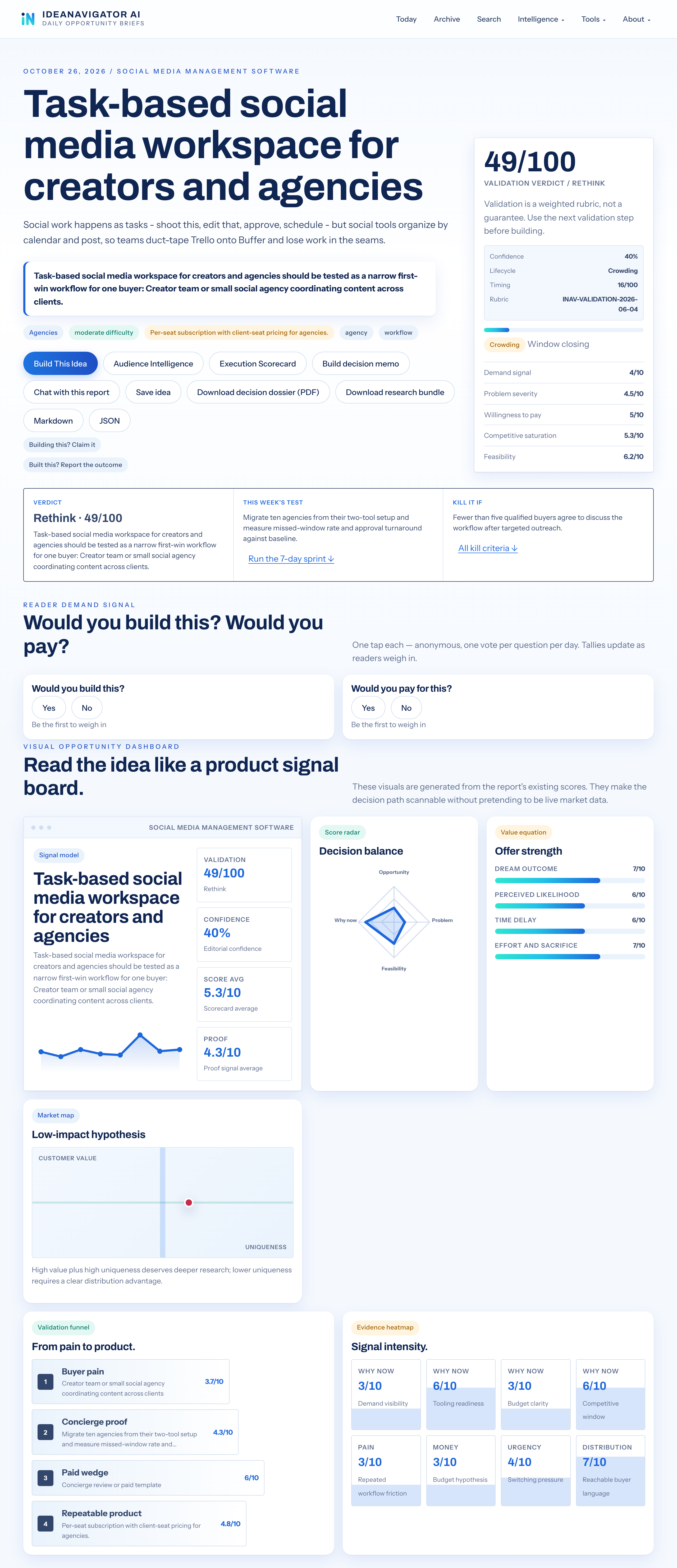
IdeaNavigator AI has outlined a proposed social media workspace that would manage each post through briefing, editing, approval and scheduling. It is a product concept, not a reported launch: the proposal recommends testing it with 10 agencies and measuring approval turnaround and missed publishing windows.
IdeaNavigator AI has proposed a task-based social media workspace for creator teams and small agencies that manage content for multiple clients. The concept would move each post through a shared workflow—from brief and asset creation to editing, client approval and scheduling—but the material describes a product opportunity and validation plan, not a launched or tested service.
The proposed product is designed for a creator team or small social agency coordinating posts across client accounts. Its central premise is that social content work is organized around tasks, while many existing social tools focus on calendars and published posts. The proposal says teams often combine a project-management tool such as Trello with a scheduling service such as Buffer, leaving work split across systems.
The suggested minimum viable product would give each post its own task and move it through five stages: brief, asset, edit, approval and scheduled. Planned features include client-facing approval links, asset versioning and scheduling that starts once a post is approved. The stated goal is one pipeline from an initial idea to publication; the proposal does not document a working product or integrations already built.
The suggested business model is a per-seat subscription, with pricing for client seats aimed at agencies. To test demand and performance, IdeaNavigator AI proposes moving 10 agencies from their current two-tool arrangements and measuring missed publishing windows and approval turnaround against a baseline. No test results, baseline figures, pricing or customer commitments are provided.
Testing the Workflow Gap
The proposal focuses on a practical coordination problem: a post can require input from a creator, editor, account manager and client before it is ready to publish. If task status, current assets and approval decisions sit in separate tools, teams may spend time reconciling information or following up rather than completing the work. A workflow designed around each post could make ownership and progress easier to track.
That potential is relevant to small agencies managing several client accounts, where approval delays can affect planned publishing windows. But the business case remains unproven. The suggested pilot would need to show that consolidating tasks and scheduling improves measurable outcomes enough for teams to adopt another platform and pay for it. The proposal identifies two measures—missed-window rate and approval turnaround—but supplies no evidence yet that either improves.
Products Worth Considering

DJI Osmo Mobile 7P with Mic Mini TX (Infinity Black) Gimbal Stabilizer

Sony WH-1000XM4C Wireless Noise-Cancelling Headphones, Black

LG 34GX90SA-W 34-inch Ultragear WQHD OLED Curved Gaming Monitor
As an affiliate, we earn on qualifying purchases.
From Calendars to Post Tasks
Social media management products commonly help teams plan and schedule posts, while general project-management systems can track assignments and deadlines. IdeaNavigator AI’s proposal identifies a gap between those functions: calendars represent when content is expected to appear, but may not capture all the work and decisions required to get it ready.
The concept is framed as a narrow first workflow for creator teams or small social agencies rather than a broad platform for every social-media user. Its proposed sequence connects production work to publishing, with client approval treated as a stage in the post’s progress. The material says rising content expectations have multiplied team workflows, but it does not provide market-size figures, research findings or a quantified trend to support that claim.
Product and Pilot Still Unconfirmed
The available proposal does not say whether development has begun, whether a company plans to launch the product, or whether agencies have agreed to participate in a pilot. It also gives no launch schedule, product name, technical details, customer interviews or evidence from users.
Key measures for judging the proposed test are not defined. The material does not specify how missed publishing windows or approval turnaround would be calculated, what baseline period would apply, or how results would be compared. Pricing levels, security and permissions for client access, and support for different social platforms are also not described. The proposal’s explanation of the problem and potential benefits should therefore be read as a product hypothesis, not demonstrated market performance.
A Ten-Agency Test Proposed
The next step laid out in the proposal is to migrate 10 agencies from their existing two-tool setups and compare operational measures with a baseline. A useful report of that test would identify participating agencies, the length of the trial, the workflow and platforms covered, and how the two measures were recorded.
No test date or launch milestone is given. Until those details or results emerge, the idea remains a product proposal. Evidence that the workflow reduces delays or missed windows—and that agencies are willing to pay for it—would help establish whether the suggested workspace addresses a sufficiently important need.
Source: IdeaNavigator AI
Key Questions
Has the task-based social media workspace launched?
No launch is reported in the available material. It describes a proposed product and a plan for testing the idea.
Who is the proposed product for?
The initial target is a creator team or small social agency coordinating content across multiple client accounts.
What features are proposed?
The suggested workflow tracks each post through briefing, asset creation, editing, approval and scheduling. Other proposed features include client approval links, asset versioning and scheduling after approval.
How would the idea be tested?
IdeaNavigator AI proposes migrating 10 agencies from two-tool workflows and measuring missed publishing windows and approval turnaround against a baseline. No results or test dates are provided.
Source: IdeaNavigator AI