
TL;DR

Get the latest gadgets delivered free with Prime
- Fast, free delivery on millions of items
- Prime Video, Amazon Music and more included
- Member-only deals all year
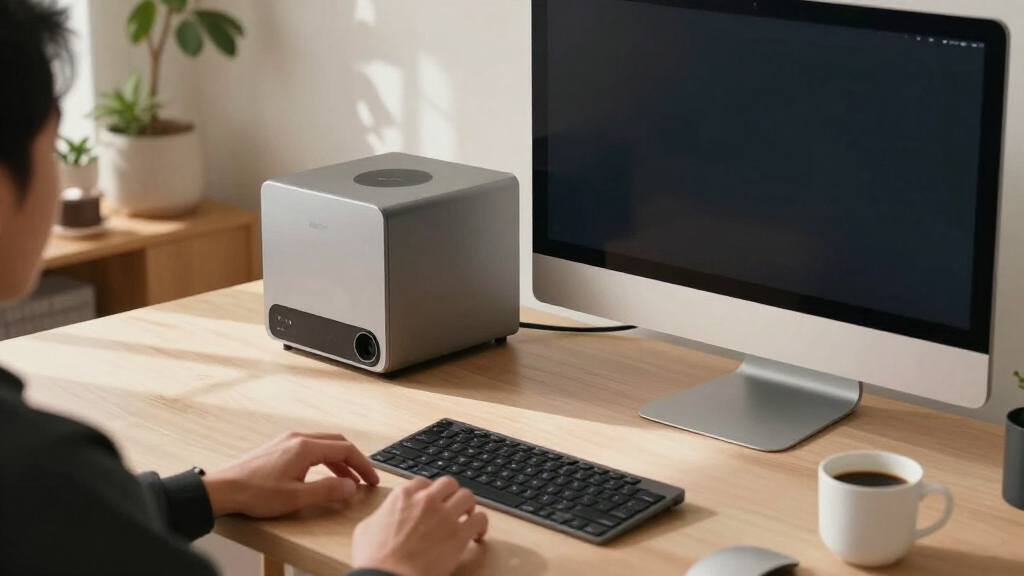
Apple announced a Mac Studio with up to 512GB of unified memory, capable of loading large AI models locally. While it can run frontier-scale models, performance and practical use cases have specific limits.
Apple has announced a new Mac Studio configuration featuring up to 512GB of unified memory, explicitly designed to run large AI models locally without relying on cloud services. This marks a significant development for AI practitioners who require high-capacity local inference hardware, especially for sensitive or experimental work. The 512GB memory configuration will be available in late October, with preorders open now, and is positioned as the first desktop capable of handling frontier-scale models at this capacity.
The new Mac Studio, announced on August 25, 2026, comes in two main configurations: the M5 Max and the M5 Ultra. The Ultra model, which is the focus here, features a dual-chip design connected via Apple’s UltraFusion interconnect, providing up to 36-core CPU and 80-core GPU. The key feature is the 512GB of unified memory, which enables the GPU to address large models directly, a capability previously limited to specialized datacenter hardware. The machine’s memory bandwidth is 1.2 terabytes per second, supporting loading large models efficiently.
Apple claims that this hardware can deliver up to 4.3x faster AI performance than the M3 Ultra and nearly 10x over older models in some benchmarks. However, these figures are based on Apple’s internal tests and specific workloads, and independent benchmarks are awaited. The machine’s significant memory capacity means users can load models that previously required server-grade GPUs, making it a potential game-changer for local AI research and small-scale deployment.
Impact of Large Memory Capacity on Local AI
The 512GB of unified memory fundamentally changes what is feasible on a desktop machine. It enables loading and running of large, frontier-scale models—such as 400-billion-parameter open models—entirely on a local device. This capability is especially relevant for researchers, developers, and privacy-sensitive applications that need to operate without cloud dependence. However, this capacity does not equate to high throughput or fast inference speeds for all workloads, and the machine’s performance is still limited compared to data center hardware.
While the hardware allows for the loading of large models, actual inference speed depends heavily on memory bandwidth and compute power. The machine’s 1.2TB/sec bandwidth is substantial but still a fraction of what top-tier datacenter accelerators can achieve. Therefore, the Mac Studio is best suited for experimentation, development, and small-scale deployment rather than serving many users at high speed or scale.
Apple Mac Studio with 512GB unified memory
As an affiliate, we earn on qualifying purchases.
As an affiliate, we earn on qualifying purchases.
Development of Apple Silicon and AI Capabilities
Apple’s recent silicon advancements, including the M5 Ultra’s design, build upon previous generations like the M1 Ultra, combining multiple dies into a single processor. The integration of neural accelerators into every GPU core has yielded significant performance improvements, with Apple claiming up to 4.3x faster AI inference over prior models. The announcement follows a trend of Apple pushing towards more capable local AI hardware, contrasting with dominant vendors relying on cloud infrastructure and proprietary silicon for large models.
This development comes amid broader industry shifts toward local inference hardware, with some vendors emphasizing cloud-based solutions. Apple’s focus on mass-market availability of high-capacity, locally operable AI hardware marks a notable step in democratizing access to frontier-scale models, previously limited to specialized research labs or cloud providers.
“While the machine can load and run large models, performance is limited by bandwidth and compute, making it ideal for experimentation rather than high-scale deployment.”
— Thorsten Meyer
large AI model local inference hardware
As an affiliate, we earn on qualifying purchases.
As an affiliate, we earn on qualifying purchases.
Performance and Practical Use of Large Models
Independent benchmarks on real-world inference workloads are still pending, so actual speeds and efficiency are not yet fully confirmed. It remains unclear how well the machine performs with different types of models, especially in multi-user or production environments. Additionally, software ecosystem maturity and tooling support for large model inference on Apple Silicon are still evolving, which could impact usability and workflow integration.
Apple Silicon Mac for AI development
As an affiliate, we earn on qualifying purchases.
As an affiliate, we earn on qualifying purchases.
Upcoming Benchmarks and Software Maturity Tests
Expect independent testing and benchmarking to clarify the machine’s real-world inference speeds and limitations. Software updates and ecosystem improvements from Apple and third-party developers will also influence how well this hardware integrates into existing AI workflows. The late October release will be a key moment to evaluate whether the Mac Studio can fulfill its promise for local, frontier-scale AI work at a desktop level.
high memory desktop for AI research
As an affiliate, we earn on qualifying purchases.
As an affiliate, we earn on qualifying purchases.
Key Questions
Can the Mac Studio run any large AI model locally?
It can load and run large models that fit within its 512GB unified memory, but performance may vary based on model size, compute demands, and workload. It is best suited for experimentation and development rather than high-throughput deployment.
How does the performance compare to data center GPUs?
The Mac Studio’s bandwidth and compute are substantial for a desktop but still fall short of top-tier datacenter accelerators. It is optimized for local use but not for large-scale, multi-user serving at high speed.
Will software support be sufficient for running frontier models?
While Apple has improved its local ML tooling, ecosystem maturity is still catching up with the needs of large model inference. Some workflows may require porting or external tools for optimal performance.
Is this a replacement for cloud AI infrastructure?
For most users, no. The Mac Studio is designed for local experimentation and small-scale deployment, not for hosting large models at scale or serving many users simultaneously.
When will the 512GB model be available to purchase?
The 512GB configuration is expected to ship in late October 2026, with preorders currently open.
Source: ThorstenMeyerAI.com
Halloween Picks
halloween
As an affiliate, we earn on qualifying purchases.