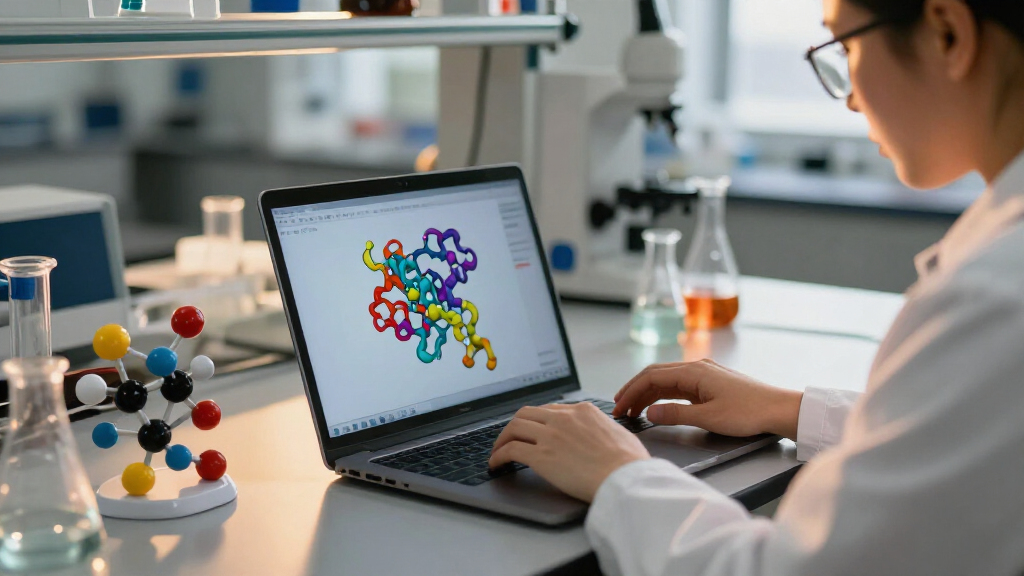
🔍 Read the full analysis: Could GPT-6 Models Support New Protein-design Research? on ThorstenMeyerAI.com

Get the latest gadgets delivered free with Prime
- Fast, free delivery on millions of items
- Prime Video, Amazon Music and more included
- Member-only deals all year
TL;DR
OpenAI reports that GPT-6 models generated protein structures and sequences using general reasoning and code, with lab tests showing evidence of binding for at least one design per target across five selected targets. The findings are from a preprint, and specialized models helped with candidate preparation or selection; the results do not establish therapeutic usefulness or a fully independent design-to-lab process.
OpenAI says its GPT-6 models generated protein structures and amino-acid sequences through general reasoning and code, and that lab tests with research partner Onava found evidence of binding for at least one tested design against each of five selected targets. The findings, reported in a preprint, are an early experimental test of the company’s claim that general-purpose models can perform parts of protein design; specialized models still helped prepare or choose candidates for testing.
In a preprint titled GPT-6 as a Universal Foundation Model for Protein Biology: Beyond Specialized Models, OpenAI reports performance across 14 protein-related tasks. The company says its latest models performed comparably to or better than specialized models on most tasks. These included designing small proteins intended to bind targets, creating proteins with specified structural features, predicting molecular interactions, and estimating how sequence changes could affect properties such as stability and binding.
OpenAI also reports a clear weakness: predicting a complete protein structure remained difficult. The lab work described in the preprint covered two types of designs. In one, Onava tested small proteins based on three-dimensional structures produced by a pre-release version of GPT-6.2. OpenAI says at least one tested protein showed evidence of binding for each of the five selected targets. The supplied account does not give the number of candidates tested per target or the measured strength of binding.
In a separate experiment, GPT-6.2 generated new amino-acid sequences for existing minibinders and antibodies. OpenAI says many redesigned proteins showed evidence of binding to the same targets as the original proteins. The company says specialized models supplied sequences and helped select candidates in the structure-design work, and also helped select candidates in the sequence-redesign experiments. The reported results therefore do not describe a fully independent GPT-6-to-laboratory pipeline.
GPT-6 enters protein design with early lab evidence
OpenAI reports that GPT-6 models used reasoning and code to design protein structures and sequences. Tests with partner Onava found evidence of binding, while specialized models still contributed to preparing and selecting candidates.
What GPT-6 Could Add to Protein Design
The reported approach could give researchers a more flexible way to describe design goals. Protein design involves connecting a desired function to a three-dimensional shape, then finding an amino-acid sequence that can fold into that shape. OpenAI says its general-purpose models can take instructions expressed in ordinary language and use reasoning and code to explore parts of that process, rather than relying on a specialized model to generate the design itself.
That flexibility could matter when a researcher wants to specify several constraints at once, such as where a small protein should attach to a target or how many coils or strands it should contain. OpenAI says such instructions can be given without retraining the model. If other studies confirm the results, this kind of interface could broaden how researchers investigate design ideas. But binding evidence is an early-stage result: it does not show that a candidate is safe, effective in an organism, or suitable as a treatment.
Products Worth Considering

LG UltraGear 27GX700A-B 27-Inch QHD OLED Gaming Monitor

Samsung Odyssey G55C 32-Inch QHD 1000R Curved Gaming Monitor

Logitech MX Creative Console with 9 Customizable Keys, Graphite
As an affiliate, we earn on qualifying purchases.
From Model Benchmarks to Lab Tests
Proteins are chains of amino acids that fold into shapes, and both their sequence and shape help determine how they interact with other molecules. Designing a protein for a particular task can involve proposing a structure and finding a sequence that produces it. Specialized biology models address parts of this work, often with task-specific inputs or constraints. OpenAI’s report argues that a general-purpose model can adapt to varied instructions and use code as part of its design process.
The preprint links computational evaluations with laboratory tests, but those are distinct forms of evidence. OpenAI’s benchmark claims concern performance across a set of protein-related tasks; the Onava experiments test selected designs against five targets. The account provided does not include enough detail to independently evaluate the benchmark methods or the full results of a comparison with RFdiffusion. The reported laboratory outcomes extend the computational claims, but the number and selection of tested candidates affect how broadly the results can be interpreted.
How Strong Is the Evidence?
The reported account leaves several details unresolved. It does not specify how many candidates were tested for each target, the measured binding strengths, or how outcomes compared with relevant laboratory controls. It also does not provide enough information here to assess all benchmark methods or the full comparison with RFdiffusion. Those details matter when judging how reliable the reported results are and whether they extend beyond the selected experiments.
The work is described as a preprint, and the supplied material does not say whether it has undergone peer review. OpenAI has not established in this account how consistently GPT-6 reproduces successful designs, whether the results generalize to other targets, or whether independent teams have replicated them. The involvement of specialized models in preparing sequences and selecting candidates also means the findings should not be read as proof that GPT-6 can independently carry designs from initial instructions through successful laboratory testing.
Nor does evidence of binding establish safety, stability in biological settings, therapeutic effectiveness, or clinical value. Further testing would be needed to assess those properties. The results are best understood as an early report of selected designs and experiments, not evidence that GPT-6-generated proteins are ready for use in medicine.
Peer Review and Independent Replication
The next steps are closer examination of the preprint’s methods, task-by-task results, and laboratory protocols, including how binding was measured and how candidates were chosen. The supplied material gives no timeline for peer review or additional experiments. Independent studies across more targets could test whether the findings hold beyond the selected cases.
Future work would also need to measure how reliably the models produce successful designs and evaluate properties beyond binding, including stability and safety. Until those details and independent results are available, the reach of the reported capability remains uncertain.
Key Questions
What did OpenAI report about GPT-6 and protein design?
OpenAI says GPT-6 models generated protein structures and amino-acid sequences using general reasoning and code. Its preprint reports performance across 14 protein-related tasks and laboratory tests with Onava.
What happened in the laboratory tests?
OpenAI says at least one tested protein based on GPT-6.2-designed structures showed evidence of binding for each of five selected targets. In a separate experiment, many redesigned sequences for existing minibinders and antibodies also showed evidence of binding. The supplied account does not state the number of candidates tested or their binding strengths.
Did GPT-6 complete the design and testing process on its own?
No. OpenAI says specialized models supplied sequences and helped select candidates in the structure-design work, and helped select candidates in the sequence-redesign experiments. The reported tests do not establish a fully independent design-to-lab pipeline.
Do the results show that GPT-6 can create new treatments?
No. Evidence of binding does not establish that a protein is safe, effective in an organism, or useful as a treatment. Those questions require additional testing.
Has the research been independently confirmed?
The work is described as a preprint. The supplied material does not say whether it has been peer reviewed or independently replicated.
Primary source: OpenAI · via ThorstenMeyerAI.com