To place surround speakers effectively, position them slightly behind and to the sides of your seating area, at ear level or slightly above for best sound clarity. Keep the speakers 1-2 feet from walls to prevent reflection issues. Adjust their placement based on your room size—closer in small rooms, wider in larger spaces. This simple map works for any room, and if you keep exploring, you’ll learn how to fine-tune your system for peak sound.
Key Takeaways
- Place surround speakers slightly behind and to the sides of the listening position, at ear level or slightly above.
- Keep speakers 1-2 feet from walls to prevent sound reflections and optimize clarity.
- Adjust speaker angles to direct sound toward the listening spot, ensuring immersive surround sound.
- Calibrate speaker levels and distances to balance sound across different room sizes and shapes.
- Use room treatments like rugs and curtains to reduce reflections and improve overall sound quality.

Blink Outdoor 4 – Wireless smart security camera, two-year battery life, 1080p HD day and infrared night live view, two-way talk. Sync Module Core included – 3 camera system
Outdoor 4 is our most affordable wireless smart security camera yet, offering up to two-year battery life for...
As an affiliate, we earn on qualifying purchases.
Why Proper Surround Speaker Placement Matters for Immersive Sound

Proper surround speaker placement is essential because it directly impacts the quality of your immersive sound experience. When your speakers are correctly positioned, you can achieve ideal audio calibration, ensuring sound reaches you from the right directions. Proper speaker alignment helps create a seamless soundstage, making you feel like you’re inside the action. If speakers are misplaced, sound may seem disconnected or imbalanced, reducing immersion. Accurate placement allows your audio system to deliver clear, precise surround effects, enhancing your overall enjoyment. Remember, even the best equipment can fall short without proper placement; it’s the foundation for effective sound integration. Taking the time to position your speakers correctly guarantees a richer, more engaging listening experience that pulls you into your favorite content. Additionally, understanding speaker calibration techniques can further optimize your setup for the best possible sound. Proper speaker placement is a crucial step that can make a significant difference in your home theater experience, especially when combined with room acoustics adjustments. To ensure consistent performance, considering speaker positioning guidelines can help you achieve optimal sound distribution throughout your space. For optimal results, consulting a professional calibration service can further enhance your setup’s precision.

Rraycom 4Pack 5G/2.4G Security Cameras Wireless Outdoor,2K Battery Powered AI Motion Detection Siren Alarm WiFi Home Indoor Camera, Color Night Vision, 2-Way Talk, Waterproof, Works w/Alexa, Cloud/SD
【New Features for 2025】Dual Bands Wifi,support both for 2.4G & 5G WiFi.2K UHD video & full-color night vision,...
As an affiliate, we earn on qualifying purchases.
How to Check Your Room Before Setting Up Speakers
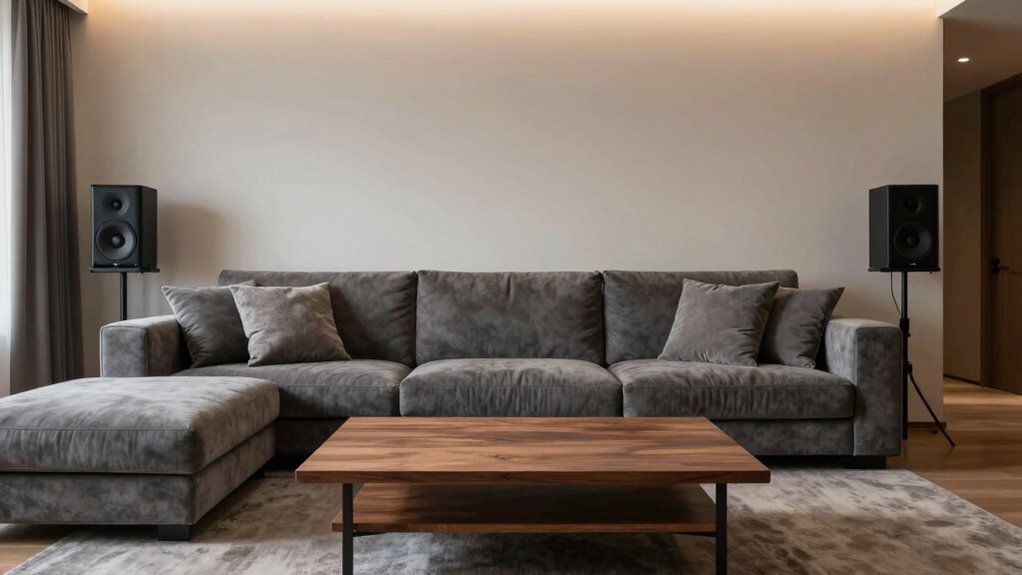
Start by measuring your room dimensions to understand its size and shape. Next, identify your main listening spot where you’ll enjoy the best sound experience. Knowing these details helps you plan speaker placement effectively. Additionally, consider the art care aspects of your space to create an environment that preserves both your audio equipment and your artwork. Ensuring proper acoustic treatment can also improve sound quality by minimizing echoes and unwanted noise. Paying attention to room acoustics can further optimize your setup for a richer listening experience, especially when incorporating technology that adapts to different environments. Being aware of room size and shape helps you position speakers for optimal sound distribution and clarity.
Measure Room Dimensions
Before setting up your surround speakers, measuring your room dimensions accurately is vital. Start by noting the room shape—whether it’s rectangular, square, or irregular—as this impacts speaker placement. Use a tape measure to record the length, width, and height of the space. Pay attention to furniture placement, as large pieces like sofas or cabinets can influence sound reflections and speaker positioning. Mark these measurements on a floor plan or sketch to visualize the space clearly. Knowing the exact room dimensions helps you determine the best speaker locations and avoid obstructions. It also allows you to plan for acoustic treatments or adjustments if needed. Accurate measurements guarantee your surround sound system delivers the best possible audio experience in your unique room. Additionally, understanding media literacy can help you interpret the sound environment and optimize your setup accordingly. Being aware of room acoustics can further enhance your ability to position speakers for optimal sound quality.
Identify Listening Spot
To identify the ideal listening spot, you need to move around your room and listen from different locations. This helps determine the best listening position and optimal speaker orientation. Start by:
- Standing near where you’ll sit and note the sound quality.
- Moving to different spots to compare clarity and stereo imaging.
- Focusing on the sound balance—does it feel immersive or hollow?
- Choosing the spot where sound feels balanced, clear, and centered.
This process ensures your listening position maximizes sound quality and that your speakers are aimed correctly. Adjust your speaker orientation to face your primary listening spot directly, avoiding reflections or obstructions. Properly identifying your listening spot helps you enjoy the best surround sound experience possible.

Blink Outdoor 4 – Wireless smart security camera, two-year battery, 1080p HD day and infrared night live view, two-way talk – 5 camera system
Outdoor 4 is our fourth generation wireless smart security camera that helps you protect your home inside and...
As an affiliate, we earn on qualifying purchases.
The Easy Map to Place Your Surround Speakers Correctly
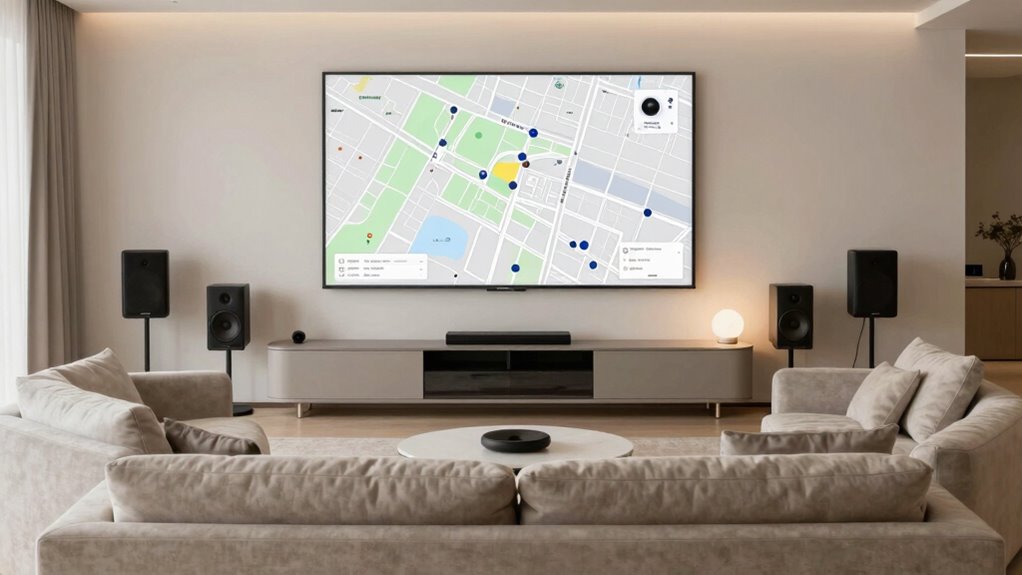
Placing your surround speakers correctly can substantially enhance your home theater experience, and an easy map makes the process straightforward. Keep your speakers roughly at ear level or slightly above speaker height for ideal sound. Use the map below as a guide:
| Position | Placement Tips |
|---|---|
| Surround Left | Slightly behind and to the left of your seat |
| Surround Right | Slightly behind and to the right of your seat |
| Height | Keep speakers at ear level or higher for clarity |
| Calibration | Adjust speaker levels to balance sound |
| Distance | Place speakers about 1-2 feet from walls |
Following this simple map and calibrating your speakers ensures immersive sound without guesswork. Remember, proper speaker placement is key to achieving a seamless and enveloping soundstage. Additionally, speaker positioning based on room acoustics can further optimize your listening experience, especially when considering room acoustics for the best sound quality. To further improve your setup, consider sound reflection techniques to minimize unwanted echoes and enhance clarity.

Blink Outdoor 4 – Wireless smart security camera, two-year battery life, 1080p HD day and infrared night live view, two-way talk. Sync Module Core included – 5 camera system
Outdoor 4 is our most affordable wireless smart security camera yet, offering up to two-year battery life for...
As an affiliate, we earn on qualifying purchases.
Common Mistakes When Setting Up Surround Sound (and How to Avoid Them)
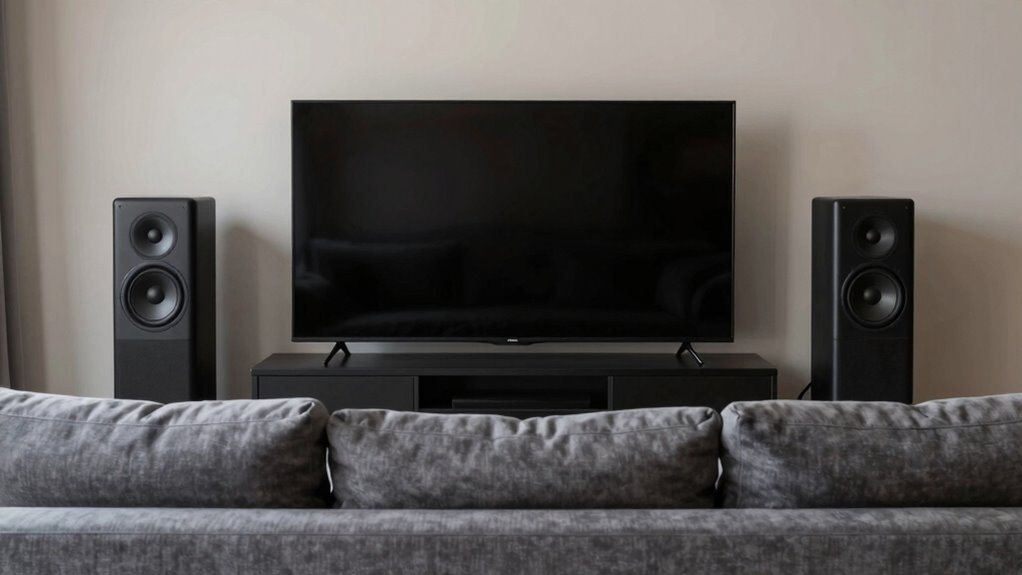
Many people make simple mistakes when setting up surround sound that can ruin your listening experience. Placing speakers incorrectly, ignoring the ideal listening height, or overlooking room acoustics can all cause issues. Knowing how to prevent these pitfalls helps ensure your system sounds its best. Paying attention to the materials and craftsmanship of your speakers can also improve sound quality by ensuring durability and precise engineering. Additionally, understanding the room acoustics can significantly enhance the overall sound by reducing unwanted echoes and sound reflections. Considering room size and shape is essential, as these factors influence how sound waves travel and reflect within the space. Being aware of home environment factors such as furniture placement and wall materials can further optimize your audio experience. Incorporating proper ventilation and space considerations can prevent sound distortion and maintain optimal speaker performance.
Incorrect Speaker Placement
Incorrectly placing your surround speakers can substantially diminish your home theater experience. To avoid this, pay attention to a few key points.
- Incorrect speaker angle: Make sure your surround speakers are angled properly toward your listening position; too steep or shallow can distort sound.
- Poor cable management: Tidy up cables to prevent clutter and accidental disconnections, which can ruin sound quality.
- Placing speakers too close or too far: Keep speakers at an ideal distance for even sound distribution and immersion.
- Ignoring placement height: While listening height isn’t the focus here, ensure speakers aren’t placed too high or too low, affecting sound clarity.
Properly aligning your speaker angle and managing cables will make a significant difference in your surround sound experience.
Ignoring Listening Height
While getting the angle right for your surround speakers is important, overlooking the listening height can undermine the entire setup. The speaker height and listening height are vital for creating an immersive sound experience. If your speakers are too high or too low relative to your ear level, sound may feel disconnected or uneven. Ideally, surround speakers should be positioned at ear level when seated, roughly 2-3 feet above ground. This ensures sound reaches you directly and with proper balance. Ignoring listening height often leads to muffled or echoing audio, reducing clarity and immersion. Always measure your listening height and adjust your speaker height accordingly. Proper alignment between speaker height and your ear level guarantees the best surround sound experience, avoiding common pitfalls that diminish audio quality. Additionally, sound science emphasizes the importance of matching speaker placement with listening position for optimal clarity. Paying attention to listening environment factors like room acoustics can further enhance your setup and overall audio experience. Considering acoustic treatment can also help improve sound quality by reducing unwanted echo and reverberation.
Overlooking Room Acoustics
Overlooking room acoustics is a common mistake that can substantially diminish your surround sound experience. Poor acoustics cause sound reflections, echoes, and dead spots, making even well-placed speakers sound off. To avoid this, focus on:
- Evaluating your room’s acoustics and adding soft furnishings like rugs and curtains to absorb excess sound.
- Using acoustic panels or diffusers in reflective areas to reduce sound bouncing.
- Calibrating your speakers carefully to account for room size and shape, ensuring balanced sound.
- Regularly checking and adjusting speaker placement and calibration to adapt to changing room conditions.
How to Adjust Your Speakers for Small, Medium, and Large Rooms
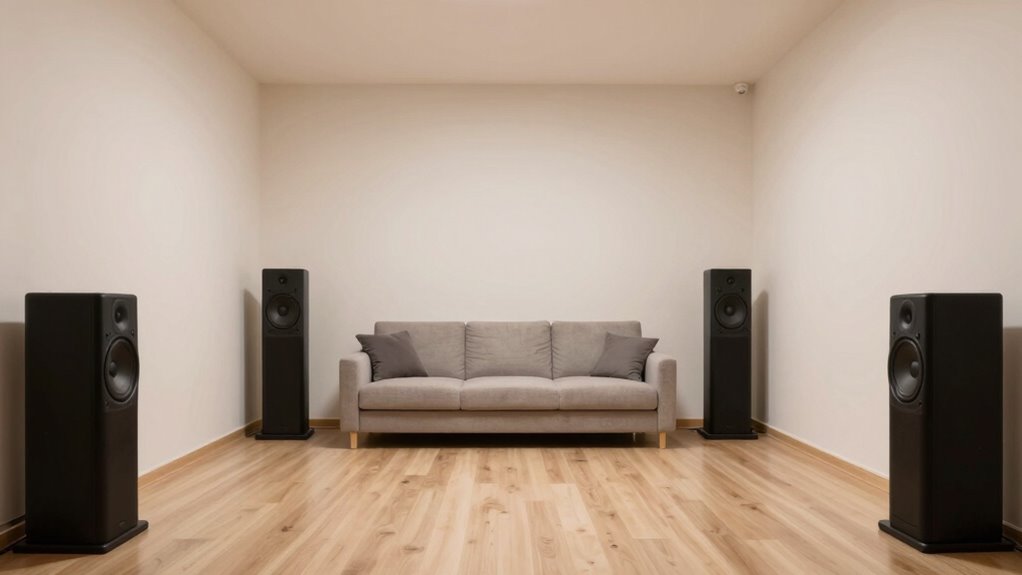
Adjusting your surround speakers based on the room size guarantees ideal sound quality. For small rooms, keep speakers closer to the listening area and perform speaker calibration to prevent overwhelming sound. In medium-sized rooms, position speakers slightly farther apart, ensuring they aren’t blocked by furniture, which can distort audio. For large rooms, increase the distance between speakers and the listening spot to fill the space evenly. Focus on furniture arrangement, avoiding obstacles that can muffle or redirect sound waves. Proper calibration ensures each speaker delivers balanced audio, regardless of room size. Take time to experiment with placement and settings, fine-tuning your system to achieve excellent surround sound for any room dimension.
Tips to Fine-Tune Your Surround Sound System for the Best Experience

Fine-tuning your surround sound system is essential to achieve the best listening experience. Start with speaker calibration to ensure each speaker’s volume and delay are set correctly for your room. Proper cable management helps prevent interference and simplifies adjustments, making calibration easier. To optimize your setup, consider these tips:
- Use a calibration microphone and receiver test tones to balance speaker levels.
- Adjust speaker distances in your system settings to match their actual placement.
- Keep cables organized and secure to avoid tangles that can disrupt sound quality.
- Regularly revisit calibration after rearranging furniture or adding new equipment.
- Incorporate proper electrical grounding practices to safeguard your audio equipment and maintain optimal performance.
Frequently Asked Questions
Can I Use Wireless Surround Speakers With This Placement Method?
Yes, you can use wireless surround speakers with this placement method. Wireless compatibility allows you to position the speakers more flexibly, making it easier to follow the simple map. Just keep in mind that placement adjustments might be necessary to optimize sound quality and minimize latency. Make sure your wireless speakers are compatible with your system and placed within a good range for a seamless, immersive surround sound experience.
How Do Wall Treatments Affect Surround Speaker Positioning?
Wall treatments can substantially impact your surround speaker positioning by influencing acoustic reflections, which affect sound clarity and immersion. You should consider how materials like acoustic panels or diffusers manage reflections without compromising wall aesthetics. Proper placement ensures sound reaches you directly, avoiding excessive echo or dead spots. Balancing effective acoustic treatment with your room’s look helps optimize surround sound performance while maintaining the style you desire.
Is It Necessary to Calibrate My System After Setup?
Yes, calibrating your system after setup is important because it guarantees ideal sound quality. Calibration adjusts for room acoustics, speaker levels, and delays, helping your system deliver balanced audio. Ignoring calibration can lead to uneven sound and poor surround effects. Take the time to calibrate, either manually or with auto-setup tools, to maximize your listening experience and enjoy clear, immersive audio tailored to your room’s unique acoustics.
What Are Signs of Poor Surround Sound in My Room?
If you notice that your sound feels unbalanced or distant, you might have speaker misalignment or sound distortion. A common sign is when dialogue sounds muffled or there’s inconsistency in volume levels. Studies show that improper speaker placement reduces sound clarity by up to 30%. To fix this, double-check your surround speaker placement, make certain they’re aligned correctly, and avoid placing them too close or too far from walls for ideal sound quality.
How Often Should I Readjust My Speaker Placement?
You should regularly review your speaker placement every few months or if you notice sound quality issues. Make small speaker adjustments as needed to optimize the audio experience, especially if you rearranged furniture or changed room acoustics. Conduct placement reviews periodically, ensuring the speakers remain in ideal positions for clear, immersive sound. Frequent adjustments help maintain consistent surround sound performance and prevent audio problems from worsening over time.
Conclusion
By following this simple map, you’ll set up your surround speakers like a pro and avoid common pitfalls. Remember, a well-placed system is the backbone of immersive sound, so don’t be afraid to fine-tune until it feels just right. Think of your setup as a recipe—you need the right ingredients in the right place to make the magic happen. Stick to these tips, and your home theater will be ready to blow you away!