📊 Full opportunity report: The GLP-1 Price Transparency Index For US Pharmacies on IdeaNavigator AI — validation score, market gap, and execution plan.

Get the latest gadgets delivered free — and shop member deals
- Fast, free delivery on millions of items
- Access to Prime Big Deal Days deals on October 6–7
- Prime Video, Amazon Music and more included
TL;DR
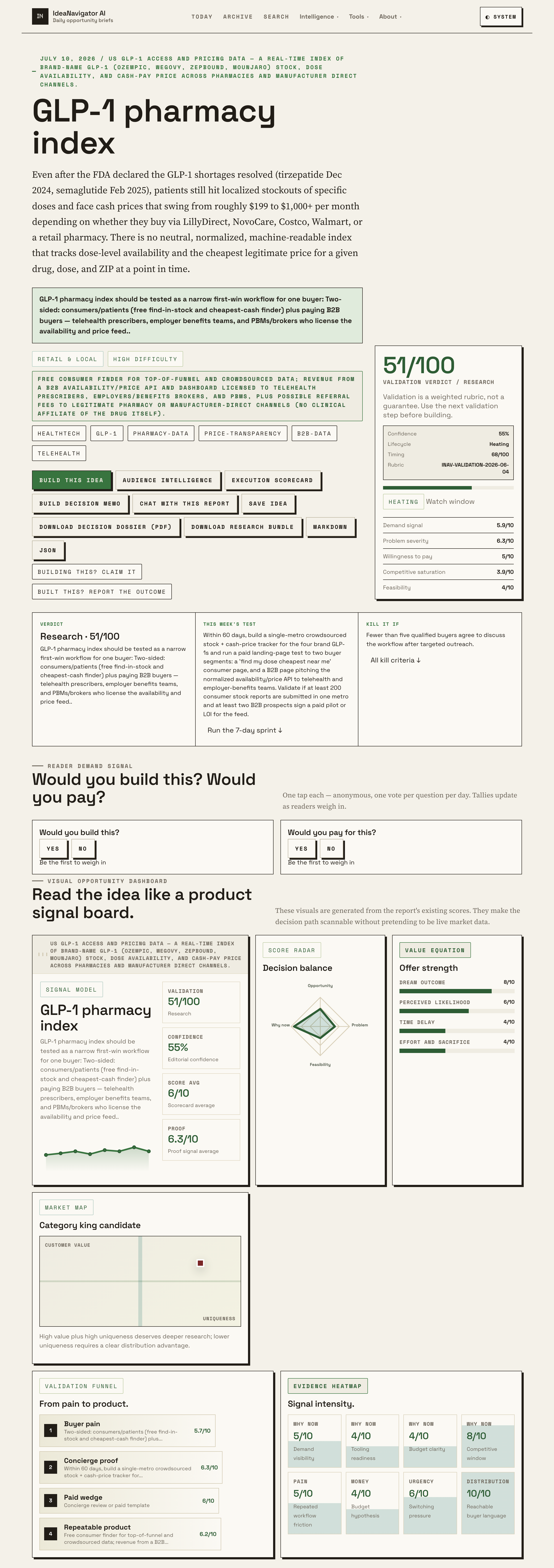
IdeaNavigator AI has outlined a proposed index to help U.S. patients compare cash prices and dose availability for four branded GLP-1 drugs by ZIP code. The proposal describes a free consumer finder and a paid data service for health care and benefits buyers; it does not establish that the index has launched or secured customers.
IdeaNavigator AI has proposed a U.S. index that would let patients search for branded GLP-1 medicines by drug, dose and ZIP code, comparing reported availability and cash prices. The concept pairs a free consumer finder with a paid data feed for telehealth prescribers, employer benefits teams, pharmacy benefit managers and brokers. The IdeaNavigator AI proposal does not say that a product is operating or that buyers have signed on.
According to IdeaNavigator AI’s proposal, the index would initially cover Ozempic, Wegovy, Zepbound and Mounjaro. Patients could look for a particular dose in their area and compare cash-pay options across manufacturer direct programs, participating retailers and pharmacies. The proposal names LillyDirect, NovoCare, Costco and Walmart as sources of price information, alongside a discount-price layer modeled on services such as GoodRx. It provides no live price table and does not define how prices would be verified or updated.
The proposal says availability data would begin with crowdsourced stock reports, with alerts for specific doses as an additional feature. The commercial side would offer a normalized availability and price dataset through an API or dashboard. IdeaNavigator AI suggests testing that feed with one or two design partners among telehealth or employer-benefits buyers. The proposal also identifies referral fees to legitimate pharmacies or manufacturer-direct channels as a possible revenue source.
IdeaNavigator AI proposes a 60-day validation period in one metro area, with targets of at least 200 patient stock reports and at least two paid pilots or letters of intent from business prospects. The proposal presents these as targets, not results. It does not identify a metro, launch date, participating pharmacy, pilot buyer or completed test.
Price Data Could Guide GLP-1 Access
IdeaNavigator AI says its proposed index would help people paying cash find a particular dose and compare costs across channels. Its proposal estimates monthly prices at roughly $199 to more than $1,000, depending on the drug and purchase channel, but gives no date, itemized products or comparison method for that range. Actual costs can depend on eligibility, dose, quantity, location and program terms. The proposed index does not yet specify how it would present those conditions.
For employers and other benefits buyers, the proposed feed could provide local supply and cash-price information. IdeaNavigator AI claims GLP-1 medicines account for roughly 20% of pharmacy spending among employers, but its material cites no survey, time period or definition of the employers included. That figure is therefore an assertion in the proposal. The proposal does not provide evidence that the feed would lower spending or change treatment decisions.
The proposal relies in part on patient stock reports and prices from channels that may update at different rates. It does not specify how reports would be checked, how current inventory would be confirmed or how timestamps and price conditions would be displayed. Those details would affect how users interpret comparisons. IdeaNavigator AI describes a potential service, but its proposal provides no operating data on coverage or accuracy and does not detail referral disclosures.
Shortages Gave Way to Local Gaps
IdeaNavigator AI frames the opportunity as a shift from broad shortages to fragmented local supply and pricing. Its proposal says the FDA declared the tirzepatide shortage resolved in December 2024 and the semaglutide shortage resolved in February 2025. The material does not link to FDA notices or explain the regulatory status of each branded product. It argues that the end of listed shortages did not eliminate local difficulty finding a particular dose.
The proposal also identifies manufacturer direct-to-consumer cash channels and retail pricing programs as sources of price variation, naming LillyDirect, NovoCare, Costco and Walmart. It describes a portal called TrumpRx as having launched in February 2026, but supplies no details about its products, prices or terms. The proposal does not explain how that portal would be included in the index.
IdeaNavigator AI presents the index as an early-stage business concept, not as a new pharmacy service or a completed market study. Its suggested first version would cover four branded drugs in one metro, using crowdsourced stock reports and publicly available cash prices. The stated plan is to test consumer reporting and business-buyer interest before expanding coverage.
Coverage and Price Checks Remain Open
IdeaNavigator AI’s proposal does not identify a product launch, operating company, development team, pharmacy partners or funding. It provides no evidence that the consumer tool or business API exists, and names no buyer that has agreed to a pilot. The 60-day validation targets are plans, not outcomes. The proposal does not say when the test would start, which metro it would use, or how it would define a paid pilot or letter of intent.
The material does not explain how frequently prices would be checked, whether displayed prices would include fees, which patients would qualify for manufacturer offers, or how the index would handle insurance and coupon restrictions. It also leaves open how crowd reports would be checked, when outdated reports would expire, and whether a listed pharmacy would confirm inventory. The proposal does not specify how it would distinguish a cash price from an insured price or describe conditions attached to offers.
The proposal suggests a single-metro test but does not present evidence of national coverage or reliable availability for every dose. It also does not detail data rights, privacy practices or commercial terms for sharing patient-submitted reports with business customers. These operating details are not established in the supplied IdeaNavigator AI material.
A Metro Pilot Would Test Demand
IdeaNavigator AI proposes building a single-metro tracker for the four branded medicines and running separate landing-page tests. One page would ask consumers whether they want a nearby dose and cash-price finder; another would pitch an availability and price feed to telehealth and employer-benefits buyers. The proposal sets targets of 200 stock reports and two paid pilots or letters of intent within 60 days.
The proposal gives no test location or start date and reports that neither target has been reached. Any future update would need to establish whether the pilot launched, how reports and prices were verified, what coverage it achieved and whether prospective buyers paid for access. As described in the IdeaNavigator AI material, the index remains a proposal and no operating service is documented.
Source: IdeaNavigator AI
Key Questions
Has the GLP-1 Price Transparency Index launched?
The supplied material describes a proposal and a possible pilot. It does not say that the index has launched or provide a working service.
Which medicines would the proposed index cover?
The suggested first version covers Ozempic, Wegovy, Zepbound and Mounjaro, with searches by dose and ZIP code.
Would the index show insurance prices?
The proposal centers on cash prices. It does not explain whether or how insurance prices would be included.
How would the proposal test whether the idea works?
It sets a 60-day, one-metro target of 200 consumer stock reports and at least two paid business pilots or letters of intent. No results are reported.
Source: IdeaNavigator AI
Fall Picks
fall essentials
As an affiliate, we earn on qualifying purchases.