🔍 Read the full analysis: From CAD To Print: The Practical Role Of AI In 3D Printing on ThorstenMeyerAI.com

Get the latest gadgets delivered free with Prime
- Fast, free delivery on millions of items
- Prime Video, Amazon Music and more included
- Member-only deals all year
TL;DR
AI already supports parts of the 3D-printing process, particularly generative design and camera-based detection of printing errors. The source says text-to-CAD is not yet reliable enough to trust, and AI-assisted parts still require human checks and physical tests.
AI can help optimize 3D-print designs and spot some printer errors as they happen, but it cannot yet reliably turn a written prompt into a part that is ready for use, according to an explainer published November 29 by ThorstenMeyerAI.com. The report describes current uses in design and print monitoring while stressing that engineers must still check and test parts, especially when they carry loads or protect people.
The clearest example in the report is generative design, in which an engineer defines a part’s connections, loads and restricted areas, then software proposes a shape. The article describes work by NASA Goddard Space Flight Center research engineer Ryan McClelland, who used commercial software to create “evolved structures.” The method, topology optimization, repeatedly assesses how forces move through a design and removes material judged to carry little load.
For a bracket for NASA’s EXCITE balloon telescope, two engineers’ conventional design took two days of effort, according to the paper cited in the explainer. The AI-assisted version took about 30 minutes for one engineer to enter requirements, plus about one hour of computing. Those figures describe the work on that example; they do not establish that every AI-generated design will be faster or better.
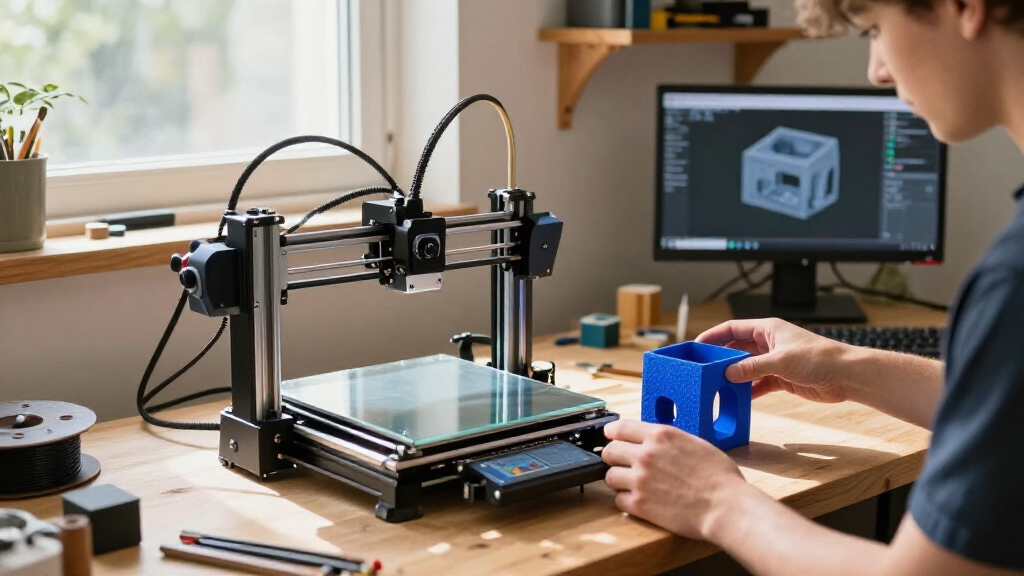
AI can also be applied during printing. The report points to a University of Cambridge system that used a camera to identify and correct common nozzle errors while a printer was operating. That example concerns material-extrusion printing, where a nozzle lays down material in successive layers. The system’s reported capability is error detection and correction for common problems, not a guarantee that a finished object is sound.
From idea to printed part: where AI looks over your shoulder
The orange marker shows where AI helps today. The last word still belongs to a real test.
Design: you set the loads, bolts and keep-out zones. The software proposes the shape.
Check: simulation predicts how the part bends. Only a real test shows how strong it is.
Print: a camera next to the nozzle spots common errors and corrects them during the print.
Every step: AI guesses from patterns. For parts that carry weight, people still test.
AI’s Role in the Print Workflow
The practical value depends on where AI is used. In design, software can explore shapes that may take engineers longer to draw manually; during printing, camera-based monitoring may catch visible process errors before a job is complete. Both uses can support human work, but neither removes the need to define requirements correctly or inspect the outcome.
That distinction matters most when failure has consequences. A design can look convincing while omitting a load, fastener or clearance requirement. The explainer says NASA’s AI-designed parts still undergo standard stress analysis and testing, and points to NASA standards for printed flight hardware. For home users, camera monitoring is best treated as an additional set of eyes, not proof that a print is safe or usable.
Products Worth Considering

Apple AirPods Pro 3 Wireless Earbuds with Active Noise Cancellation

Jackery Explorer 300 Portable Power Station, 292Wh

Kindle Paperwhite Signature Edition, 32 GB (12th Generation, 2024), Metallic Black
As an affiliate, we earn on qualifying purchases.
From CAD Model to Printed Part
A typical workflow starts with computer-aided design (CAD), where a person creates a dimensioned model. Engineers may then use simulation to assess how forces act on it. A slicer converts the model into layers and machine instructions, often G-code, before the printer builds the object layer by layer. The report notes that failures during additive-manufacturing fabrication can lead to repeated print attempts.
The explainer distinguishes several printer types: material extrusion, which melts and deposits a filament; resin printing, which hardens liquid with ultraviolet light; and powder-based processes that fuse layers of material. Its Cambridge monitoring example concerns material extrusion, not every kind of 3D printer. The source cites the US National Institute of Standards and Technology for its description of material extrusion as common in personal and commercial printers.
AI-generated geometry is a separate issue from text-to-CAD. The report characterizes systems that attempt to turn a sentence directly into a usable model as research rather than a trusted production tool. Producing code or a shape is not the same as demonstrating that the part meets engineering requirements.
Limits That Still Need Testing
The source does not provide broad comparative results showing how often AI design tools outperform conventional engineering across different parts, materials or printers. The NASA bracket is a specific case, and the Cambridge example concerns detection of common nozzle errors; the report does not establish performance across all machines or failure types.
It is also not yet clear when text-to-CAD systems will become dependable for parts with real safety or structural requirements. A model that can be generated or converted into machine instructions has not necessarily been validated under load. The explainer also notes legal limits in the United States: it says purely AI-created output does not receive copyright and only humans can be named as inventors. Those points are presented as background, not as a detailed legal analysis.
Human Checks Remain the Next Step
For now, the next step in any AI-assisted workflow remains human review and testing. Designers need to verify that their inputs capture loads, attachment points and clearances. Print operators still need to inspect the job, including early layers, and assess the finished part for its intended use.
The source does not announce a new product launch or a specific future release date. Its practical guidance is to use AI as support: monitor prints where suitable, treat generated designs as proposals, and test parts that carry weight, protect people or will be used in flight. Wider adoption will depend on evidence that systems work reliably across real conditions, not simply on their ability to produce a plausible model.
Key Questions
What can AI do in 3D printing today?
According to the source, AI is used to propose optimized part shapes and to monitor some printing processes for common errors. These uses assist parts of the workflow; they do not certify a finished part.
Can AI turn a sentence into a reliable 3D-printed part?
The explainer says text-to-CAD remains research and is not yet a tool users should trust for producing validated parts. A generated model still needs to meet engineering requirements and be checked.
Does an AI-designed part need testing?
Yes. The source says AI-assisted designs still need human review, stress analysis where appropriate and physical testing, particularly when the part carries a load or has safety implications.
How much time did AI save on the NASA bracket example?
The cited paper reports two days of effort by two engineers for the conventional design. The AI-assisted design involved about 30 minutes of work by one engineer to encode requirements and about one hour of computing. This is one reported example, not a general time-saving guarantee.
Source: ThorstenMeyerAI.com