🔍 Read the full analysis: Why A Controlled World Matters For Robot Learning: The ToyBlocks Approach on ThorstenMeyerAI.com

Get the latest gadgets delivered free with Prime
- Fast, free delivery on millions of items
- Prime Video, Amazon Music and more included
- Member-only deals all year
TL;DR
Hugging Face has introduced ToyBlocks, an open simulated tabletop environment for training and evaluating robot arms on block tasks. It is designed to let researchers vary demonstrations and test performance on tasks excluded from training; the supplied material reports no scores or physical-robot results.
Hugging Face has introduced ToyBlocks, an open simulation environment where researchers can train and evaluate a robot arm on tabletop block tasks. The project is the first example of the company’s proposed FoundationWorlds framework, intended to make robot-learning experiments easier to repeat and compare by controlling the simulated setting and varying the training data. The supplied announcement describes the testbed and its tools, but reports no model scores or results from physical robots.
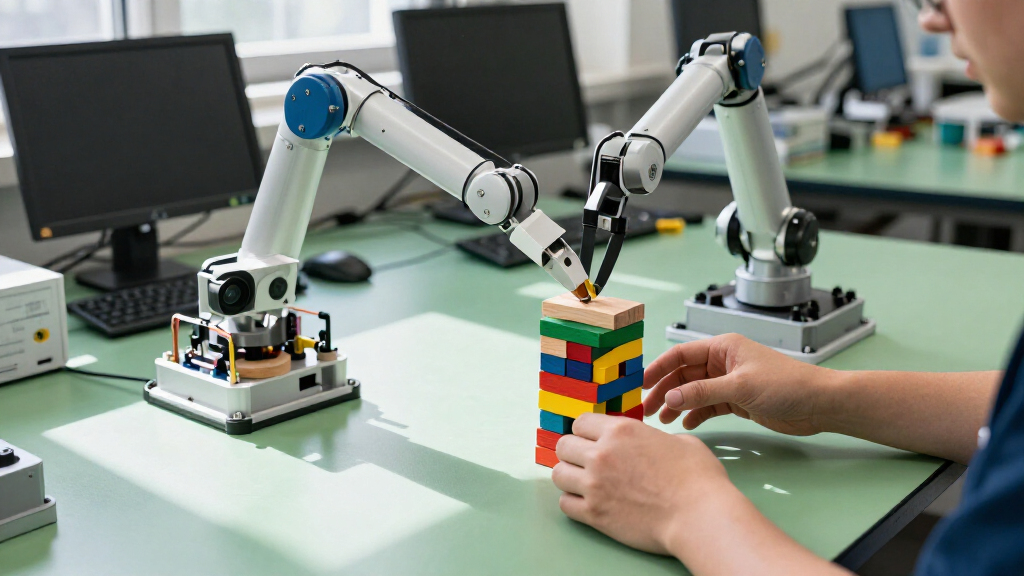
ToyBlocks centers on a simulated arm that can push, flip and stack marked blocks. Pictures and letters on the block faces let researchers define tasks such as searching, sorting and arranging. Some tasks require the arm to uncover a hidden face before it can determine where a block belongs, combining physical manipulation with visual interpretation. The environment can also vary properties such as block size and table height.
The framework automatically generates tasks and demonstrations, or simulated records of a robot completing a task. A task-and-motion planner chooses and sequences short actions, such as pushing or flipping, and plans movement between them. Training uses reinforcement learning and motion planning in Isaac Lab, Nvidia’s open-source robot-learning simulation framework. The described design separates models that choose high-level skills from models that control movement.
Researchers can change the mix of demonstrations—for example, adding more pushing or flipping examples—and evaluate models on tasks left out of training. Hugging Face says hundreds of plans can run in parallel on one GPU at up to 24 times real-time speed. That throughput figure is attributed to the company; the supplied material does not give its measurement setup or an independent assessment.
ToyBlocks tests robot skillsin a controlled world
Hugging Face introduced a simulated tabletop for training and evaluating robot arms. It helps researchers study how demonstrations shape performance on unfamiliar tasks.
A focused testbed
ToyBlocks limits the setting to a robot arm, a tabletop and marked blocks.
Move the blocks
Tasks include pushing, flipping and stacking, as well as searching, sorting and arranging.
Inspect before acting
Letters and pictures on block faces can require the robot to reveal a hidden face before deciding what to do.
How researchers use it
Generated demonstrations make it possible to vary training examples and evaluate skills on tasks held out from training.
A task-and-motion planner sequences short skills and plans movements between them.
Researchers can change how often examples involve skills such as pushing or flipping.
Evaluation on tasks excluded from training can show whether skills transfer within the simulated setting.
What the announcement establishes
ToyBlocks is the first environment in Hugging Face’s proposed FoundationWorlds framework.
- Hundreds of plans can run in parallel on one GPU.
- Hugging Face reports up to 24 times real-time simulation performance.
- No model scores or comparisons with other simulators are provided.
- No physical robot trial results show transfer to the real world.
Testing Skills Beyond Training Tasks
ToyBlocks is intended to make it easier to ask whether a robot has learned a skill that carries over to an unfamiliar task, rather than simply repeating a demonstration. In a controlled simulation, researchers can adjust one part of the training data, hold other conditions steady and compare results. That could help investigate how data quantity and skill coverage relate to performance on tasks the model has not seen.
The controlled design also puts visual reasoning and dexterity in the same test: a robot may need to move a block to read its markings, then act on what it sees. If documented evaluations show that changing demonstrations produces repeatable differences, the environment could offer researchers a practical way to study those effects. For now, that is the purpose of the testbed, not a reported finding. No experiment results are included in the supplied material.
The distinction matters for anyone interpreting simulation results as a sign of readiness for household or industrial work. ToyBlocks covers one arm, a tabletop and blocks. It may help isolate specific learning questions, but success in that setting would not by itself establish reliable performance across the varied objects, sensors and physical conditions robots encounter outside simulation.
Products Worth Considering

DJI Mic 3 Wireless Microphone Kit (2 Transmitters, 1 Receiver, Charging Case)

Bose QuietComfort Wireless Noise Cancelling Headphones, Black

Bose QuietComfort True Wireless Earbuds with Active Noise Cancellation, Black
As an affiliate, we earn on qualifying purchases.
From FoundationWorlds to ToyBlocks
Hugging Face presents FoundationWorlds as a collection of controlled simulated settings paired with tools for generating tasks and demonstrations and measuring robot behavior over time. ToyBlocks is the first environment in that proposal. The source also places it alongside earlier open robot-learning work from the company, naming MolmoAct 2, MolmoBot and MolmoSpaces.
The choice of a narrow tabletop domain trades breadth for experimental control. A simulation covering many kinds of objects and interactions would be broader, while ToyBlocks focuses on a smaller set of objects and actions. Hugging Face’s stated rationale is that this scope can support realistic physics and appearance, generate many examples, and cover varied tasks within the chosen setting. The source provides no comparative results showing how ToyBlocks performs against other simulation environments.
“Our first foundation world is ToyBlocks: an open simulation framework built around a robot arm and blocks on a tabletop.”
— Hugging Face
Simulation Transfer Still Untested
The supplied material does not report model scores, comparisons with other systems or experimental findings on how performance changes when training demonstrations are varied. It describes evaluations on held-out tasks as something the framework enables, not as a completed test with published results. The company’s reported 24-times-real-time throughput also lacks a stated measurement method and independent confirmation in the material provided.
Transfer to physical robots remains an open question. The simulation can use information such as a block’s exact position and orientation when generating actions, whereas a real robot must estimate those details from sensor data. The source says models are also trained to map raw sensor observations to actions, but it gives no physical trial results or evidence about performance under real-world variation. It is not clear when such results, or a comparison with other simulators, will be released.
Evidence Needed From Future Tests
The next useful evidence would be published evaluations showing how models perform on held-out tasks and how results change with different demonstration mixes. Details on the number and variety of tasks, the evaluation procedure and the basis for the reported throughput would help readers judge what the simulation measures.
Physical-robot trials would address a separate question: whether skills learned in ToyBlocks carry over when robots must rely on real sensors and contend with physical variation. Hugging Face says it plans to extend FoundationWorlds to more complex environments, but the supplied material gives no schedule for those evaluations or the next environment.
Key Questions
What is ToyBlocks?
ToyBlocks is an open simulated tabletop environment for training and evaluating a robot arm on tasks involving marked blocks. The arm can push, flip and stack blocks.
What is the purpose of held-out tasks?
Researchers can test a model on tasks excluded from its training to examine whether its learned skills extend beyond the demonstrations it saw. The announcement describes this capability but does not report results from such tests.
Has ToyBlocks shown that robots can do these tasks in the real world?
No physical-robot results are provided in the supplied material. Simulation performance does not establish real-world transfer, particularly when real robots must infer object position and orientation from sensors.
What does the 24-times-real-time figure mean?
Hugging Face says hundreds of plans can be generated and run in parallel on one GPU at up to 24 times real-time speed. The source does not specify the measurement setup or provide independent verification.
Primary source: Hugging Face · via ThorstenMeyerAI.com