
🔍 Read the full analysis: The Story Of The Luddites And The Fears Behind Their Resistance on ThorstenMeyerAI.com

Get the latest gadgets delivered free with Prime
- Fast, free delivery on millions of items
- Prime Video, Amazon Music and more included
- Member-only deals all year
TL;DR
In 1811, Nottinghamshire framework knitters began breaking stocking frames amid unemployment and disputes over piece rates. A magistrate’s report described targeted attacks on employers paying below-price rates and on wider frames associated with cheaper goods; the government responded with troops and a capital law. The history is often invoked in debates about workplace technology, but the supplied account does not establish a direct equivalence with modern AI disputes.
A historical account published by ThorstenMeyerAI.com on November 5, 2026, revisits the Luddites as machine workers protesting job insecurity and low piece rates, not as people unfamiliar with technology. The movement began among framework knitters near Nottingham in 1811; within a year, attacks on knitting frames had prompted a large military deployment and a law making frame-breaking a capital offense.
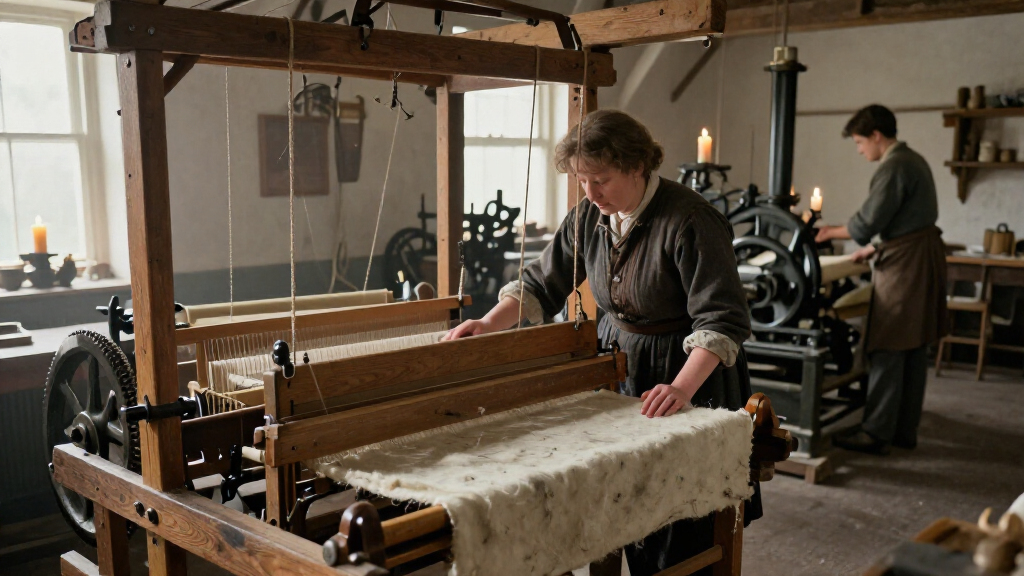
The first Luddites were framework knitters who made stockings and other goods on mechanical frames operated by hand and foot. Many worked at home or in small workshops and did not own the equipment. In a Commons speech on February 14, 1812, Home Secretary Richard Ryder said frames were often hired to workers by employers or by middle-class owners who invested in them. Knitters paid to use frames and were commonly paid by the piece by hosiers, the merchants who supplied work and sold the finished goods.
The account cites Nottingham magistrate Robert Baker’s February 6, 1812, report to the Home Office, held by the National Archives. Baker wrote that in some areas a fifth of frame workers were out of work. He said attacks focused on frames belonging to hosiers who paid “the under-price” and on wider frames that could produce cheaper, lower-quality stockings. Baker reported that resentment toward underpaying hosiers had been the movement’s “leading feature,” while noting that breakers had seldom targeted other property. These are Baker’s observations as an official investigating the unrest, not a complete account of every attack or participant’s motive.
The disturbances spread beyond Nottinghamshire, reaching Yorkshire and Lancashire in 1812. The source says 900 cavalry and 1,000 infantry had been sent into Nottingham by December 1811. Parliament passed the Frame-Breaking Act on March 20, 1812, making frame-breaking a capital felony. The account reports that 17 men were executed in 1813.
The Dispute Was About Work
The Luddite history matters because it complicates a familiar shorthand. “Luddite” is often used for someone who rejects technology, but these workers earned their living using the machines they attacked. The account’s evidence points to a conflict over who controlled the equipment, the price of labor, and the quality of goods—questions that can arise when new machinery changes how work is organized.
The source connects those concerns to current disputes over workplace AI, including writers’ contracts in Hollywood, works-council rights in Germany and the EU’s AI Act. That comparison is an interpretation, not proof that the situations are the same. The historical record described here does, however, show that resistance to machinery can be about the rules governing its use, as well as its technical effects.
The economic figures in the account add a longer view. It attributes to economist Robert Allen an estimate that British real wages rose 12% from 1780 to 1840, while output per worker rose 46% over that same period. The source says later research narrows, but does not close, that gap, and that wages grew faster than output after 1840. The figures describe long-term changes, not the experience of every worker or the effect of one machine in one workplace.
Products Worth Considering

Samsung Galaxy Tab A7 Lite 8.7 32GB Wi‑Fi Android Tablet – Long‑Lasting Battery, Compact Slim Design, Sturdy Metal Frame (US Version)

Samsung Galaxy Tab A11+ (6 GB RAM, 128 GB storage, expandable) – Gray

Bose TV Speaker (2nd Gen) Compact Soundbar
As an affiliate, we earn on qualifying purchases.
From Nottingham to Parliament
The unrest began among knitters in and around Nottingham. According to historian Kevin Binfield, editor of the collected Writings of the Luddites, an attack on wide knitting frames in Arnold on March 11, 1811, opened the most intense period of Luddism, which lasted from 1811 to 1813. The National Archives describes the disturbances as spreading from Nottinghamshire to the West Riding of Yorkshire and Lancashire in 1812, as well as to Leicestershire and Derbyshire.
Letters associated with the movement were signed “General Ned Ludd” or “King Ludd.” The National Archives calls Ludd a mythical figure; the source says there is no reliable evidence that a person named Ned Ludd led the movement. The name gave dispersed protests a shared identity, but stories about an apprentice who smashed a frame are presented as legend rather than established history.
Workers also faced limits on legal collective action. The source says the Combination Acts of 1799 and 1800 made trade unions illegal, and Parliament rejected a minimum wage for weavers in 1808. Those restrictions form part of the account’s explanation for why protest took a coercive form. They do not, by themselves, establish the motive behind every frame-breaking incident.
““Resentment against the hosiers who paid the under-prices” had been “the leading feature up to the present day.””
— Robert Baker, Nottingham magistrate, in a February 6, 1812, report to the Home Office
Evidence Has Its Limits
The account relies in part on official records written by authorities seeking to understand and suppress the unrest. Baker’s letter offers a detailed description of targeting and pay disputes, but it cannot establish that all participants shared the same aims. A Nottingham reward notice from January 25, 1812, described five frames in Lenton as working at “the FULL PRICE,” suggesting that some attacks did not fit a simple pattern of targeting underpaying employers. The source does not resolve why those frames were attacked.
The precise number of frames broken across the region, the full range of participants’ motives, and the extent to which attacks changed employers’ practices are not established in the supplied material. Nor does the historical comparison with AI show that today’s workers face the same legal, economic or technological conditions.
How the Comparison Holds Up
The historical account points readers toward current disputes over pay, work quality and worker influence as places where questions raised in the Luddite era reappear. It names Hollywood writers’ contracts, German works-council rights and the EU’s AI Act, but does not provide details on their current status or assess their effects. Readers should treat those examples as topics for comparison, not as evidence that the outcomes are already settled.
The source also refers to later economic research on wages and productivity without identifying all the studies or their methods. A fuller assessment would require examining those studies alongside the original records. For now, the evidence presented supports a narrower conclusion: many Luddites were skilled machine users whose protests were tied to the terms of employment and the way machinery affected their work.
Key Questions
Who were the Luddites?
They were workers who resisted machinery and its economic effects. The first group described here consisted of framework knitters in Nottinghamshire who made goods on stocking frames.
Were the Luddites opposed to all technology?
The supplied account does not support that broad description. The early Luddites worked with stocking frames; their attacks were reported as focusing in part on machines linked to underpayment and cheaper goods.
Why did they break stocking frames?
Magistrate Robert Baker reported that attacks targeted frames belonging to hosiers who paid below-price rates and wider frames used to make cheaper stockings. His account does not establish the motive for every attack.
What happened to people convicted of frame-breaking?
The Frame-Breaking Act of March 20, 1812, made frame-breaking a capital felony. The source reports that 17 men were executed in 1813.
What does the Luddite story have to do with AI?
The source draws a comparison around pay, work quality and workers’ say in how machines are used. It presents this as a modern parallel, not proof that AI-related disputes are identical to the conditions of 1811.
Source: ThorstenMeyerAI.com