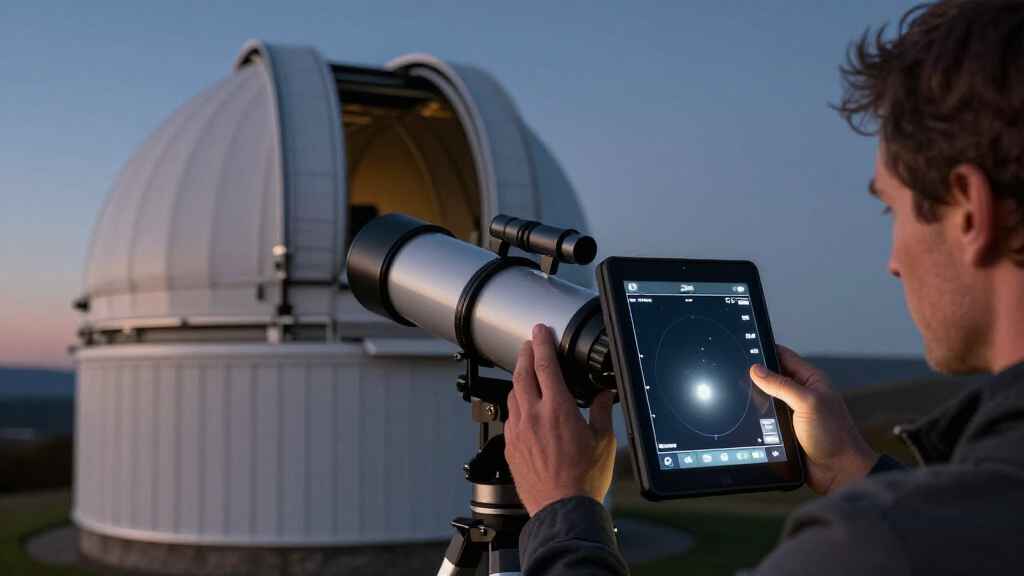

🔍 Read the full analysis: What The Held-Light Technique Adds To “OORT — Comet Vigil For P/2043 K1 Vesper” on ThorstenMeyerAI.com

Get the latest gadgets delivered free with Prime
- Fast, free delivery on millions of items
- Prime Video, Amazon Music and more included
- Member-only deals all year
TL;DR
OORT — Comet Vigil for P/2043 K1 Vesper is an AI-built exhibition about a fictional comet and observatory. Its held-light technique adds star trails as time passes, while local storage preserves the simulated sky on the same device; the site also uses scrolling to animate the comet’s fictional orbit.
The AI-built exhibition OORT — Comet Vigil for P/2043 K1 Vesper, described in the original analysis, uses a technique called held light to make visitors’ time part of the work: a seeded star field draws longer trails as a person stays on the page, then resumes on the same device when they return. The comet and observatory are fictional, but the interaction offers a concrete example of how a website can make waiting—not just viewing—its central material.
OORT frames itself as an observatory keeping watch over P/2043 K1 Vesper, an invented comet. Its canvas places stars around a point below the visible screen and extends their curved paths over time. According to the design description, the trails follow a logarithmic curve so changes appear early in a visit while the effect can continue over a longer stay. A repeatable seed keeps the sky consistent on a device, and local storage retains elapsed time between visits.
Time also shapes a second instrument: scrolling moves a comet through an inline SVG illustration. Its ion tail points away from the sun, while the dust tail curves along the imagined orbit. Both respond to the same progress value, synchronizing the graphic’s position with displayed distance and year. A range control changes a defocus view and its associated brightness estimate.
Another interaction asks visitors to hold a control briefly to open a simulated shutter. The site records a timestamp, but does not present the action as a real sighting: the comet remains unseen within the exhibit’s fiction. The design account says the choice is meant to represent attention and waiting rather than fabricate a discovery.
Interactive art · Room 170 of FABLE/175
What the Held-Light Technique Adds to OORT
In OORT — Comet Vigil for P/2043 K1 Vesper, time spent on the page becomes part of the artwork: a seeded sky draws longer star trails, then resumes on the same device when visitors return.
The central interaction
How Held Light Changes the Visit
A conventional page shows a finished image. OORT makes duration visible: as a visitor stays, a seeded star field extends its curved trails. The effect can continue over a longer visit, and local storage preserves elapsed exposure on that device for a return visit.
Staying leaves a trace
Stars radiate from a point below the screen. Their paths lengthen over time, turning the visitor’s presence into a visible layer of the piece.
Return to the same sky
A repeatable seed keeps the field consistent. Local storage retains elapsed time between visits on the same device.
Waiting becomes material
The interaction asks for attention without asking visitors to submit a photo or claim they observed an astronomical object.
A second instrument
Scroll Through a Fictional Orbit
Scrolling advances the comet through an inline SVG illustration. The visual position and displayed distance and year share one progress value, connecting movement through the page with movement through the imagined orbit.
Progress advances
The page’s scroll position supplies the shared value for the orbital sequence.
Comet moves
The inline illustration places the fictional comet along its imagined route.
Two forms diverge
The ion tail points away from the sun; the dust tail curves along the orbit.
Distance and year update
Displayed values track the same progress as the comet’s illustrated position.
The exhibit’s boundaries
Simulation, Clearly Framed
OORT borrows the language of comet watching, while keeping its subject inside fiction. The distinction matters: the project is an interactive art and web-design study, not an astronomical report.
“The comet remains unseen and in transit.”
Holding a control briefly opens a simulated shutter and records a timestamp. The action represents attention within the fiction; it does not record a real sighting or establish a discovery.
What the description supports
Design Intent and Evidence
The available account describes intended behavior and art direction. It does not provide independent testing or measured outcomes, so claims about performance and reception remain unverified.
| Topic | Described in the account | Not established by the source |
|---|---|---|
| Held light | ✓ Seeded trails accumulate; local storage retains elapsed exposure on the same device. | ~ No cross-device or cross-browser syncing is stated. |
| Animation | ✓ Scroll links the SVG orbit, tails, distance and year; reduced-motion behavior and hidden-page pause are described. | ~ No frame-rate measurements or device testing are supplied. |
| Accessibility | ✓ Accessibility is included among the art-direction goals. | ✗ No independent audit results are reported. |
| Reception | ✓ The room is identified as part of FABLE/175. | ✗ Visitor numbers, reactions and performance metrics are absent. |
| Astronomy | ✓ P/2043 K1 Vesper and its observatory are fictional. | ✗ No real comet discovery or observation is reported. |
A practical reading
What Makes the Technique Distinct
Time on the page changes the artwork instead of remaining an invisible measure of a visit.
The same device can bring back an accumulated sky, while the source makes no claim of syncing elsewhere.
The shutter gesture marks a moment of attention within the fiction, not evidence of a sighting.
Key questions
What Visitors Should Know
What is the held-light technique?
OORT’s name for star trails that grow with elapsed time. The seeded sky is stored locally so exposure can resume on the same device.
Is P/2043 K1 Vesper real?
No. The comet, observatory and watching community are fictional. OORT is an AI-built art project.
What does scrolling do?
It advances a comet through an inline SVG, with the ion tail, dust tail, displayed distance and year tied to shared progress.
Does the shutter record a sighting?
No. It opens a simulated shutter and records a timestamp, while the exhibit keeps the comet unseen and in transit.
How Held Light Changes the Visit
Held light makes duration visible in a way a conventional static page does not. The visitor’s time becomes a trace in the artwork, and returning to the same device can reveal a sky that has continued to accumulate exposure. That gives the act of staying a role in the piece without asking visitors to submit a photograph or claim they saw an astronomical object.
The distinction between simulated observation and real astronomy is central. OORT borrows the language and instruments of comet watching, but the source describes its comet, community and observatory as fictional. Its significance is as an interactive art and web-design project, not as evidence about an actual comet or a new astronomical observation.
The project also makes technical choices part of its subject. A persistent canvas, scroll-linked orbital illustration, reduced-motion handling and a pause when the page is hidden are described as ways to connect the experience to time while limiting unnecessary animation. The work’s success as an artwork does not establish how well it performs across devices or for all visitors; the source does not provide independent testing or usage data.
As an affiliate, we earn on qualifying purchases.
A Fictional Observatory in 175 Rooms
OORT is identified as room 170 of 175 in the FABLE/175 exhibition series. The source says it was built with AI and presents the room as both an exhibition and a technical study. Its visual direction evokes a dark-adapted observatory: black backgrounds, cyan for the ion tail and readings, red-orange for actions, and pale text for longer passages. Display lettering gives headings an instrument-like character, while monospaced text is used for coordinates and field notes.
The room also exposes the art-direction prompt that produced it through a footer link. That prompt calls for a single-page site made with HTML, CSS and JavaScript, without frameworks or external requests, and lays out accessibility, responsive-design and performance goals. It describes a three-pass process—building, critique and visual refinement—but the prompt itself is not independent verification that every requested step or quality target was completed.
The source material identifies the live room at fable-25-830.netlify.app/sites/oort/ and points to a separate design guide. It gives no publication date for the write-up and no metrics on visitors, performance or accessibility audits. The available account therefore supports describing the design and intended behavior, but not making broader claims about its reception or measured results.
“The page makes duration part of the artwork instead of treating it as time spent before the content.”
— OORT exhibition description
LED light strips for home lighting
As an affiliate, we earn on qualifying purchases.
As an affiliate, we earn on qualifying purchases.
What the Description Does Not Verify
The source describes intended behavior, but does not provide independent testing, browser measurements, accessibility audit results or evidence that the animation maintains a particular frame rate on visitors’ devices. It also does not report visitor numbers or reactions. The claim that local storage preserves the exposure is limited to the same device; the source does not say that trails synchronize across devices or browsers.
P/2043 K1 Vesper is fictional, as is the observatory and its history. References in the art-direction prompt to a long wait and a prior sighting are part of the invented setting, not verified astronomical records. No real comet discovery or observation is reported.
smart LED projectors for outdoor displays
As an affiliate, we earn on qualifying purchases.
As an affiliate, we earn on qualifying purchases.
Visit the Room and Design Guide
The room is available at fable-25-830.netlify.app/sites/oort/, and the source invites readers to consult its design guide for notes on the seeded exposure, SVG orbit, palette and typography. Visitors can also browse the wider FABLE/175 collection. The source does not announce a future release, event or further development for OORT; any next steps beyond viewing the live exhibit remain unspecified.
As an affiliate, we earn on qualifying purchases.
Key Questions
What is the held-light technique?
It is OORT’s name for a star-trail effect that grows with elapsed time. The design description says the seeded sky is stored locally so it can resume on the same device when a visitor returns.
Is P/2043 K1 Vesper a real comet?
No. The source describes P/2043 K1 Vesper as fictional, along with the observatory and its watching community. OORT is an AI-built art project, not an astronomical report.
What does scrolling do in the exhibit?
Scrolling advances a comet through an inline SVG. The graphic’s ion and dust tails respond to the same progress value as the displayed distance and year, according to the design account.
Does the shutter interaction record a real sighting?
No. Holding the control opens a simulated shutter and records a timestamp, but the exhibit explicitly keeps the comet unseen and in transit. The action represents a moment of attention within the fiction.
Source: ThorstenMeyerAI.com
Halloween Picks
halloween
As an affiliate, we earn on qualifying purchases.