
TL;DR

Get the latest gadgets delivered free with Prime
- Fast, free delivery on millions of items
- Prime Video, Amazon Music and more included
- Member-only deals all year
NVIDIA reports that it simulated a 104-qubit fault-tolerant quantum processor on JUPITER, the exascale supercomputer at Jülich, using 8,192 GPUs. The work modeled magic-state cultivation under realistic hardware noise; NVIDIA says the method studied could use 90% fewer qubits than previous approaches, but the simulation does not establish that a practical fault-tolerant quantum computer has been built.
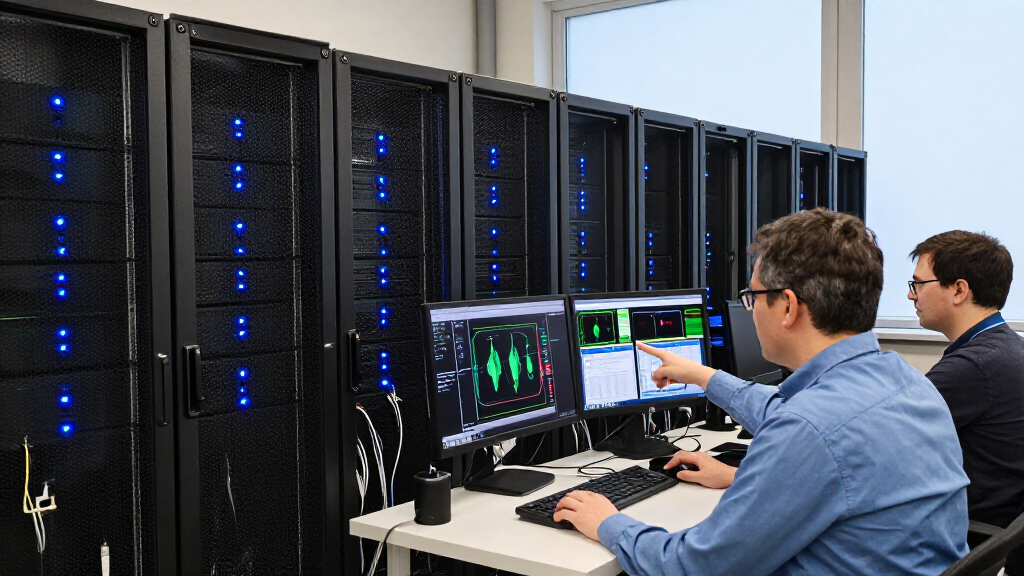
NVIDIA says it simulated a 104-qubit fault-tolerant quantum processor on JUPITER, the exascale supercomputer at Germany’s Jülich Supercomputing Centre, using 8,192 GPUs to model how a quantum-computing technique performs under realistic hardware noise. The company says the work tested magic-state cultivation, an approach it describes as requiring 90% fewer qubits than previous methods; the result is a computer simulation, not a demonstration of a working fault-tolerant quantum machine.
According to NVIDIA’s announcement, the simulation modeled magic-state cultivation as part of a fault-tolerant processor, including the effects of realistic hardware noise. The company called it the largest comprehensive simulation of a fault-tolerant quantum processor to date. That superlative is NVIDIA’s characterization; the supplied report does not include an independent assessment or comparison with other simulations.
The computation ran on NVIDIA GH200 superchips at JUPITER using the company’s cuQuantum software and the fault-tolerant logical layer of its CUDA-Q platform. NVIDIA says the team developed and tested its methods on a GB200 NVL72 system at its Accelerated Quantum Research Center before scaling the work from four GPUs to hundreds and then to JUPITER’s 8,192 GPUs. The company says this preparation helped shorten a simulation that would have taken weeks to days.
NVIDIA says the approach studied could reduce the qubits needed to produce magic states by 90% compared with previous methods. That figure refers to the resource requirements of the technique, as presented by NVIDIA; it is not a claim that a complete quantum computer needs 90% fewer qubits overall. The announcement does not provide detailed independent validation, full error rates or enough methodological data to assess the estimate separately.
Why Simulating Quantum Errors Matters
Fault-tolerant quantum computing aims to keep computation reliable despite errors in physical qubits. Modeling a processor under hardware noise can help researchers examine how a proposed design behaves before committing to building and testing the corresponding quantum hardware. This matters because the memory needed for detailed simulations can grow exponentially with the number of qubits, making large studies difficult for conventional computers.
The work also highlights a practical role for GPU supercomputers in quantum research: they can simulate and compare aspects of quantum-system designs, complementing experiments on quantum hardware. If the results and resource estimates hold up to further scrutiny, they could help researchers choose which error-correction and magic-state approaches to investigate. They do not, by themselves, establish when useful fault-tolerant quantum applications will become available.
GPU supercomputer for quantum simulation
As an affiliate, we earn on qualifying purchases.
As an affiliate, we earn on qualifying purchases.
From Ideal Models to Noisy Qubits
Fault-tolerant quantum processors need ways to manage errors caused by the noise and control operations affecting qubits. As described in NVIDIA’s report, magic states are special states used and consumed repeatedly during fault-tolerant computation. The cost of producing them is one part of the resource challenge in designing a useful quantum computer.
The announcement contrasts this project with earlier Jülich work that simulated 50 qubits under ideal, noiseless conditions. NVIDIA says the new simulation instead examined magic-state cultivation while accounting for realistic hardware noise. That makes it relevant to evaluating designs beyond idealized models, but it remains a computational model rather than a direct test of a 104-qubit quantum device.
“Useful quantum computing will require fantastically complex, fault-tolerant systems — and understanding how they behave at scale is essential to building them.”
— Jensen Huang, NVIDIA founder and CEO
fault-tolerant quantum computing hardware
As an affiliate, we earn on qualifying purchases.
As an affiliate, we earn on qualifying purchases.
Limits of the Simulation Results
The announcement does not identify an independent peer-reviewed paper or provide detailed data on the modeled noise, error rates, or validation procedure. It is therefore unclear from the supplied material how other researchers can reproduce the results or independently evaluate the 90% qubit-reduction estimate. NVIDIA’s description of the simulation as a record is likewise not independently substantiated in the report.
The simulation does not show that a physical processor with 104 qubits has achieved fault-tolerant computation. Nor does the announcement give a timeline for building hardware based on the work, identify a specific quantum application demonstrated by the simulation, or quantify how much the proposed approach would reduce the total resources needed for an operational machine.
As an affiliate, we earn on qualifying purchases.
Further Testing and Design Work
NVIDIA and Jülich describe the simulation as a tool for researchers to assess processor designs and test potential improvements before building hardware. The next useful milestones would include publication of the methods and results in enough detail for independent review, further simulations of alternative designs, and comparison with experimental quantum-hardware data. The announcement does not specify dates for those steps.
For now, the confirmed development is a large-scale GPU simulation of a fault-tolerant quantum-computing process under modeled noise. Whether the findings translate into lower hardware requirements or faster progress toward practical quantum applications remains a question for further research and experimental validation.
quantum computing simulation tools
As an affiliate, we earn on qualifying purchases.
As an affiliate, we earn on qualifying purchases.
Key Questions
What did NVIDIA simulate?
NVIDIA says it modeled a 104-qubit fault-tolerant quantum processor, focusing on magic-state cultivation under realistic hardware noise.
Where did the simulation run?
The simulation ran on JUPITER at the Jülich Supercomputing Centre in Germany, using 8,192 GPUs, according to NVIDIA.
Does this mean a 104-qubit fault-tolerant quantum computer exists?
No. The announcement describes a computer simulation of a quantum processor, not a physical quantum device demonstrating fault-tolerant computation.
What does the reported 90% reduction refer to?
NVIDIA says the magic-state cultivation approach studied could require 90% fewer qubits to produce magic states than previous methods. The announcement does not say that this reduces the total qubits needed for a complete quantum computer by 90%.
What remains to be verified?
The supplied report does not include an independent review or detailed data sufficient to assess the simulation’s methods, noise assumptions, or resource-reduction estimate. Further publication and experimental comparisons would help establish how the results apply to hardware.
Source: rss
Halloween Picks
halloween
As an affiliate, we earn on qualifying purchases.