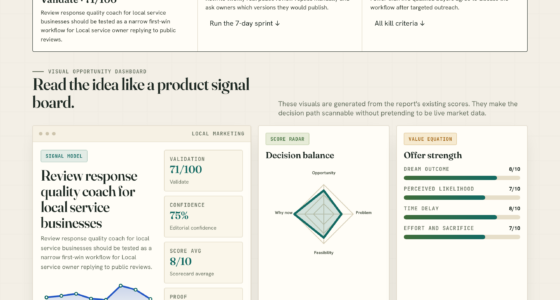

📊 Full opportunity report: Why AI Adoption Is A Cautious Step And Its Effects Endure on ThorstenMeyerAI.com — validation score, market gap, and execution plan.
TL;DR
Enterprises are slow to adopt AI due to organizational inertia and high switching costs, which simultaneously serve as a moat protecting incumbents. This cautious approach ensures their dominance persists despite the hype around disruption.
Major enterprise AI platforms, including Microsoft Copilot and Salesforce’s Agentforce, continue to be led by established vendors, demonstrating that incumbents remain dominant despite widespread AI investment and hype. This persistence is rooted in the structural advantages of these incumbents, making their slow adoption process a form of resilience rather than weakness.
Recent industry analysis confirms that the largest share of enterprise AI investment is flowing into platforms from existing vendors like Microsoft, Salesforce, and SAP. These companies have embedded AI deeply into their core systems, such as Microsoft’s integration into Microsoft 365, which creates a high barrier for displacement. Despite the perception of slow adoption—many pilot projects fail, and internal resistance remains—these incumbents have effectively become the operational backbone for enterprise AI.
According to Thorsten Meyer, the ‘slowness’ of incumbents is not a sign of weakness but a strategic moat. The same organizational inertia that delays AI adoption also makes it difficult for competitors to displace these firms. Data gravity, regulatory compliance, and workflow integration reinforce this durability, ensuring that the incumbents’ hold on enterprise data and systems remains unchallenged.
Furthermore, industry reports from BCG and others note that in an AI-first world, incumbents have the structural advantages needed to succeed long-term, especially as they converge on similar architectures—agents operating on trusted enterprise data within governance frameworks. This convergence underscores the shift from disruption to absorption, where AI is integrated into existing systems rather than replacing them outright.
Incumbents are painfully slow to adopt AI — and remarkably hard to displace. How can both be true? They’re the same fact wearing two faces.
- 95% of pilots deliver nothing
- The internal customer resists
- Two-year timelines to change
- Built to resist transformation
- Absorb most enterprise AI spend
- Became the “control planes”
- Two years no rival can rip it away
- BCG: “a clear right to win”
Implications of Incumbent Dominance in AI
This trend matters because it challenges the common narrative of rapid disruption by AI. Instead, it shows that existing enterprise giants are leveraging their deep data, customer trust, and regulatory compliance to maintain dominance. For businesses and investors, understanding this dynamic is crucial, as it suggests that the most valuable AI assets may be found within established vendors rather than new startups. It also highlights that the perceived vulnerability of incumbents is often an illusion; their slowness is a strategic advantage that fortifies their market position.

Mastering Enterprise Platform Engineering: A practical guide to platform engineering and generative AI for high-performance software delivery
As an affiliate, we earn on qualifying purchases.
As an affiliate, we earn on qualifying purchases.
The Evolution of Enterprise AI Strategies
Over the past few years, enterprises have shown reluctance to fully embrace AI, with many pilots failing to scale. However, during the same period, incumbent vendors have shifted their strategies, focusing on embedding AI into their core platforms. This transition from experimentation to integration has been driven by the realization that data gravity and operational control are critical to long-term success. Industry analysts have observed that by 2026, most major vendors have converged on similar AI architectures—agents operating on trusted, governed data—making disruption less about innovation and more about integration.
Historically, the tech giants have been slow to change, but their deep roots in enterprise data and processes have allowed them to withstand competitive pressures. This pattern suggests that the real battleground is not just innovation but the ability to embed AI into the core operational fabric of large organizations.
"The slowness of incumbents is not a sign of weakness but a strategic moat that makes them hard to displace."
— Thorsten Meyer
As an affiliate, we earn on qualifying purchases.
Unresolved Aspects of AI Adoption and Disruption
It remains unclear how long incumbents can sustain their dominance as AI technology and organizational practices continue to evolve. While current data shows strong incumbents, future shifts in regulation, data privacy, or technological breakthroughs could alter this landscape. Additionally, the pace at which smaller, more agile startups might develop disruptive innovations that bypass traditional data lock-in remains uncertain.
As an affiliate, we earn on qualifying purchases.
Future Developments in Enterprise AI Competition
Next steps include monitoring how incumbents further embed AI into their platforms and whether new entrants can find innovative ways to bypass data and integration barriers. Industry analysts expect continued convergence on similar AI architectures, but disruptive breakthroughs or regulatory changes could still reshape the competitive landscape. Enterprises will likely remain cautious, balancing innovation with risk management, which could slow widespread AI adoption even further.

The Enterprise Data Catalog: Improve Data Discovery, Ensure Data Governance, and Enable Innovation
As an affiliate, we earn on qualifying purchases.
As an affiliate, we earn on qualifying purchases.
Key Questions
Why are large enterprises slow to fully adopt AI?
Many enterprises face organizational inertia, high switching costs, and regulatory constraints that make rapid AI adoption difficult. These factors create a cautious environment focused on risk mitigation and data governance.
Are incumbents truly secure in their dominance?
While current data shows incumbents maintaining dominance through deep integration and data lock-in, future technological or regulatory shifts could challenge this stability. Their current advantage is partly due to their embedded position, which may evolve over time.
What does this mean for startups trying to disrupt the market?
Startups should recognize that disrupting entrenched vendors requires more than innovative AI; they need to find ways to bypass data lock-in and integration barriers or target niche markets less dependent on legacy systems.
Will the slow adoption of AI impact overall innovation?
Yes, the cautious approach may slow the pace of widespread AI-driven innovation at the enterprise level, but it also encourages more thoughtful, governance-focused deployment that could lead to more sustainable AI integration.
Source: ThorstenMeyerAI.com